

The Financial Supervisory Service is set to impose its first sanctions starting next year on insurance companies that inflated earnings using optimistic assumptions about future projected loss ratios.
Some insurance companies have faced criticism for arbitrarily reducing liabilities by 4 trillion to 9 trillion won through a "cap" that limits the increase in the final loss ratio (10 years later) of long-term insurance policies to within 10% compared to current actual loss ratios.
The financial authorities, who had previously only issued "verbal warnings," revised detailed rules this year to establish grounds for sanctions.
Arbitrary application of "loss ratio will not rise more than 10% in 10 years"… Liabilities could surge by up to 9 trillion won if past statistics are reflected
According to financial authorities and the insurance industry on Thursday, criticism was publicly raised at the Insurance Industry Capital and Accounting Symposium (held on Nov. 17) that insurance companies are arbitrarily reducing insurance liabilities through optimistic actuarial assumptions, thereby inflating Contractual Service Margins (CSM).
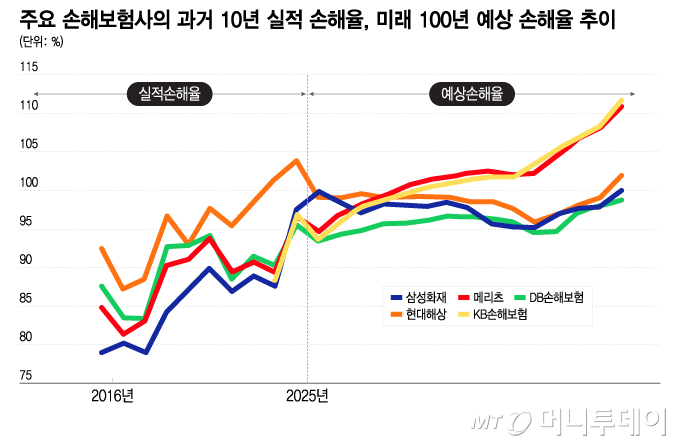
In fact, an analysis of public disclosure materials from five major non-life insurance companies reveals that many insurers assume that while past loss ratios for long-term insurance have deteriorated, future projected loss ratios will improve.
The loss ratio is the figure obtained by dividing the insurance benefits paid by the risk premiums received from policyholders in a given year. A high projected loss ratio becomes a burden on an insurer's performance.
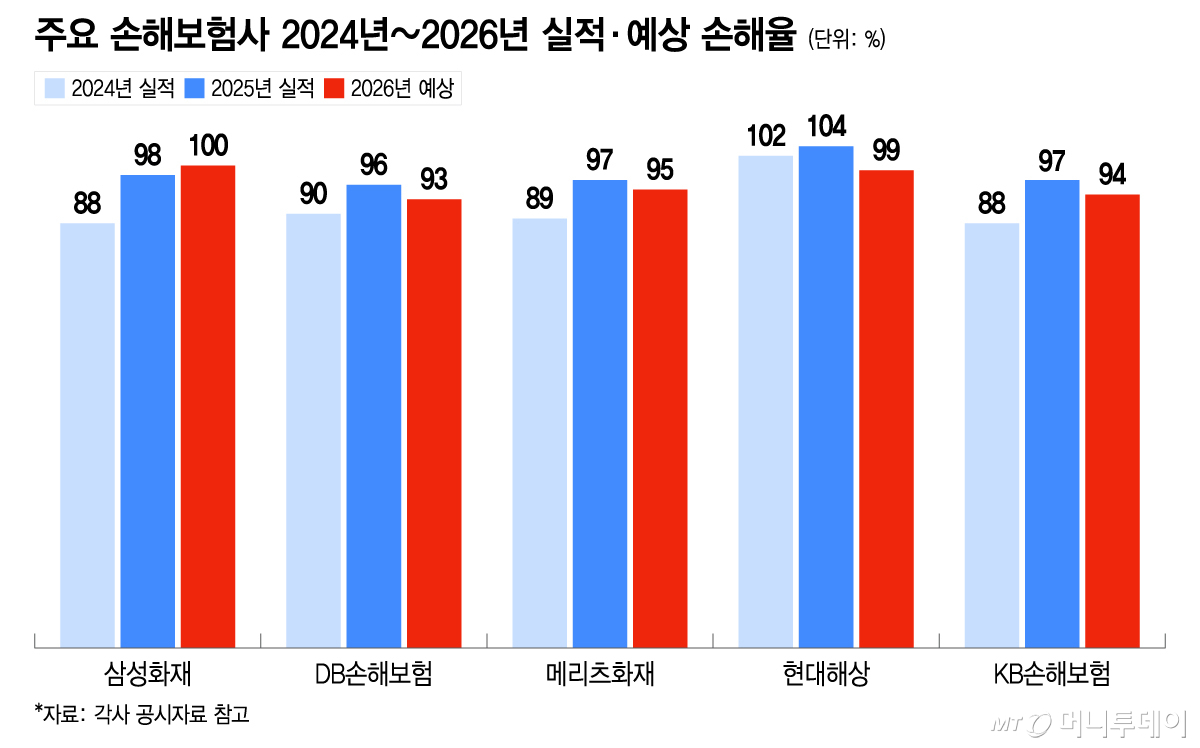
Hyundai Insurance and DB Insurance recorded actual (realized) loss ratios of 104% and 96%, respectively, for 2025, which are high levels among major insurers. However, these insurance companies assumed that this year's loss ratios would improve to 99% and 93%, respectively.
During the same period, Samsung Fire & Marine Insurance (98%→100%), Meritz Fire & Marine Insurance (97%→95%), and KB Insurance (97%→94%) were estimated to have projected loss ratios that either improved slightly or did not deteriorate.
Non-life insurance companies have shown similar patterns in actual loss ratios over the past 10 years (since 2016). Most showed a sharp upward trend in loss ratios.
Therefore, projected loss ratios should also trend upward based on past statistics, but assumptions for projected loss ratios vary by company. KB Insurance and Meritz Fire & Marine Insurance assume an upward trend similar to the past, while other insurance companies assume that loss ratios will improve over the next 100 years.
This year, controversy even arose over the "cap" on final loss ratios for some insurance companies. Insurance companies project the loss ratio up to 10 years later (final loss ratio) and apply this final loss ratio for the subsequent 90 years.
The size of liabilities inevitably varies significantly depending on how the final loss ratio is set. However, Samsung Life Insurance, Kyobo Life Insurance, Samsung Fire & Marine Insurance, and DB Insurance arbitrarily applied a cap limiting the increase to within approximately 10% compared to current actual loss ratios when assuming the final loss ratio, and subsequently received "verbal warnings" from the Financial Supervisory Service.
Estimates suggest that if the final loss ratio is assumed according to the trend of actual loss ratios without a cap, liabilities could surge by approximately 4 trillion to 9 trillion won for each insurance company.
As liabilities increase, CSM decreases, ultimately leading to a reduction in annual net income by several hundred billion won. Some insurance companies that received verbal warnings from the Financial Supervisory Service did not apply the cap in their first-half performance, but some major insurance companies have not yet reflected this change.
Regulations on new coverage for simplified insurance to be introduced by year-end… Financial Supervisory Service previews "grounds for sanctions established, will conduct inspections"
Professor Han Seung-yeop of Ewha Womans University publicly criticized the issue at the symposium on the 17th, stating, "There was an issue with capping loss ratios during the process where regulatory authorities conducted industry inspections and checks. While I will not say whether it is right or wrong, if even the regulatory authorities, who are also professional users of external information, cannot be convinced, it is difficult to satisfy accounting neutrality."
Financial authorities plan to closely examine regulations on loss ratios for new coverage in simplified insurance (insurance for those with pre-existing conditions), which they have set to take effect by the end of this year. This regulation mandates a uniform 90% loss ratio for new coverage within the last five years, where empirical statistics are insufficient.
Meritz Fire & Marine Insurance, KB Insurance, and Hanwha Insurance applied the 90th% rate in June, while other insurance companies have postponed implementation until the end of the year. Applying a 90% loss ratio would cause liabilities to surge by approximately 700 billion to 800 billion won for major insurers, inevitably impacting annual net income.
Financial authorities, who had previously emphasized the autonomy of new insurance accounting standards (IFRS17), have decided to directly wield the "sword" of sanctions starting next year.
An FSS official said, "We revised the enforcement rules at the end of June to establish grounds for sanctions when loss ratios are arbitrarily lowered through caps or other means," and added, "If the gap between projected and actual figures becomes excessively large, deviating from the principles of neutrality and conservatism, we will take appropriate measures after inspections in early next year."

 in FINANCE

