

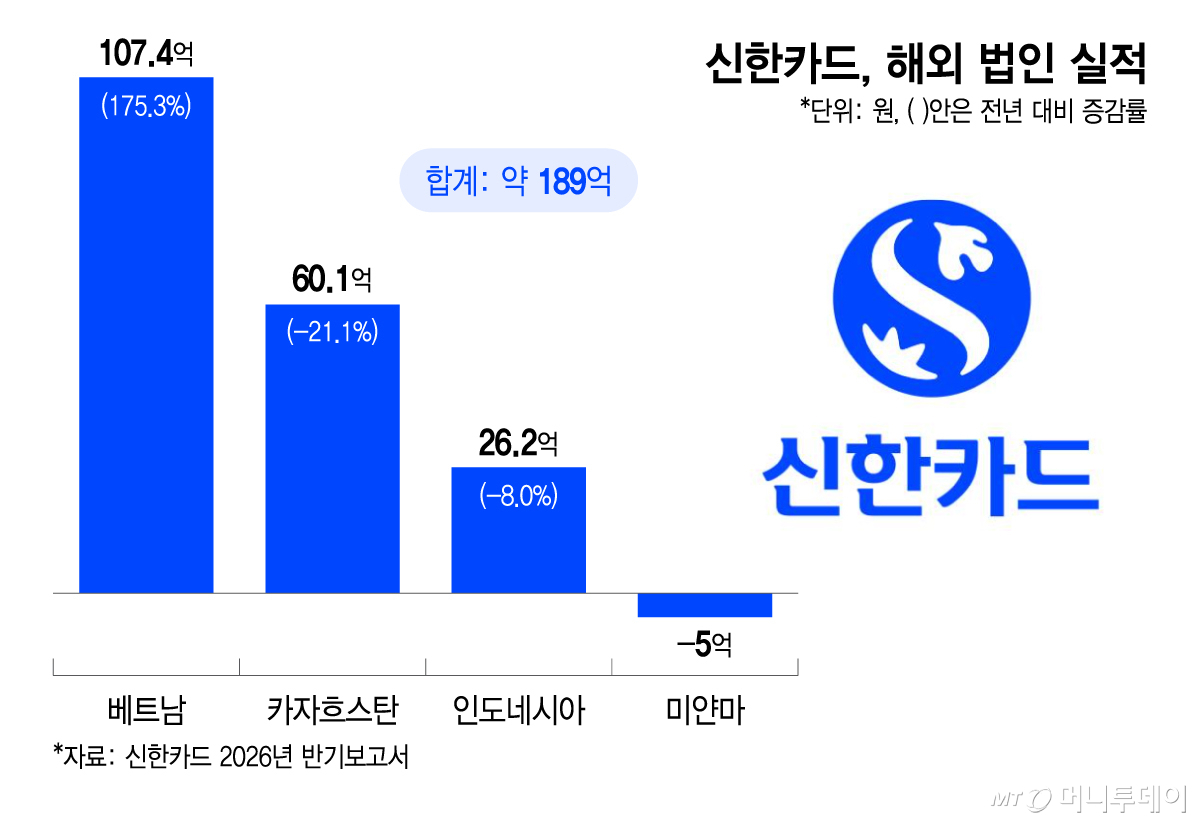
Thanks to its Vietnam subsidiary, Shinhan Card achieved its highest-ever semi-annual performance in overseas operations. While subsidiaries outside Vietnam did not deliver comparably strong results, analysts attribute the underperformance more to unfavorable business environments than to internal company issues.
According to Shinhan Card’s semi-annual report released on the 18th, net profit from overseas subsidiaries for the first half of this year rose 44.4% year-on-year to 18.86 billion won. Focusing solely on the second quarter, net profit increased by 65.4%, climbing from 5.72 billion won last year to 9.46 billion won this year, indicating an even steeper growth trajectory.
Performance improvement at the Vietnam subsidiary was particularly notable. The Vietnam subsidiary recorded cumulative net profit of 10.74 billion won in the first half of the year, representing a 175.3% increase compared to the same period last year (3.9 billion won).
A Shinhan Card official explained, “As Vietnam’s economy improved, diversification of product portfolios led to expansion of business assets. Strategies implemented since last year, including strengthening soundness management through refined loan eligibility criteria, proved highly effective.”
Shinhan Card’s overseas subsidiaries are emerging as a core business driving the company’s overall performance. The share of overseas subsidiaries in Shinhan Card’s total semi-annual results rose from 5.3% last year to 7.4% this year.
Other overseas subsidiaries posted relatively disappointing results. The Kazakhstan subsidiary recorded net profit of 6.01 billion won, a 21.1% decline year-on-year in the first half of the year. The Indonesia subsidiary achieved net profit of 2.62 billion won, an 8.0% decrease over the same period. The Myanmar subsidiary reported a net loss of approximately 500 million won in the first half. However, it reduced its deficit by more than 60% compared to the same period last year, laying the groundwork for a turnaround.
A Shinhan Card official stated, “In Kazakhstan, the impact was significant due to local high inflation and rising base rates, which contracted consumer sentiment and reduced loan demand. In Indonesia, unfavorable external conditions such as sharp currency appreciation and economic slowdown resulting from changes in government policies also had an effect.”
The official added, “Especially in Myanmar, difficulties in expanding operations arose due to locally unfavorable conditions including civil war, the COVID-19 pandemic, and earthquakes.”
Shinhan Card plans to take its overseas business to the next level based on localized strategies. The Vietnam subsidiary intends to strengthen collaborations with existing major partners such as Vinfast and Cellphone S.
To support this initiative, Shinhan Card launched a new product at the end of last year that enables non-face-to-face lending using only credit rating agency data. Additionally, it signed a memorandum of understanding (MOU) this month to establish a partnership with Afinit, an alternative credit evaluation firm based on artificial intelligence (AI).
The Kazakhstan subsidiary is continuing its cooperative relationship with JV partner Astur Auto while pushing to strengthen sales with major local dealerships including Astana, Alur, and Orbis. It is also pursuing strategies focused on enhancing internal capabilities through streamlining debt collection processes and strengthening self-sourcing capabilities.
Last month, the Kazakhstan subsidiary issued credit-based corporate bonds for the first time, raising 10 billion KZT (approximately 31.7 billion won). Previously, funding was conducted entirely under a 100% payment guarantee from Shinhan Card’s headquarters in Korea. This is seen as evidence of successful efforts to strengthen fundraising capabilities and secure stable creditworthiness.
In Indonesia, the subsidiary aims to secure high-quality lease customers for its corporate leasing business and expand retail operations through partnerships with local companies. In Myanmar, it plans to ensure financial soundness by restructuring delinquent assets and optimizing debt collection organizations, while also planning a profitable turnaround through operational efficiency improvements at the subsidiary level.

 in FINANCE
