

As competition intensifies among insurance companies to secure the market for products covering dementia and long-term care due to an aging population, new contracts are surging. However, cancellations continue steadily, deepening the dilemma for insurers who must maintain these policies.
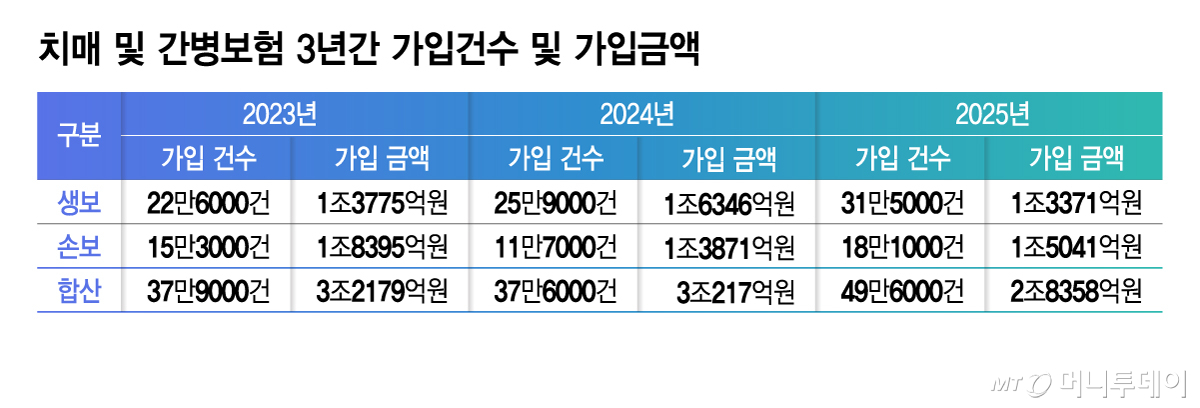
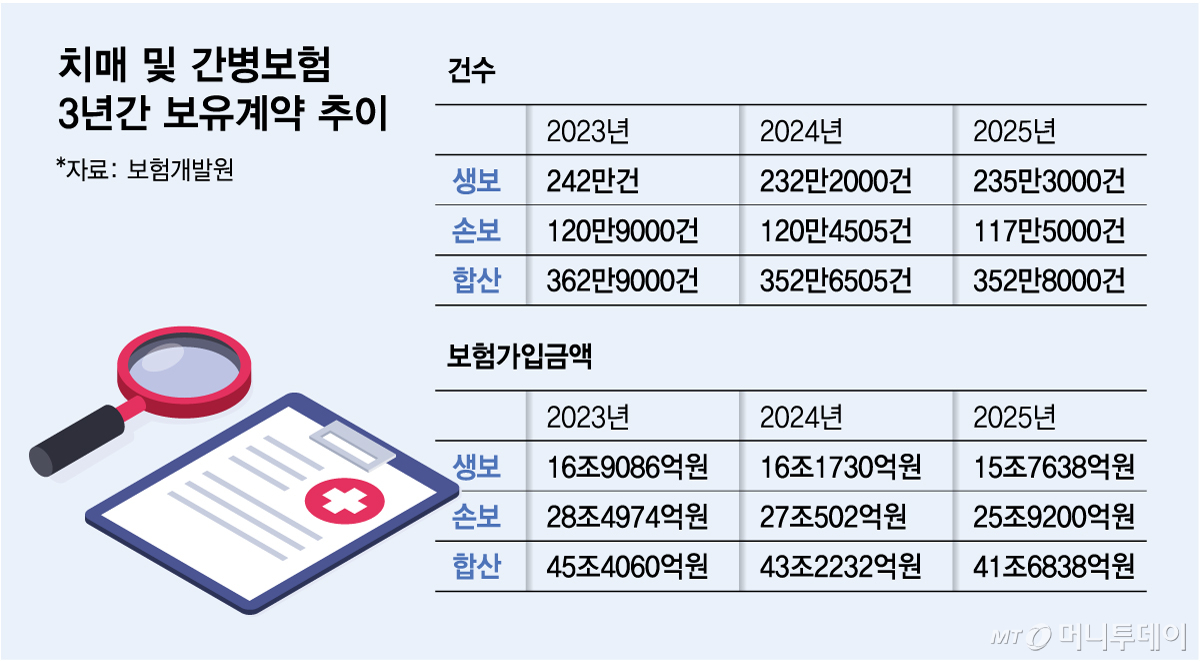
According to the Insurance Development Institute on the 17th, the number of dementia and long-term care insurance enrollments rose from 379,000 in 2023 to 496,000 last year. While new contracts have increased sharply each year, held contracts actually declined from 3.609 million to 3.528 million over the same period. Even with a sharp rise in new contracts, cancellations exceeded them, resulting in an overall decrease in cumulative held contracts.
This indicates that while the dementia and long-term care insurance market is expanding rapidly on the surface, insurers are facing significant challenges in maintaining these contracts over the long term. In particular, insurance products targeting the elderly often involve relatively high premium burdens, making it difficult for policyholders to maintain their contracts after enrollment, analysts say.
Insurance companies themselves are also increasingly concerned. Although the aging population is driving growing latent demand for dementia and long-term care coverage, the structure is becoming one where insurers must incur losses if they aim to cover not only post-dementia care but also associated caregiving costs. Especially as caregiving expenses following a dementia diagnosis continue to rise, pressure on insurers is mounting.
In response, insurers are scaling back coverage amounts. In fact, the maximum payout amount—known as the sum insured—declined from 3.2179 trillion won in 2023 to 2.8358 trillion won last year. It is estimated that insurers initially aggressively sold high-coverage products but later adjusted product structures to be more conservative, or policyholders voluntarily reduced their coverage due to increased premium burdens. Some insurers, believing they cannot generate profits from dementia and long-term care insurance, are now focusing more on morbidity insurance (simplified underwriting insurance).
Moreover, recent fierce competition among products covering expensive new dementia drugs costing tens of millions of won has prompted financial regulators to slow down the pace of dementia insurance launches. The Financial Supervisory Service requested internal data regarding loss ratio calculations in February after multiple products offering up to 40 million won in coverage for dementia treatment costs were launched. This move came as insurers recently recruited policyholders by promoting coverage for new drugs like Lecembi, which slows the progression of Alzheimer’s disease.
Nevertheless, from the insurers’ perspective, the dementia and long-term care insurance market remains a critical opportunity. It is a long-term protection product that can secure the Insurance Contract Margin (CSM), whose importance has grown following the adoption of new accounting standards (IFRS17). Given CSM’s characteristic of recognizing expected future profits over the insurance period, dementia and long-term care insurance—covering risks over extended periods—is considered a key product category for expanding new contract CSM.
An industry insider stated, “Due to aging, the absolute number of elderly people continues to grow, and the financial burden when dementia occurs is substantial, so enrollments remain steady.” He added, “Compared to early products, some coverage has been reduced in current offerings, and maintaining contracts is also difficult, leading to significant concerns among insurers.”

 in FINANCE

