

Amid strong government regulations on household loans limiting the growth of household lending, internet banks have begun targeting corporate clients to boost interest income. Due to structural limitations on face-to-face sales, they are accelerating efforts to attract corporate customers by partnering with fintech companies and regional banks to launch loan products.
According to the financial sector on the 17th, K bank plans to partner with Naver Pay in the third quarter to launch a credit loan product for individual business owners.
The core of this product is an alternative credit evaluation model jointly developed with Naver Pay. Previously, K bank introduced Naver Pay's alternative credit evaluation model, 'Naver Pay Score,' which was developed based on non-financial data, into personal credit loans; now it is expanding the application scope to business loans. A K bank official stated, "We plan to cooperate with Naver Pay in terms of borrower credit evaluation," adding, "The product is still being finalized."
KakaoBank has chosen a regional hub bank as its partner. Through the financial regulatory sandbox, KakaoBank plans to launch a joint corporate loan product with BNK Busan Bank. Under this model, customers apply for loans through the KakaoBank platform, and both banks jointly share the funding. Following the earlier launch of a joint loan product targeting individuals with Jeonbuk Bank, the expansion to corporate clients is expected next year.
KakaoBank plans to use this as a starting point to expand into corporate lending. Kwon Tae-hoon, CFO of KakaoBank, stated during an earnings conference call on the 5th regarding the first half-year results: "We have begun formal discussions on launching a corporate loan product to be handled jointly with Busan Bank," and added, "We aim to use this as an opportunity to lay the groundwork for direct entry into the corporate lending market."
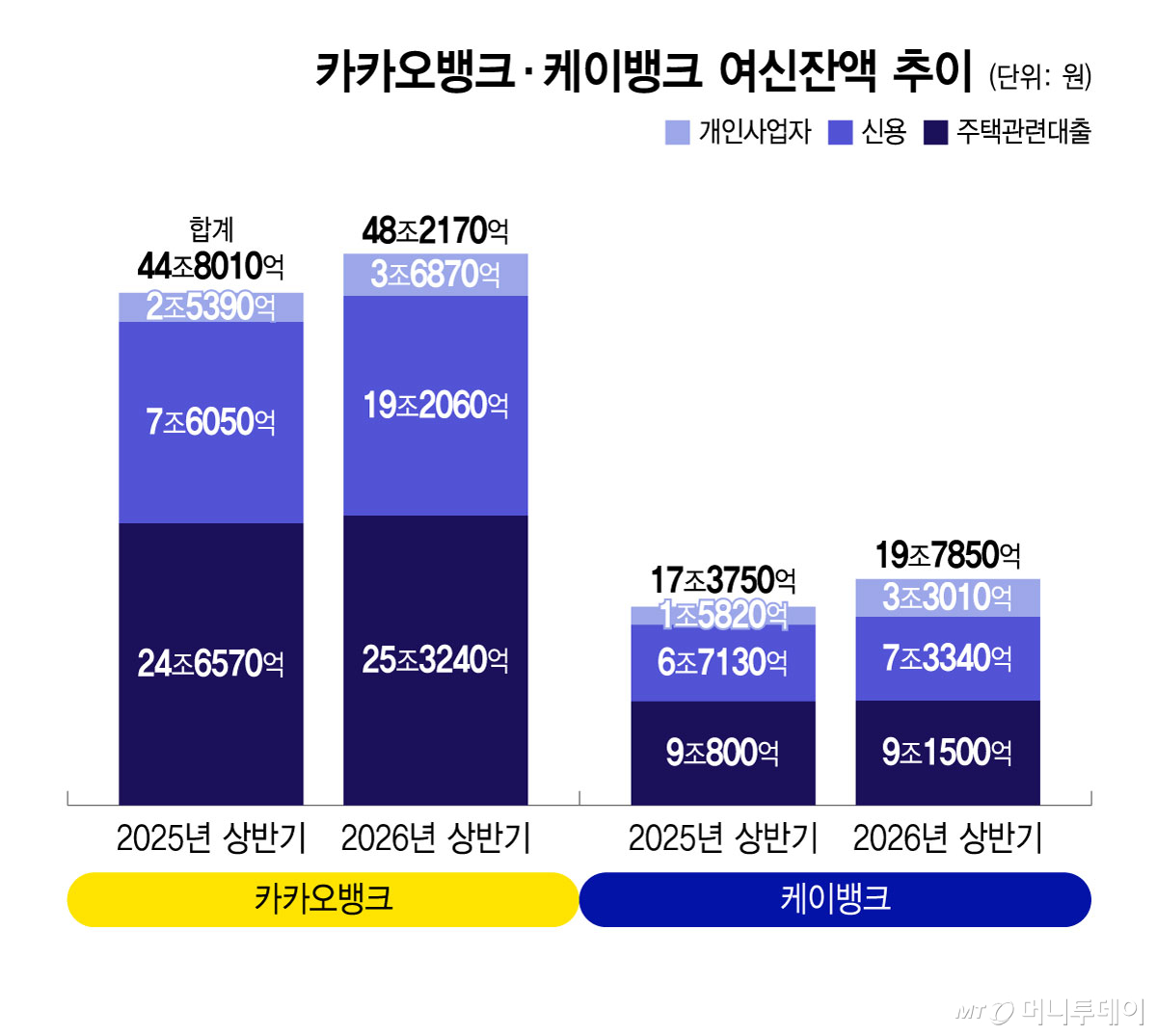
Internet banks, which have grown primarily through household loans, have seen a significant increase in the presence of individual business owner loans this year. As of the end of June this year, KakaoBank's loan balance for individual business owners reached 3.687 trillion won, up 45.2% from the same period last year, while K bank's business loans grew to 3.301 trillion won, a 108.7% increase year-on-year. Considering that both banks saw single-digit growth in their mortgage and unsecured loan balances amid a policy of managing household loans, this growth trend is steep.
The reason for partnering with fintech companies and regional banks lies largely in the structural limitations of internet banks, which cannot freely conduct face-to-face sales. Although the Financial Services Commission allowed limited face-to-face operations in July regarding corporate loan reviews, collateral verification, delinquent debt management, and consumer complaint handling, face-to-face sales for fundraising remain restricted.
Meanwhile, latecomer Toss Bank has prioritized establishing its basic lending product line and is not expected to enter the corporate loan market in the short term. A Toss Bank official said, "We are currently preparing to launch mortgage loans and begin fund sales in the second half," adding, "While we certainly keep open the possibility of expanding our target to include corporations, there are no concrete plans visible at this stage."
Ultimately, the key question is how much these initiatives will contribute to net interest income. KakaoBank reported a 20.8% year-on-year increase in net interest income to 775.7 billion won, while K bank recorded a 19.5% increase to 253 billion won, achieving strong results. However, compared to commercial banks, there is still a long way to go. With net interest income averaging 4.7 trillion won across the five major banks, internet banks' expansion of interest income is expected to be a key driver for their sustainable growth.

 in FINANCE
