

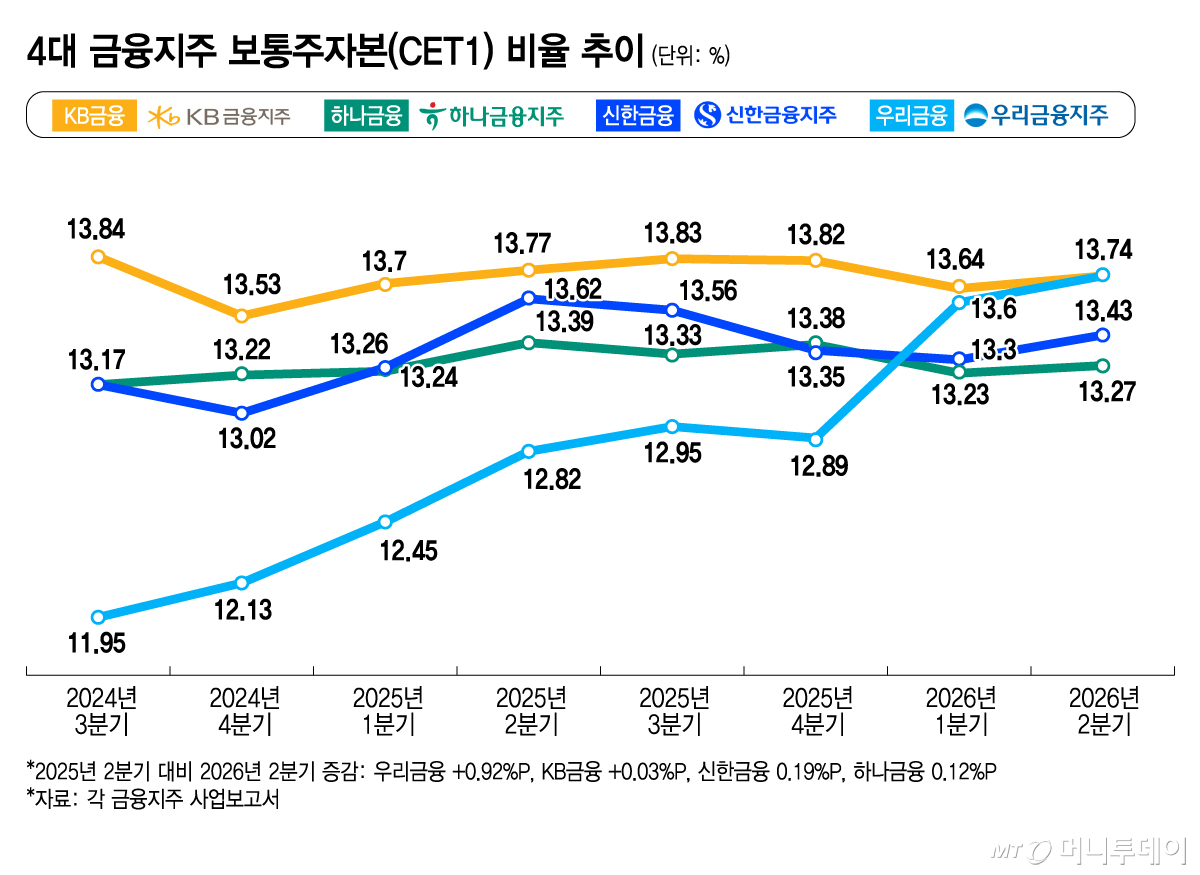
Woori Financial Group has undergone a complete transformation in capital adequacy. It raised its CET1 ratio by nearly 1.8 percentage points (P) over seven quarters, climbing to joint first place among the four major financial holding companies. Woori Financial plans to leverage its strengthened capital base to support corporate lending, nurture subsidiaries, and implement shareholder return policies.
According to the financial sector on the 24th, Woori Financial Group's CET1 ratio as of end of the second quarter this year stood at 13.74%, tying with KB Financial for the top tier among the four major financial holding companies. Woori Financial initially announced a provisional CET1 ratio of 13.71% during its second-quarter earnings announcement but recently disclosed the final confirmed figure of 13.74% in its business report. Shinhan Financial followed at 13.43%, and Hana Financial at 13.27%.
This is the result of about two years of Woori Financial's grueling structural reforms. Woori Financial's CET1 ratio hit a low point in the 11th% range in the third quarter of 2024, showing a significant gap compared to the other two financial holding companies, but it achieved a sharp increase of 1.79 percentage points over seven quarters. The rise over the past year alone reached 0.92 percentage points, demonstrating an overwhelming improvement trend compared to other financial holding companies (+0.03~0.19 percentage points) during the same period. Analysts attribute this not to one-off favorable factors but to a chain reaction of profit accumulation, efficient management of risk-weighted assets (RWA), and asset revaluation across multiple quarters.
The financial sector notes that Woori Financial's improvement in its capital ratio has secured a 'buffer' to respond to future tightening of capital regulations by financial authorities. Under the current financial system, the required CET1 ratio for important banks and bank holding companies (D-SIBs) totals 9%, comprising a basic capital requirement of 4.5%, an additional D-SIB capital buffer of 1%, a capital conservation buffer of 2.5%, and a countercyclical capital buffer of 1%. Woori Financial's current CET1 ratio exceeds this by 4.74 percentage points.
Additional capital accumulation burdens are also anticipated. Authorities are pushing to establish a household sector systemic risk buffer (SSyRB) through the the 13th measures. This system requires banks to accumulate up to an additional 1% in capital depending on their share of mortgage loans when the ratio of household debt to gross domestic product (GDP) exceeds a certain threshold. The assessment criteria for this year's fourth quarter will be finalized, with a six-month pilot operation starting next January and formal implementation scheduled for the second half of next year.
The countercyclical capital buffer (CCyB), currently applied at 1%, can also be imposed up to a maximum of 2.5% under the system. Since this is determined by authorities based on indicators such as total credit, there remains room for an additional imposition of up to 1.5 percentage points in the future. The introduction of a stress buffer of up to 2.5 percentage points is also being discussed.
The government's drive to expand productive finance is also a factor increasing the importance of capital management. Corporate loans carry higher risk weights than household loans such as mortgages, meaning that expanding lending leads to a significant increase in RWA. The Financial Services Commission previously analyzed the effects of rationalizing capital regulations related to productive finance last year and applied an average risk weight of 43% to corporate loans. This implies that expanding corporate finance could exert downward pressure on the CET1 ratio.
The capital buffer secured by Woori Financial will support the stable implementation of the 'Future Co-Growth Project' worth 90 trillion won and is planned to be utilized as a foundation for expanding shareholder returns. In particular, it intends to actively support the growth of relatively vulnerable non-bank subsidiaries such as securities and insurance companies.
Woori Investment & Securities, which is promoting the rise of a comprehensive financial investment company (securities subsidiary) with 3 trillion won in equity capital, has become capable of stable capital expansion based on the holding company's capital strength. When designated as a securities subsidiary in the future, business activities such as corporate credit provision are expected to expand, broadening productive finance supply channels to include securities. Management flexibility in the insurance sector will also strengthen following the full acquisition of Dongyang Life Insurance. Amid the K-ICS strengthening trend, including the introduction of basic capital regulations for insurance companies in 2027, the ample holding company capital is expected to serve as a solid pillar for maintaining soundness.
A Woori Financial official stated, "The capital buffer accumulated over several quarters has become a growth foundation for the group," adding, "Based on this, we will pursue both corporate valuation enhancement, including achieving an ROE (return on equity) of 10% or more, and fulfilling social responsibilities through productive and inclusive finance."

 in FINANCE
