

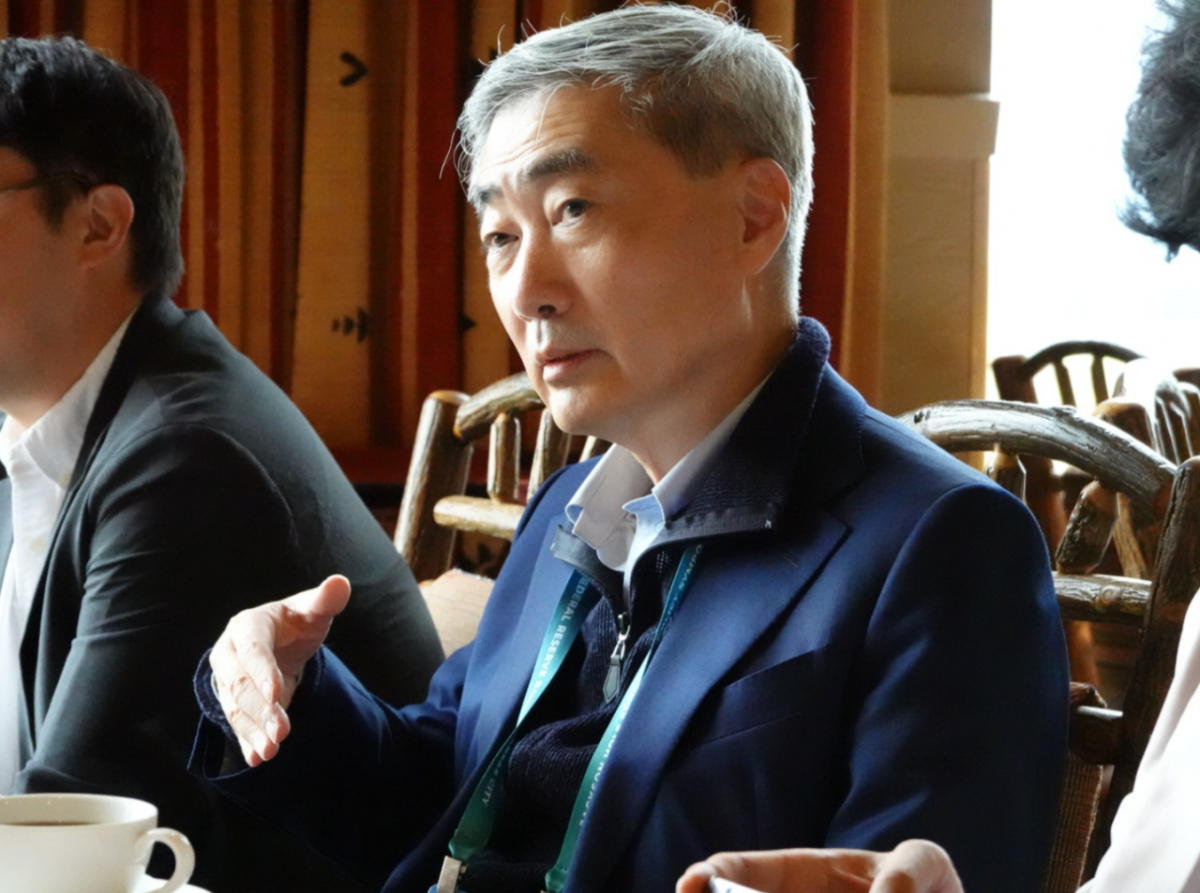
Governor Shin Hyun-song stated that regarding the possibility of the U.S. Federal Reserve (Fed·Federal Reserve) shifting its monetary policy toward tightening, "Even if the U.S. raises interest rates, we are not obligated to mechanically follow suit," expressing his intention to pursue an independent monetary policy based on a comprehensive assessment of domestic economic conditions and financial stability.
On the 28th (local time), at the '2026 Jackson Hole Economic Policy Symposium' (Jackson Hole Meeting) held in Wyoming, U.S., Governor Shin met with New York-based special correspondents from domestic media outlets. While he evaluated Federal Reserve Chairman Kevin Warsh's keynote speech as containing "significant implications for the upcoming September Federal Open Market Committee (FOMC) meeting," he drew a clear line on Korea's response approach.
Governor Shin analyzed that although Chairman Warsh did not outline a specific interest rate path, his speech delivered a clearer and more concrete message compared to the July FOMC press conference. In July, the Federal Reserve merely reaffirmed its foundational stance of a "2% inflation target," but in this speech, it clearly expressed its resolve to actively utilize interest rates as a policy tool because: △inflation remains significantly above the target; △the period during which inflation has exceeded the target has lasted 65 months; and △it intends to employ interest rates proactively.
Governor Shin remarked that although Chairman Warsh did not provide specific "forward guidance" or a dot plot (unlike previous Jackson Hole speeches by Federal Reserve chairmen), his clear articulation of the resolve and policy tools to combat inflation sent a message that the central bank would not be dragged along by market forces but would instead assert its leadership. He further diagnosed that the rise in short-term bond yields and the initial slight strength followed by a downturn in the stock market immediately after the Jackson Hole speech reflected the market's renewed recognition of the Federal Reserve's credibility and leadership.
Governor Shin emphasized, however, that the Federal Reserve's actions cannot serve as an absolute benchmark for Korea's monetary policy. He explained, "It is not necessary to mechanically react simply by calculating the interest rate differential between Korea and the U.S. and crossing a specific threshold. The central bank must comprehensively consider its policy intent, overall stance, and domestic financial stability conditions."
While cautioning against mechanical linkage between U.S. and Korean interest rates, it is interpreted that Governor Shin left room for the possibility that additional U.S. rate hikes could influence the Bank of Korea's policy decisions. In a situation where the U.S. policy direction may shift, this signifies an intent to identify the optimal policy mix by simultaneously examining imbalances in domestic finance, including exchange rates, inflation, the real estate market, and household debt.
Regarding the recent stabilization of the won/dollar exchange rate around 1,370 won, Governor Shin expressed confidence in the won's flexibility and the Bank of Korea's policy credibility. Even as the dollar index (a measure of the U.S. dollar's value against six major currencies) showed strength, he noted that the won maintained a robust stance because "the Bank of Korea provided a clear direction for monetary policy, reestablished its leadership in the foreign exchange market, and thereby built trust among market participants." On the 28th, the won/dollar exchange rate closed at 1,372.5 won on the Seoul foreign exchange market, marking the lowest level since July 24 of last year (1,367.2 won) based on closing prices—a span of 13 months.
Addressing concerns that Korea's planned annual investment of $20 billion in the U.S. could burden the won/dollar exchange rate, Governor Shin stated, "This was agreed upon at a level we can fully manage." He added, "Even considering only the operating income from foreign exchange reserves amounting to $427 billion as of July, it is more than sufficient to handle this burden."
Governor Shin expressed caution against explaining recent exchange rate fluctuations solely through short-term supply and demand factors such as export companies selling dollars or dollar inflows from SK Hynix's American Depositary Receipt (ADR) listing. He stated, "In Korea, the exchange rate is not merely a relative price reflecting trade conditions but an indicator reflecting overall economic trust and risk appetite, and a symbol of confidence in the financial and monetary system." He concluded, "While the won/dollar exchange rate remains at a higher level compared to historical averages, ultimately, the appropriate level will be determined by the market."

 in FINANCE
