

As AI (artificial intelligence) cyberattacks targeting the financial sector have become a reality, there are calls to expand the scale of the Financial Security Institute, which serves as the integrated security monitoring center under law and is responsible for responding to breach incidents. In particular, as vulnerabilities are being exposed more easily than before due to AI hacking, the role of the Financial Security Institute in areas such as security monitoring, hacking training, and post-incident response is expected to grow more than ever.
According to financial industry sources on the 14th, the Financial Security Institute will begin consultations with member companies regarding next year's budget at the end of this month, with plans to finalize the budget and scale by early December.
The Financial Security Institute has 220 financial institutions as members and secures its budget through dues paid by these institutions. A total of 39 representative companies, including 13 banks, 9 financial investment firms, 8 insurance companies, 7 small and microfinance institutions, and 2 financial-related agencies, vote to approve business plans and budgets/settlements.
Inside and outside the financial sector, it is seen as unavoidable that the Financial Security Institute's budget will increase next year. Currently, the institute has 311 staff members, falling short of its authorized headcount of 354. Budget shortages are cited as a reason why additional staffing is difficult. Furthermore, as vulnerabilities in AI hacking within the financial sector have come to light, it is expected that the budget required for not only staffing but also operating AI security-related infrastructure will increase.
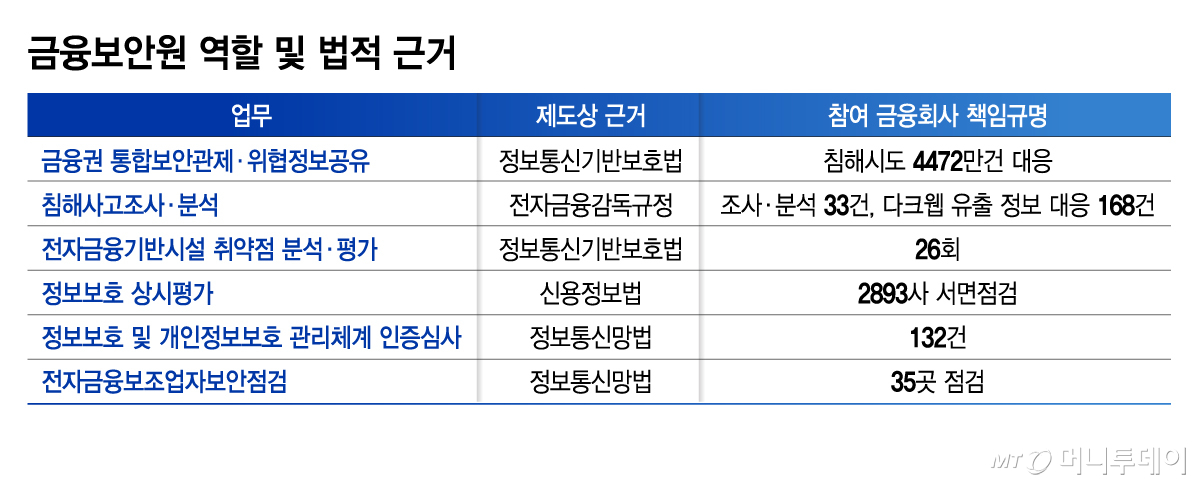
Under the Information and Communications Network Protection Act, the Financial Security Institute is responsible for integrated security monitoring of the financial sector and sharing threat information. Last year, through integrated monitoring, it responded to 44.72 million intrusion attempts and collected 270,000 pieces of malware, which were shared with financial institutions. It also conducts vulnerability checks on electronic financial infrastructure such as systems, software, hardware, and networks of financial companies, as well as hacking preparedness training, including joint blind mock drills in the financial sector. In accordance with the Credit Information Act, it also implements regular evaluations to inspect the status of personal information management by financial institutions. Additionally, when actual hacking or other breach incidents occur, it is responsible for incident investigation and analysis together with the Financial Supervisory Service, and also handles security-related education and certification.
As cyber threats utilizing high-performance AI agents have intensified, the roles undertaken by the Financial Security Institute are steadily increasing. For example, as threats from high-performance AI agents such as US-based Toss have become visible this year, authorities have increased joint blind mock drills in the financial sector from once to twice a year, with the Financial Security Institute leading these exercises. With the adoption of AX (AI transformation) and the relaxation of network separation, checking for security vulnerabilities has also become one of the areas the Financial Security Institute must oversee. Since last year, it has begun evaluating security measures for the use of generative AI in innovative financial services and verifying the security of AI models. It has also introduced AI red teaming, which proactively explores unique flaws and vulnerabilities in AI systems from an attacker's perspective.
The banking sector, which had previously shown a negative stance toward increasing dues to the Financial Security Institute, is finding it difficult to ignore demands for budget increases. Recent AI agent hacking targeting the financial sector could have resulted in reduced damage or prior blocking because the Financial Security Institute shared information with all financial institutions after receiving a report of an incident at Shinhan Bank, prompting them to conduct self-inspections.
In particular, considering that small and mid-sized companies lack the capacity to invest in security, voices are converging on the need to expand the joint security system. A senior executive at a financial holding company stated, "The role of immediately disseminating information when hacking occurs at one financial institution to prepare for vulnerabilities is significant," adding, "There is inevitably a difference in security levels among each financial institution, and this serves to raise them to a uniform standard."

 in FINANCE
