

The telecom carriers appear set to fully shake off the impact of this year’s hacking incidents and settle onto a path toward normalization.
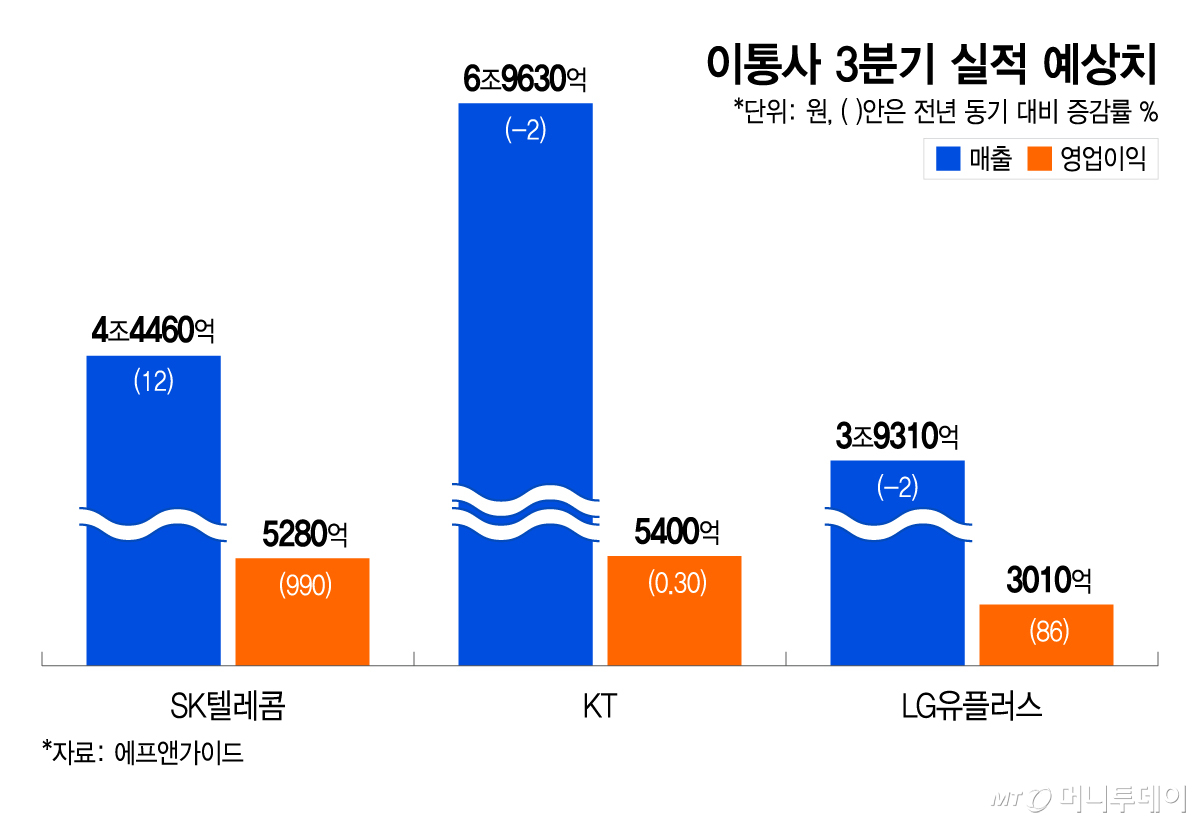
According to earnings forecasts compiled by financial information provider FnGuide, the combined operating profit of the three major carriers on a consolidated basis for Q3 this year is estimated at 1.37 trillion won, an 11% increase from Q3 last year.
The combined operating profit of the three carriers exceeded 1.5 trillion won in Q1 2025, but fell short of 800 billion won in Q3 last year due to SK Telecom’s hacking issue. However, with a rapid recovery, it surpassed 1.3 trillion won in Q1 this year and exceeded 1.5 trillion won in Q2, already surpassing pre-hacking performance levels. If this trend continues through the end of the year, the combined annual operating profit of the three carriers could potentially break the 5th trillion won mark for the first time in history.
SK Telecom’s consolidated operating profit for Q3 is expected to reach 528 billion won, a 990% increase from the same period last year. Revenue is projected to rise 12% to 4.446 trillion won, and net income for the period is expected to turn sharply positive at 355 billion won.
In Q3 last year, SK Telecom recorded an operating profit of just 48.4 billion won, a 90% plunge, as it incurred massive costs related to waiving early termination fees for customers who canceled due to the USIM hacking incident, offering communication fee discounts and membership benefits, and replacing USIM chips for all customers. The company posted a net loss for the period of 209.9 billion won, marking its first deficit in 25 years.
Over the following year, the company recovered its performance faster than expected through various benefits and trust-restoration initiatives. According to Daishin Securities, wireless segment revenue is projected to increase 23% from the same period last year to 2.6 trillion won in Q3 this year.
KT’s consolidated operating profit for Q3 is expected to reach 540 billion won, a 0.3% increase from the same period last year, suggesting that the trend of declining profits will come to a halt. The company appears to be moving past the impact of subscriber churn during the early termination fee waiver period following its customer reward program implemented after the femtocell hacking incident. However, revenue for the same period is projected to decrease 2% from the same period last year to 6.96 trillion won.
LG Uplus’s consolidated operating profit for Q3 is estimated at 312.3 billion won, an 86% increase from the same period last year. The base effect from the impact of voluntary early retirement in Q3 last year is a significant factor. Revenue is expected to remain similar to the same period last year at 393.05 billion won.
With the hacking risks that surrounded the three major telecom carriers receding, an even greater leap is anticipated for the remaining Q4 and next year. This is expected to be driven by the planned introduction of 5G SA (Standalone) mode at the end of this year and the AI data center (DC) business set to fully ramp up next year.
SK Telecom is boosting expectations for earnings growth with the emergence of subsidiaries Horizon and Hyper, which will exclusively handle its AI DC business. SKT plans to launch the Ulsan AIDC at a scale of 100 MW in the second half of next year and expand it to a total capacity of 1 GW. AIDC revenue reached 267.6 billion won in the first half of this year, a 91% increase from the same period last year, and further growth in AIDC revenue is expected going forward.
LG Uplus also plans to expand its AIDC scale from the current 165 MW to 400 MW by 2030. Next year, an expansion of the utilization rate at the Pyeongchon 2 Center and the opening of Paju Building 1 are scheduled. KT is also set to secure DCs in Bucheon next year, Gwangmyeong in 2028, Gunsan, and Yongin, with a policy of operating a total capacity of 1 GW over the next five years.
The fact that all three major telecom carriers will introduce 5G SA (Standalone) mode starting at the end of this year, allowing for higher rate applications, is also a factor boosting earnings expectations. Kim Hong-sik, a research analyst at Hana Securities, stated, “Globally, rate differentiation based on service quality differences is becoming common,” adding, “Higher rates are expected to be applied to 5G SA (Standalone) services.” He further added, “The acceleration of AI base station deployment and 5G/6G investment for the success of physical AI also enhances the appeal of the entire telecommunications sector.”

 in TECH
