

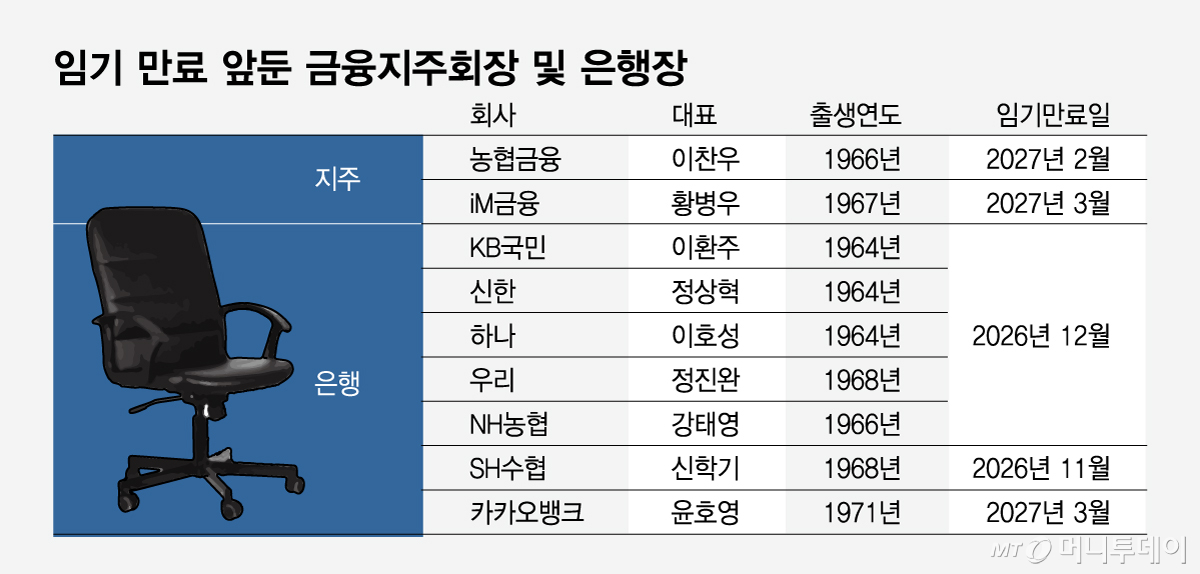
KB Financial Group has selected 1966-born Lee Jae-geun, head of the group’s business division, as its final candidate for next chairman, initiating a generational shift. Attention is now focused on whether this bold move by the leading financial institution will spark further leadership changes across the financial sector concentrated at year-end.
According to financial sector sources on the 13th, KB Financial’s unexpected selection of Lee Jae-geun as its final candidate for next chairman is expected to shift the focus of upcoming personnel moves in the financial industry toward a wave of generational change.
Among financial holding company chairmen, Kim Chan-woo of Nonghyup Financial Group and Hwang Byeong-woo of iM Financial Group will see their terms expire in February and March next year, respectively. iM Financial Group’s regulations require the succession committee to initiate management succession procedures six months before Hyeon (Chairman)’s term expiration, meaning personnel decisions must begin this month. iM Financial has publicly disclosed Ji Nan-dal (Chairman)’s eligibility criteria, and its board is reportedly meeting with major shareholders ahead of formally launching the procedure. Nonghyup Financial Group mandates that succession procedures begin three months prior to term expiration, so it is expected to start selecting its next chairman in November.
While re-election cases for Nonghyup Financial’s chairman are not common, they are not entirely unprecedented. Kim Kwang-soo of Jeon (Chairman) took office in 2018 and successfully secured a one-year extension, serving as chairman until 2021. For Hwang (Chairman), the prevailing view is that he will continue his term to consolidate the system, bolstered by his achievements in transforming iM Bank into a commercial bank. In particular, Hwang (Chairman), born in 1967, is among the youngest chairmen of financial holding companies and may not be seen as a target for generational change. However, some analyses suggest that it would be premature to feel reassured, as this year’s KB Financial chairman selection could alter the personnel trend across the financial sector.
Bank president appointments are also within the scope of influence. The terms of five major bank presidents—Lee Hwan-ju of Kookmin Bank, Jeong Sang-hyeok of Shinhan Bank, Lee Ho-seong of Hana Bank, Jung Jin-wan of Woori Bank, and Kang Tae-young of NH NongHyup Bank—all expire in December this year. Additionally, SH Suhyup Bank President Shin Hak-ki’s term ends in November this year, and KakaoBank CEO Yoon Ho-young’s term concludes in March next year. Suhyup Bank is currently underway with its process to select the next president.
Lee Hwan-ju of Kookmin Bank, born in 1964, was expected to have a high likelihood of re-election since this is his first term, yet he is two years older than Lee Jae-geun. Jeong Sang-hyeok of Shinhan Bank and Lee Ho-seong of Hana Bank are also born in 1964, while Kang Tae-young of Nonghyup Bank was born in 1966. Jung Jin-wan of Woori Bank and Shin Hak-ki of Suhyup Bank were born in 1968, and Yoon Ho-young of KakaoBank, the youngest at 1971-born, holds the position of CEO.
Excluding Jeong Sang-hyeok and Yoon Ho-young as presidents, all others are serving their first terms and have been evaluated for delivering solid performance throughout their tenures. However, analyses suggest that the wave of generational change initiated by leading financial groups could become a variable in determining re-election prospects. Already, some banks are highlighting executives born in the 1970s as potential next-generation leaders. The rapid rise of generational change as a new personnel keyword reflects the financial sector’s consensus that despite record-breaking net profits across all major financial groups, accelerating M&A activity and AI-driven transformation have become critical challenges requiring bold changes and innovation.
Some voices question whether the wave of generational change triggered by KB Financial will quickly spread to other financial institutions. A financial sector official stated, “KB Financial has a structure that allows for independent judgment, as its candidate nomination and verification pathways are diverse—including not only shareholder recommendations but also outside director nominations.” The official added, “Some holding companies are significantly influenced by specific shareholders, so situations vary across each holding company.”

 in FINANCE
