

Earlier this month, Shinhan Bank, which had closed its loan recruitment channel for just two days after opening it, is now re-allocating limits and will soon resume accepting applications. As total volume regulations are relaxed and the upward trend in loan balances slows, banks with increased operational capacity are gradually loosening restrictions on loans by reselling variable-rate loans and refinancing products from other banks.
According to the financial sector on the 16th, Shinhan Bank is considering resuming acceptance of housing-related loans through its loan recruitment channel. The loans in question include mortgage loans and rental security deposits scheduled for execution in November.
Previously, Shinhan Bank had resumed accepting applications through its loan recruitment channel on the 1st but stopped after exhausting its limit within two days. Although it was originally planned to reopen applications starting from next month when limits were set to be renewed, the bank decided to allocate November limits ahead of schedule.
Commercial banks have recently shown signs of gradually relaxing loan regulations. IBK Industrial Bank of Korea reopened its loan recruitment channel on the 15th and resumed handling variable-rate mortgage loans and refinancing loans from other banks. Hana Bank also halted acceptance of loan applications through its recruitment channel earlier this month but began accepting them again for November execution.
NH NongHyup Bank has lifted a significant number of self-imposed loan restrictions since June. It removed limits on handling refinancing loans and variable-rate mortgage loans while allowing new participation in Mortgage Credit Guarantee (MCG) for mortgage loans. The loan term for non-capital area mortgages was reduced from 40 years to 30 years but has since been restored to 40 years. Currently, only restrictions on Mortgage Credit Insurance (MCI) participation and credit loans remain. Additionally, starting today, the bank is lowering face-to-face mortgage interest rates to attract loan demand. The lower and upper limits were adjusted downward by approximately 0.20 percentage points and 0.45 percentage points, respectively.
The banking sector has gained flexibility in handling loans as the government’s policy on total household loan management has somewhat eased. Through its the 13th real estate measures, the government raised the growth rate limit for household loans at banks from the previous 1.5% to around 3% to promote housing supply and support actual homebuyers. As a result, it is reported that large banks received additional limits of approximately 1.5 trillion won each.
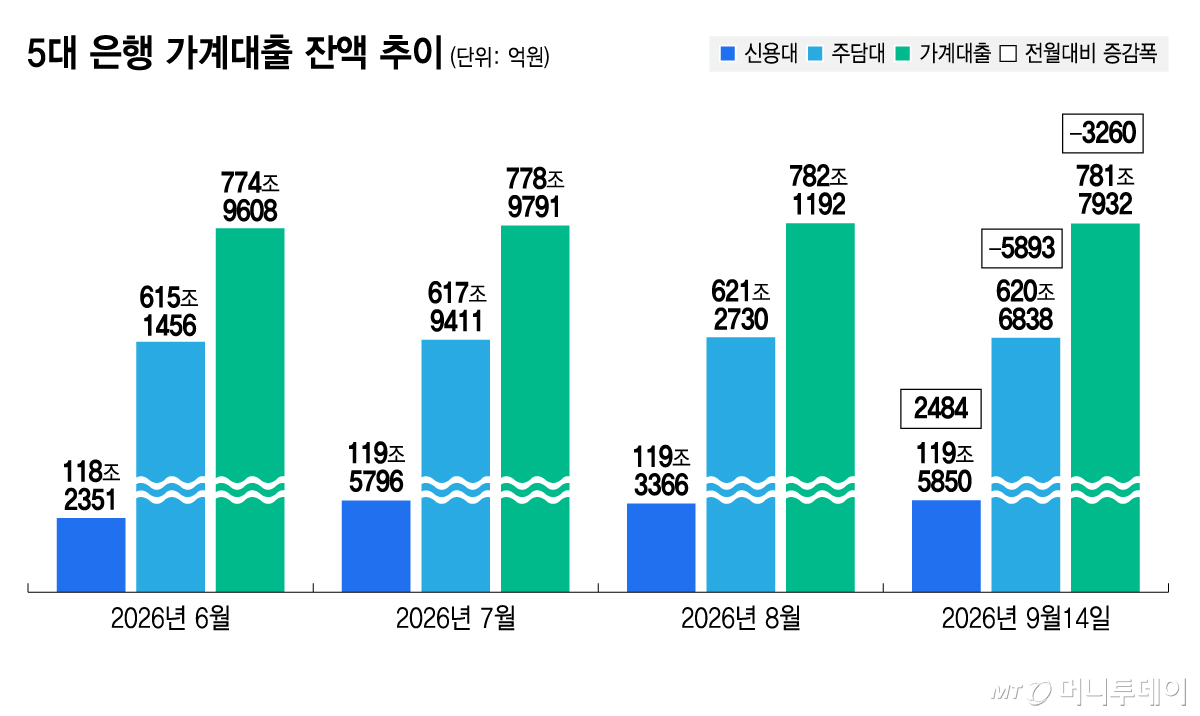
The recent slowdown in the growth trend of household loans also explains why banks are expanding their operations. As of the 14th, the combined household loan balance at five major banks—KB Kookmin Bank, Shinhan Bank, Hana Bank, Woori Bank, and NH NongHyup Bank—stood at 781 trillion 793.2 billion won, a decrease of 326 billion won from the previous month. Although credit loans increased slightly, this was offset by a reduction of 589.2 billion won in housing-related loans, including group loans, general mortgage loans, and rental security deposits.
Many institutions still maintain loan tightening measures. Kookmin Bank limits per-person mortgage loans to 300 million won, while Woori Bank sets branch-specific lending caps at 1.5 trillion won. Hana Bank has temporarily halted handling variable-rate loans.
Analysts suggest that banks have room to expand loan operations as they move past the moving season into the off-peak period. In particular, group loans are excluded from total volume management, and during year-end and early next year, demand for moving decreases, leading to smaller execution volumes of mortgage loans. A financial sector official stated, “November and December are periods when mortgage loan demand is relatively reduced,” adding, “When the volume of applications and repayments balances out, banks will have more capacity to accept additional applications.” However, it is expected that voluntary regulations with significant market impact, such as the 300th million won per-person limit, will be relaxed gradually rather than restored all at once, taking into account their effects on the market.

 in FINANCE
