

Amid frequent voice phishing incidents, it has emerged that the compensation insurance service offered by banks for consumer protection is effectively nominal. Over five years, there were only 21 cases in which compensation insurance was actually paid out.
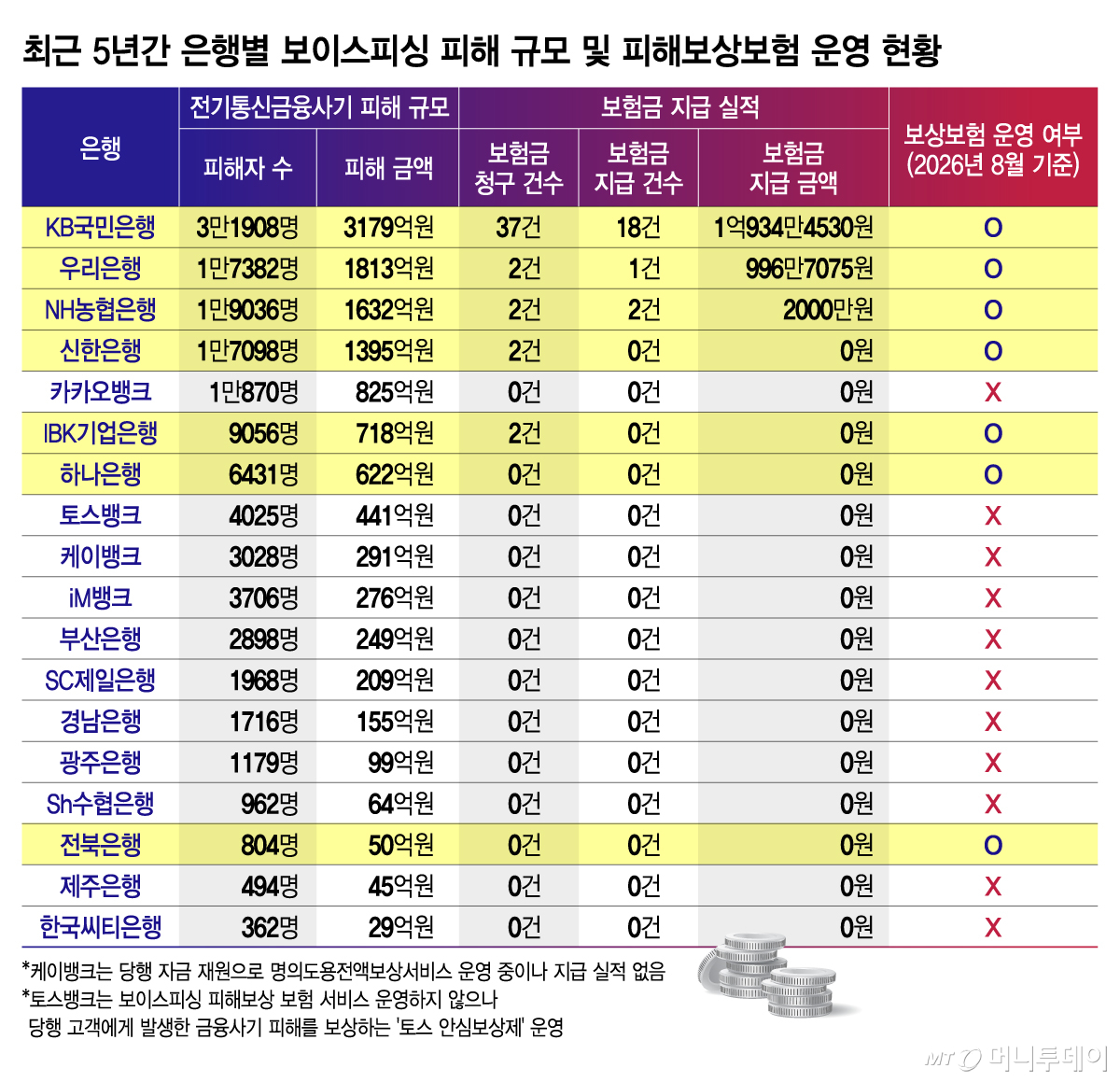
According to data submitted by Park Min-gyu, a member of the Democratic Party of Korea serving on the National Assembly’s Political Affairs Committee, to the Financial Supervisory Service on the 20th, the total number of victims of telecommunication financial fraud in the banking sector (first-tier banks) over the past five years (2021–2025) was 132,923, with total losses amounting to 1.2092 trillion won.
Looking at the top five banks by loss amount: KB Kookmin Bank had 31,908 victims (317.9 billion won), Woori Bank had 17,382 victims (181.3 billion won), NH NongHyup Bank had 19,036 victims (163.2 billion won), Shinhan Bank had 17,098 victims (139.5 billion won), and KakaoBank had 18,870 victims (82.5 billion won).
By year, losses were recorded as follows: 112 billion won in 2021, 91.5 billion won in 2022, 141.1 billion won in 2023, 277.6 billion won in 2024, and 587 billion won in 2025. This represents more than a fivefold increase in loss amounts over four years. During the same period, the number of victims rose from 22,637 in 2021 to 45,122 last year—approximately doubling.
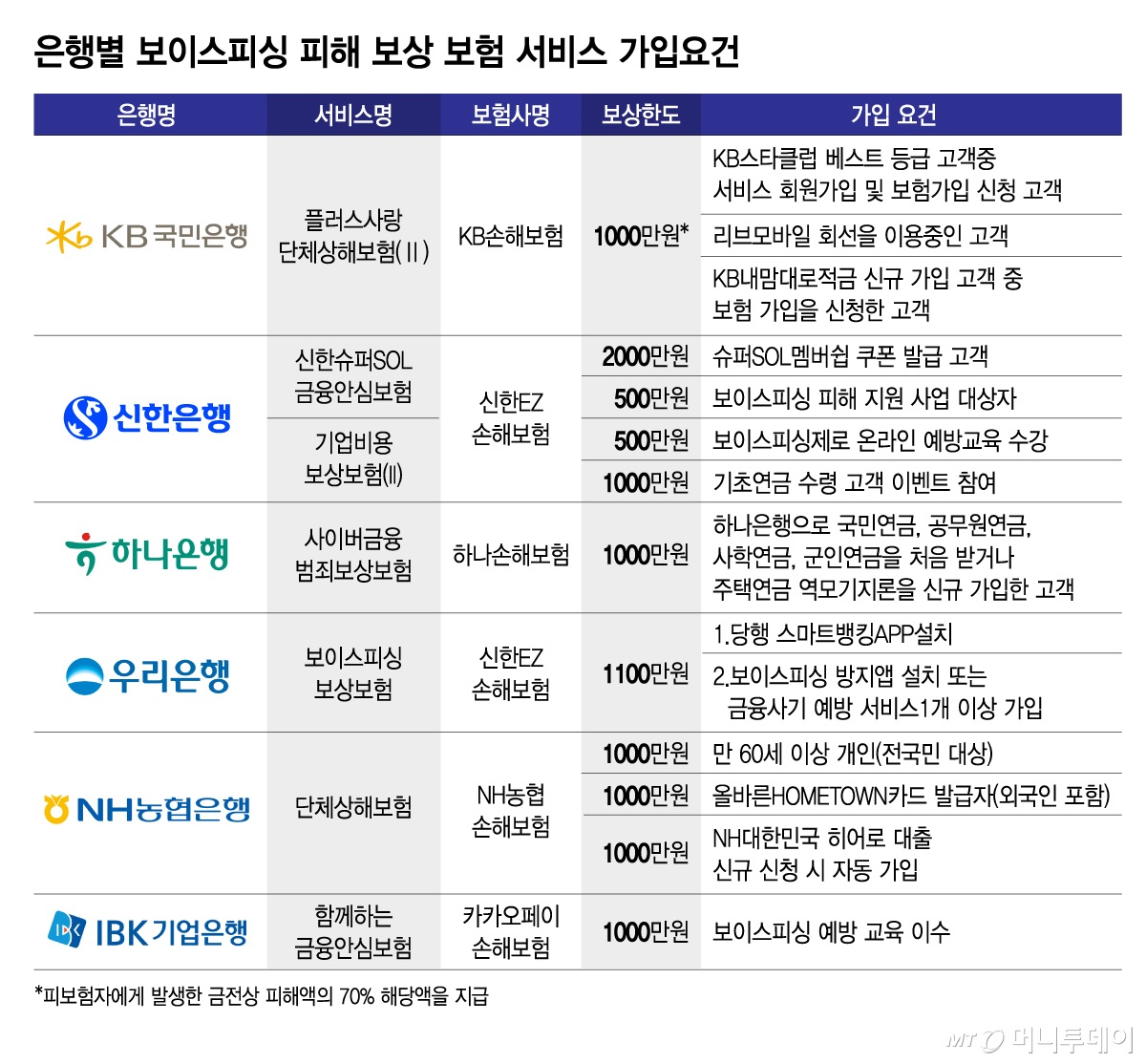
Banks offer various voice phishing prevention and customer protection measures. The most representative is the voice phishing compensation insurance service. This product compensates for customers’ financial losses, with banks typically covering the premium and supporting free enrollment for customers. Generally, it covers up to 70% of the loss amount, with a maximum limit of 0.1 billion won.
However, despite widespread promotion by banks, the effectiveness of voice phishing compensation insurance services has proven minimal. As of late last month, seven banks operate such services: KB Kookmin Bank, Shinhan Bank, Hana Bank, Woori Bank, NH NongHyup Bank, IBK Industrial Bank, and Jeonbuk Bank.
Over the past five years, these banks received 45 claims, but only 21 resulted in actual payouts. With 132,923 victims over the same period, only 0.034% filed a claim, indicating very low enrollment rates. KB Kookmin Bank had the highest number of claims at 37, with payouts made in 18 cases.
The total amount claimed was 428 million won, but only 190 million won was actually paid out, resulting in a payout rate of just 25.5% relative to the claimed amount.
The reason voice phishing compensation insurance services remain largely nominal is not only insufficient promotion to customers but also that banks impose conditions such as mandatory enrollment in specific products, completion of training programs, or age restrictions, which significantly limit the number of insured individuals.
A representative from a major commercial bank stated, “In practice, voice phishing compensation insurance services are often offered as one of several optional services available to customers alongside coffee coupons,” adding, “While some groups, such as basic pension recipients, are automatically enrolled, recent voice phishing incidents have primarily affected high-income and highly educated individuals, leading to low enrollment rates.”
In this context, Toss Bank’s Peace of Mind Compensation Program has drawn attention. Unlike other banks, Toss Bank operates a program that compensates customers up to 500 thousand won for financial fraud such as voice phishing and up to 500,000 won for second-hand goods scams, without requiring separate enrollment. This is the first system in the banking sector to provide compensation after internal review even when the bank bears no legal responsibility for fraud losses. From 2023 through last year, Toss Bank paid out compensation in 137 of 463 claims filed.
According to the Financial Supervisory Service, under the voluntary compensation system introduced by banks in 2024, only 10% of applications resulted in actual compensation. Critics argue that the banking sector must seriously consider more effective consumer protection policies. Banks plan to strengthen promotion of insurance services and expand eligibility criteria.
Park Min-gyu (Rep.) emphasized, “To ensure more citizens can receive support for recovering from voice phishing losses, banks should actively participate in compensation insurance service policies. They must also verify whether coverage targets and enrollment requirements are overly restrictive, avoiding mere ‘paper compensation’ systems, and work to improve them accordingly.”

 in FINANCE

