

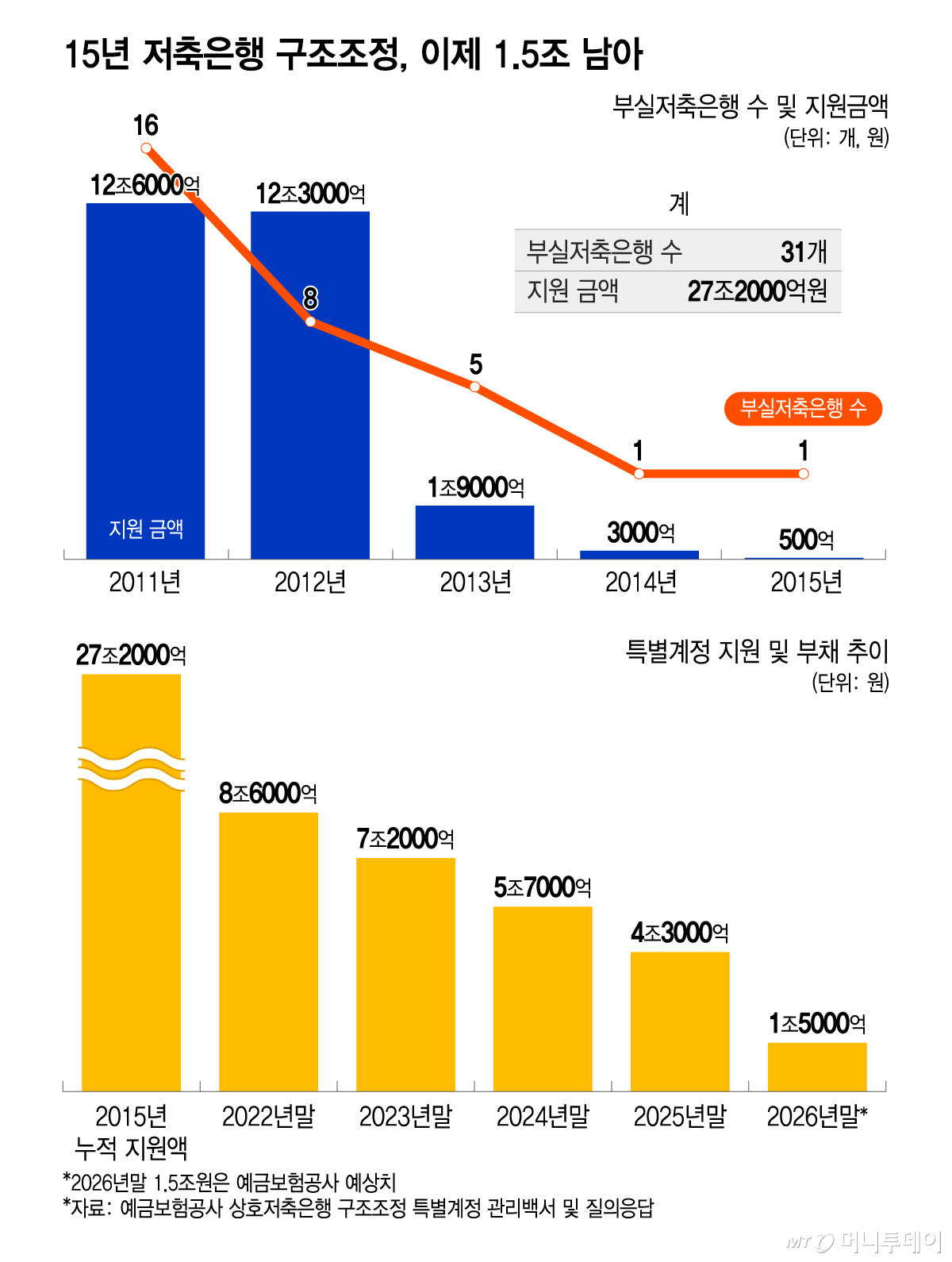
A deficit of 1.5 trillion won is expected to remain in the special account for savings bank restructuring by the end of this year. The restructuring, into which 27.2 trillion won was invested, has effectively entered its final stages, but a bill to have all financial industries share and repay the remaining deficit over one more year has failed to clear the hurdle at the National Assembly. Financial authorities and all financial industries had already reached an agreement earlier this year to extend the special account by one year and jointly repay the debt remaining in the special account.
According to the financial sector on the 29th, the First Law Review Subcommittee of the Political Affairs Committee of the National Assembly decided on the 15th to continue reviewing, rather than sending it to a plenary session, an amendment to the Deposit Insurance Act that would extend the operating period of the savings bank special account from the end of this year to the end of next year by one year.
The special account for savings banks was established to prevent the insolvency of savings banks in 2011 from spreading across the entire financial market. In addition to savings banks, other financial industries such as banking, insurance, and financial investment also share part of the deposit insurance premiums to repay the restructuring costs. Although the initial operating period was set to end by the end of this year, a deficit of approximately 1.5 trillion won is expected to remain at that point.
The restructuring cost, initially estimated at 15 trillion won, increased significantly during the actual resolution process. As of March 2011, just before the special account began operations, eight savings banks were undergoing restructuring. However, following a real estate recession and continued insolvency in project finance (PF) loans, the number of target institutions rose to 31 by 2015, and the final support amount reached 27.2 trillion won.
Kwon Dae-young, Vice Chairman of the Financial Services Commission, stated at the law subcommittee on the 15th, "We estimated the insolvency (at 15 trillion won) based on the going-concern valuation in the financial statements (from 15 years ago), but liquidation value was reflected during the resolution process." He added, "The scale of investment increased because insolvency spread to other savings banks, resulting in a much larger number of institutions requiring resolution than originally planned."
In the law subcommittee of the Political Affairs Committee in March 2011, the option of amending the supplementary provisions again was also discussed if more support funds were needed than the 15th trillion won. When Park Sun-sook, then a Democratic Party lawmaker, asked, "If principal and interest costs exceed 15 trillion won, does that mean you intend to amend the supplementary provisions of this law again?" Lee Jin-bok, then Han Na-ra-dang (Rep.), replied, "We will have no choice but to do it at that time." In fact, the reality that the actual support plan exceeded 15 trillion won was also reported to the National Assembly in 2012.
Counterarguments emerged in the National Assembly over whether other financial industries should share the burden of the remaining deficit as well. Song Eon-seok, a People Power Party lawmaker, pointed out that if the issue could be resolved through borrowings from the proprietary account even without the special account, there would be no need to extend it for another year. Cho Jung-hoon, also a People Power Party lawmaker, emphasized the necessity of additional burden on the savings bank industry, stating, "Banks and life insurance companies are not the entities that caused the problem."
The Korea Deposit Insurance Corporation (KDIC) views that if the special account is terminated and its assets and liabilities are transferred to the proprietary account of savings banks, the net asset deficit of the proprietary account will expand from approximately 2 trillion won currently to 3.5 trillion won. This would mean the scale of the deficit becomes larger than the 2.1 trillion won deficit at the end of 2010, just before the special account was created. It is explained that since the insurance premiums collected annually from the savings bank industry are approximately 400 billion won, it will be difficult to cover the deficit while simultaneously securing the capacity to respond to future insolvencies.
Financial authorities maintain that since financial industries jointly bore the costs to prevent the savings bank crisis from spreading into instability across the entire financial system, the remaining deficit should also be settled in the same manner. The Political Affairs Committee is scheduled to re-review the extension bill after verifying the process by which the initial estimate of 15 trillion won increased to the 27th trillion won range and the content of reports made to the National Assembly at that time.

 in FINANCE
