

More than two years have passed since the Timemef (TMON·WEMEF, hereinafter "Timemef") settlement dispute erupted, yet it has been confirmed that three-quarters of Standard Chartered Bank Korea’s related selected industry loans are in default. With public debt restructuring achievements amounting to only 0.02%, criticism has arisen that government support has been neglected. However, under National Assembly mediation, a channel for bond sales and purchases between public institutional investors and the bank has finally opened. Nevertheless, since many borrowers remain tied up in legal lawsuits, significant difficulties are expected before actual debt restructuring can be achieved.
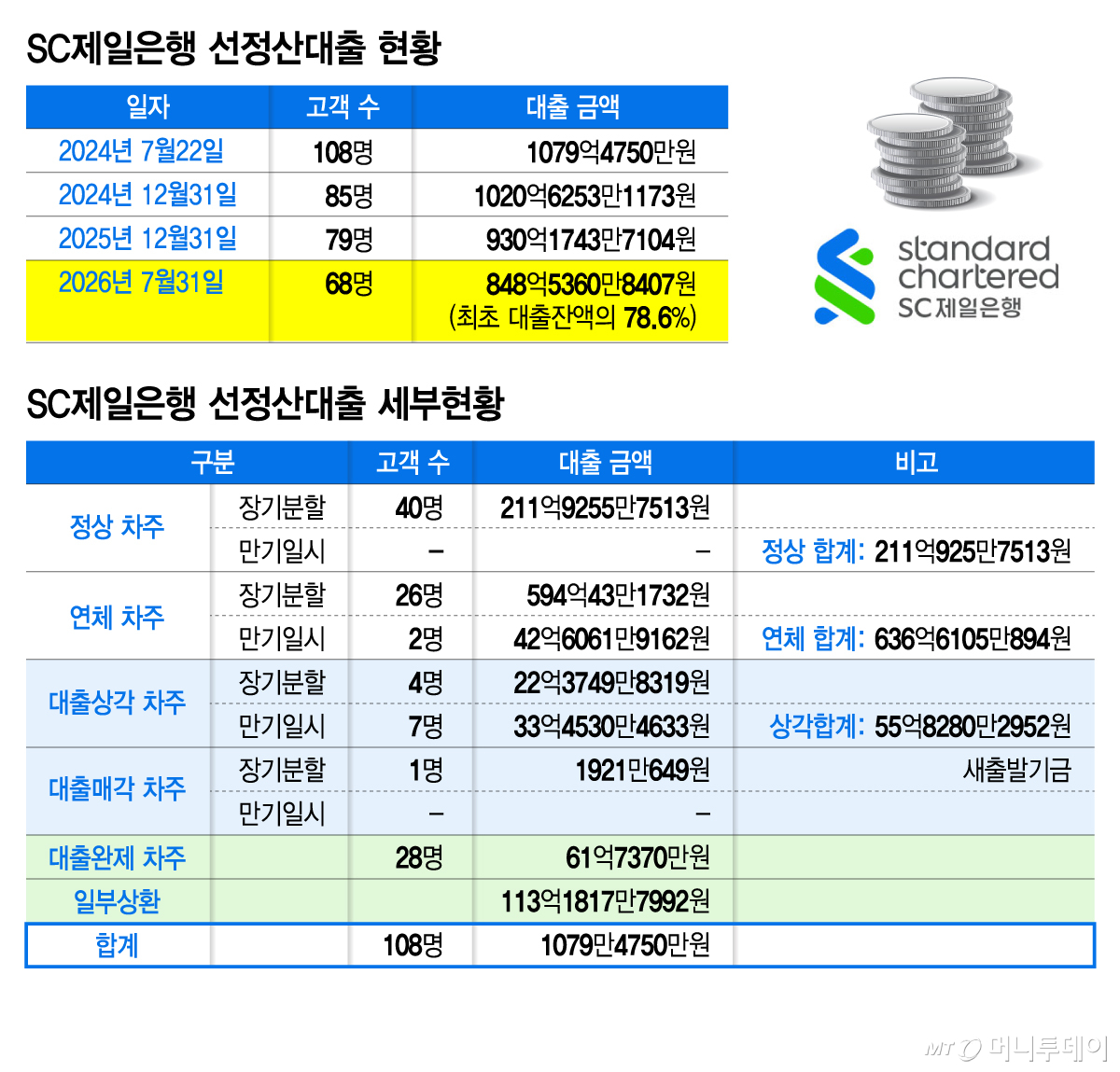
According to data submitted on the 27th by Park Min-kyu, a member of the Democratic Party of Korea’s Political Affairs Committee, to the Korea Asset Management Corporation (KAMCO) and Standard Chartered Bank Korea, as of July 2024 during the Timemef crisis, out of approximately 107.9 billion won (108 companies) in related selected industry loans held by Standard Chartered Bank Korea, only about 17.5 billion won in principal had been repaid over two years through full repayment and partial installments.
As of late July, loans remained outstanding for 68 companies, with a remaining balance of approximately 84.9 billion won, representing 78.6% of the original loan balance. Among these, the remaining balance for 40 companies undergoing normal long-term installment repayment stands at 21.2 billion won, while the total loan balance for 28 defaulted companies reaches 63.7 billion won. The delinquency rate exceeding 30 days has surged to 75%, and the non-performing loan (NPL) ratio based on reclassified loans has climbed to 61%. Notably, the scale of loans for defaulted companies was significantly larger. The average remaining loan balance per defaulted company was approximately 2.3 billion won, which is 4.3 times higher than the average of about 530 million won for normally repaying companies.
The background for this large-scale deterioration has been attributed to excessive lending promotion by the bank combined with regulatory neglect by financial authorities. Unlike other banks such as KB Kookmin Bank, which limited loan amounts per borrower to less than 100 million won and managed only two defaulted borrowers, Standard Chartered Bank Korea expanded its loans by relaxing limits, thereby exacerbating non-performing assets. In this context, the selected industry loan bonds of Standard Chartered Bank Korea, which were intended for purchase and debt restructuring through KAMCO’s New Start Fund, amounted to just one case—19.21 million won (0.02%).
As the crisis deepened, in response to calls from Park (Rep.) for countermeasures, both KAMCO and Standard Chartered Bank Korea adopted proactive stances. In a written response, KAMCO stated, “We will positively consider establishing a separate accounting account within our organization to separately purchase selected industry loan bonds related to Timemef and conduct debt restructuring.” Standard Chartered Bank Korea also said, “We will actively cooperate with the sale of bonds to public institutional investors (KAMCO) and participate in practical negotiations for the normalization of affected companies and the cleanup of non-performing loans.” If KAMCO acquires non-performing loans (NPLs), affected companies could receive debt restructuring measures such as principal reduction, installment repayment, or repayment deferral based on their repayment capacity. Under KAMCO’s general unsecured NPL debt restructuring system, up to 60% of the principal can be reduced.
However, actual public debt restructuring remains difficult to achieve. Major affected borrowers with large loan amounts filed a lawsuit against Standard Chartered Bank Korea one year ago seeking confirmation of non-existence of debt. Without withdrawal of these lawsuits or acknowledgment of debt by the borrowers, KAMCO cannot purchase the bonds. Additionally, eight cases (7.6 billion won) involving bankruptcy or corporate rehabilitation would only transfer creditor status to KAMCO even if acquired, limiting their relief effect. Furthermore, five corporate bonds (3.6 billion won) without joint guarantors are excluded from acquisition targets.
The Black Umbrella Grand Unified Committee (Timemef Victims’ Alliance) told MoneyToday, “If we had known that public debt restructuring was possible, we would not have filed lawsuits and incurred legal costs.” The confirmation of non-existence of debt lawsuit is currently pending. Regarding this matter, the Financial Services Commission stated, “While purchasing NPLs by KAMCO is legally permissible under current regulations, whether actual purchase occurs depends on negotiations between KAMCO and financial institutions considering factors such as KAMCO’s investment capacity, sale price, conditions, and rights relationships.”
Ultimately, although repayment deadlines were delayed over two years through maturity extensions and installment repayments, the deterioration of a significant portion of loans has necessitated different exit strategies for each bond. Detailed coordination among KAMCO, Standard Chartered Bank Korea, and affected companies is expected to be required, including clarifying rights relationships for bonds under litigation and finding separate handling measures for bonds in rehabilitation, bankruptcy, or business closure status.
Park (Rep.) stated, “Standard Chartered Bank Korea also bears certain responsibility for the deterioration of selected industry loans and must promptly address non-performing assets; therefore, it should actively negotiate with affected companies to develop practical solutions such as debt restructuring and bond sales.” The committee further added, “Financial authorities and the Korea Asset Management Corporation should support debt restructuring between banks and affected companies and actively consider alternative public bond purchase plans beyond the New Start Fund.”

 in FINANCE
