

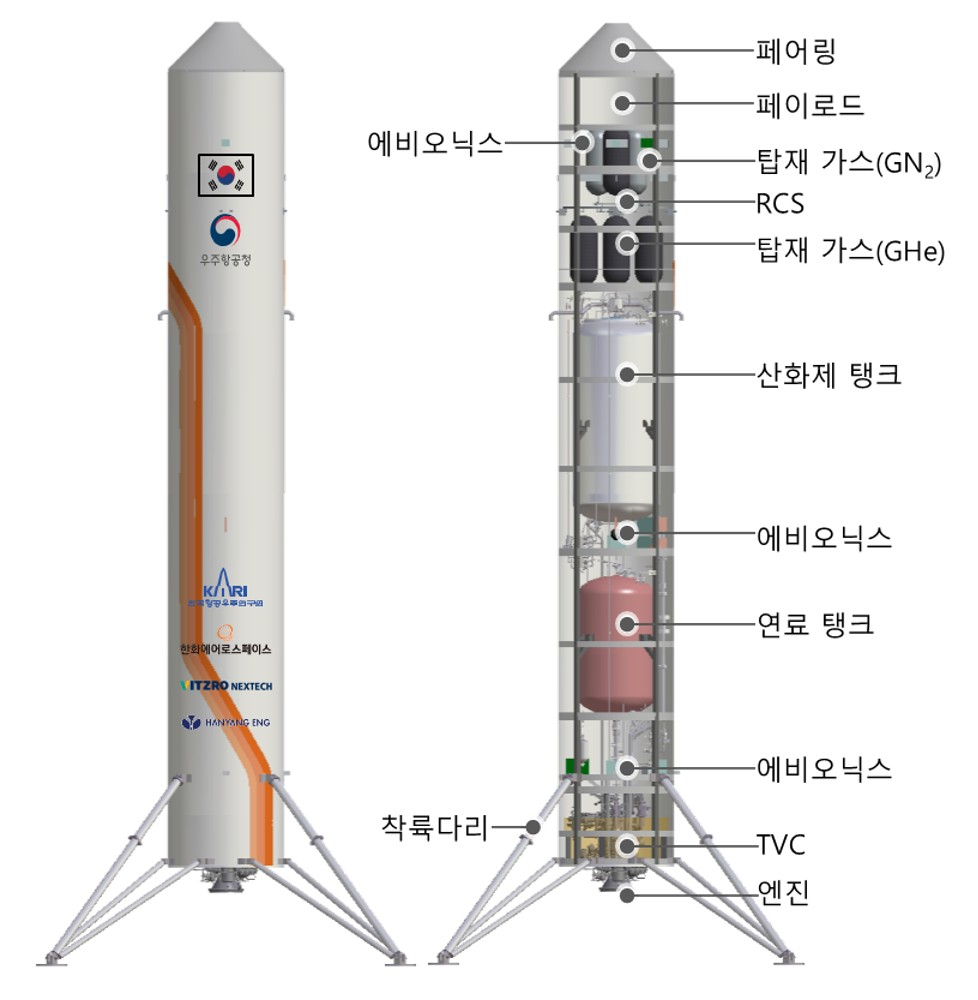
Hanwha Aerospace announced on the 30th that it has begun final assembly of a "reusable technology demonstrator" aimed at securing launch vehicle reusability technology.
For this project, the Korea Aerospace Research Institute (KARI) is leading the overall research, while Hanwha Aerospace is responsible for system integration. Under KARI's leadership, Hanwha Aerospace will develop the reusable technology demonstrator and plans to verify core technologies essential for launch vehicle reusability, including engine thrust control, attitude control, and guidance and control. In addition, domestic space companies such as Bitsro Nextech and Hanyang Engineering are participating in the project.
Participating institutional investors and companies aim to complete technology demonstration by 2028 and secure core launch vehicle reusability technologies comparable to those of "Falcon 9," the main launch vehicle of the U.S.-based "SpaceX." The reusable technology demonstrator measures 12.2 meters in height and 1.5 meters in diameter, and is equipped with one multi-burn cycle turbopump engine capable of thrust adjustment.
The flight test is scheduled to be conducted in 2028. The objective of this test is to ascend to an altitude of 500 meters within approximately 90 seconds after vertical takeoff, and then achieve a stable vertical landing at the designated landing site.
Launch vehicle reusability technology is regarded as a key technology for securing competitiveness in space transportation services in the global market. "SpaceX," which was the first in the world to successfully commercialize reusable launch vehicles, is known to have drastically reduced launch costs per kilogram by reusing the first-stage rocket of its "Falcon 9" dozens of times. The industry expects that even reusing only the first stage, located at the bottom of the launch vehicle, could significantly reduce launch costs compared to existing methods.
Based on this project, Hanwha Aerospace aims to lay the groundwork for the reuse of the first stage of next-generation launch vehicles, which is scheduled for the mid-2030s, and to accelerate its entry into the global space transportation service market by securing cost competitiveness in launches.
A Hanwha Aerospace official emphasized, "Securing launch vehicle reusability technology is an essential task for growing into a 'Korean version of SpaceX.' Together with KARI and partner companies, we will successfully carry out this research to contribute to strengthening South Korea's space transportation capabilities and the growth of the private space industry ecosystem."

 in INDUSTRY
