

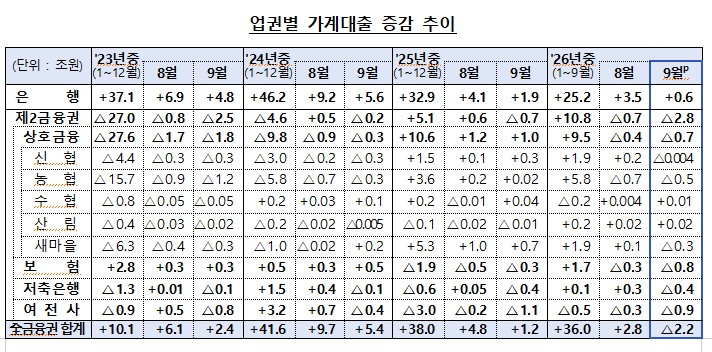
Household loan balances decreased by 2.2 trillion won last month, marking the first net decrease since the beginning of this year. This is interpreted as being due to factors affecting the housing market, such as a decline in home transaction volumes and new unit supply. The financial authorities are reviewing lending conditions to prevent a year-end lending cliff, including applying exceptions to total household loan volume regulations for newly built residential complexes.
The Financial Services Commission announced on the 15th that household loans across all financial sectors decreased by 2.2 trillion won compared to the end of the previous month. This marks the first time this year that household loan balances have declined, following a net decrease of 1.2 trillion won in December last year.
Mortgage loans increased by 330 billion won, but the increase narrowed by approximately 1 trillion won compared to the previous month’s increase of 430 billion won. Other loans, including credit loans, decreased by 550 billion won, a significant expansion from the previous month’s decrease of 150 billion won. This is due to credit loans alone decreasing by 300 billion won last month.
By sector, bank household loans increased by 60 billion won, a significant narrowing compared to the previous month’s increase of 350 billion won. The increase in banks’ own mortgage loans narrowed from 290 billion won in the previous month to 180 billion won in September. Policy-based loans increased by 110 billion won, maintaining the level of the previous month. Other loans decreased by 230 billion won, expanding the decrease compared to the previous month’s drop of 60 billion won.
Household loans at non-bank financial institutions decreased by 280 billion won. The decrease also expanded significantly compared to the previous month’s 70 billion won. While mutual finance, insurance, and credit card companies all saw their decreases expand, savings banks also decreased by 40 billion won, turning to a downward trend.
The Financial Services Commission held a joint household debt review meeting on the day, chaired by Secretary-General Shin Jin-chang and attended by relevant institutional investors. Secretary-General Shin stated, “September household loans recorded their first net decrease this year due to the slowing growth of mortgage loans and the expanded decrease in other loans,” adding, “This is attributed to housing market influences such as declining home transaction volumes and new unit supply, as well as seasonal factors including quarter-end non-performing loan (NPL) sales and write-offs, and holiday bonuses.”
He said, “As we have recently raised the total household loan management target and are managing group loans separately within each financial institution’s total volume target, concerns about a year-end lending cliff will be limited.”
Secretary-General Shin urged, “In accordance with the the 13th measures, since group loans for newly built residential complexes are 100% excluded from each financial institution’s total volume target, please thoroughly verify and review within the financial sector to ensure that actual demand borrowers can receive loans without hindrance according to their funding plans anticipated at the time of purchase.”
In accordance with the recent the 13th measures, policies to resolve the marriage penalty for Home Loan (Bogijjaroreon) and strengthen support for special-purpose rental loan guarantees for young people without housing will be implemented starting from the 19th. For Home Loans, eligibility is granted if one spouse’s annual income is 70 million won or less. Previously, newlywed couples had to have an income of 85 million won or less. The age limit for special-purpose rental loan guarantees for young people is expanded from under 34 to under 39 years old, and the guarantee limit increases from 200 million won to 300 million won (for newlyweds and families with children).

 in FINANCE

