

Semiconductor materials, components and equipment ETFs, which had posted weak returns amid concerns over AI profitability, rose on news that Anthropic had filed for an initial public offering (IPO). With funds continuing to flow into these ETFs, investors are watching to see whether their returns can reverse course.
According to KOSCOM ETF Check on Tuesday, 'SOL AI Semiconductor Materials, Components and Equipment' closed trading at 22,300 won, up 1,215 won (5.76%) from the previous day.
Under ETF Check's classification criteria, other semiconductor materials, components and equipment ETFs also surged by more than 5%, including 'PLUS AI Semiconductor Materials, Components and Equipment Active' (8.64%), 'HANARO Semiconductor Core Process Leaders' (7.14%), 'SOL Semiconductor Back-End Process' (5.93%), 'SOL Semiconductor Front-End Process' (5.27%), and 'ACE AI Semiconductor TOP3+' (5.1%).
Semiconductor materials, components and equipment ETFs, which had posted returns in the negative 20% range over the past month due to concerns over AI profitability, rose across the board.
This was thanks to news that Anthropic, the developer of the AI chatbot 'Claude,' disclosed on the 26th (local time) that it has submitted a listing application to the U.S. Securities and Exchange Commission and plans to list on NASDAQ under the ticker symbol 'ANT' in mid-November. The news of Anthropic's IPO push alleviated the concerns over AI profitability that had been weighing down ETF returns.
Experts in the financial investment industry forecast that given the significant growth potential of semiconductor materials, components and equipment, a rebound in semiconductor materials, components and equipment stocks could continue as concerns over AI profitability weaken.
Lee Dong-ju, a researcher at SK Securities, stated, "Semiconductor materials, components and equipment stocks underwent sharp corrections as they fully absorbed the impact of the macro environment and customer sentiment."
He added, "However, after this year's second-half earnings season, adjustments to next year's earnings per share (EPS) for semiconductor equipment companies will begin, and from the first half of next year, momentum from new fab orders and a full-fledged earnings rally for materials and components are expected to kick in."
The analysis suggests that as semiconductor companies embark on large-scale capacity expansions through 2028, both front-end and back-end process firms will benefit.
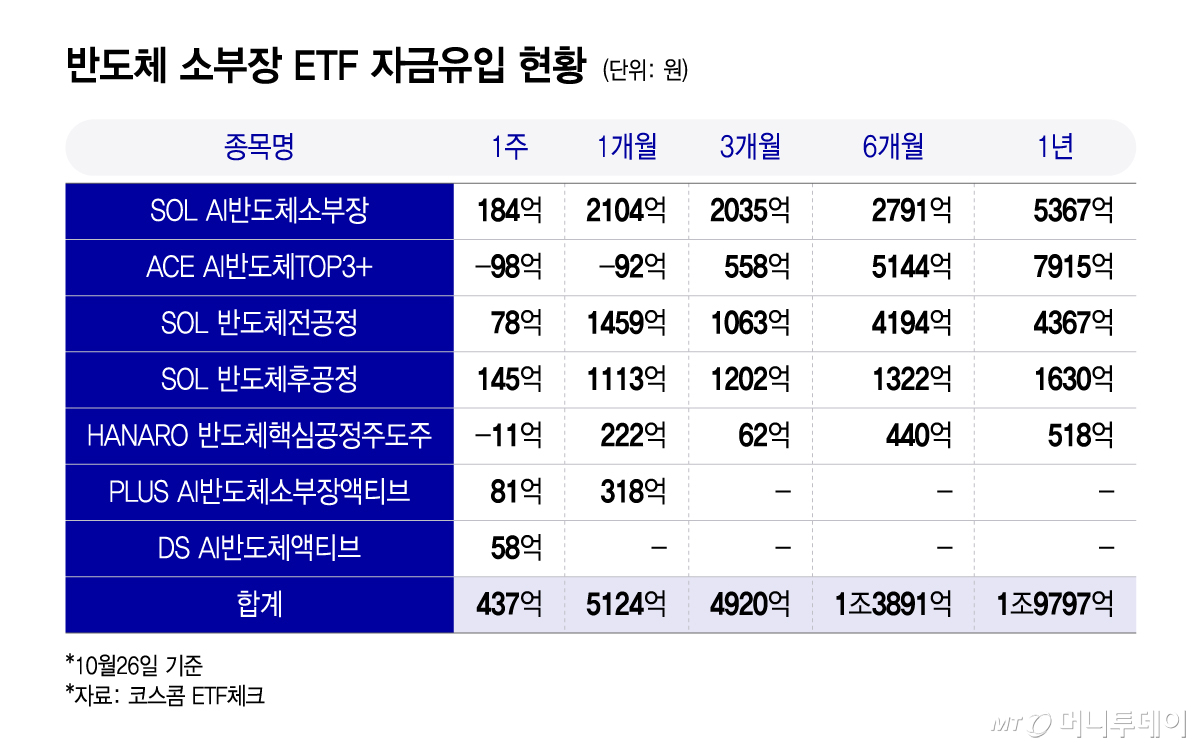
Investors are also expecting a rise in semiconductor materials, components and equipment stocks. As of the previous day, the average return for seven semiconductor materials, components and equipment ETFs over the past month was approximately -20%, yet 512.4 billion won flowed into these ETFs during that period. In the last week alone, 43.7 billion won was injected into semiconductor materials, components and equipment ETFs. This contrasts with capital outflows from ETFs focused on large-cap semiconductor stocks over the same period.
Lee Dae-hwan, a manager at Samsung Asset Management, also said, "Expectations continue that increased capital investment driven by expanded AI spending and the memory semiconductor supercycle will lead to improved earnings for materials, components and equipment companies." He added, "We judge that medium- to long-term funds are flowing into semiconductor materials, components and equipment ETFs."
Analysis also suggests that investors have instead moved to buy at low prices as earnings growth in semiconductor materials, components and equipment continues.
Park Su-min, head of the ETF Strategy Division at Shinhan Asset Management, explained, "Investors perceive this correction not as damage to the fundamentals of the semiconductor materials, components and equipment sector, but as a zone where price attractiveness has increased relative to earnings." She added, "The outlook that expanded capital investment by global semiconductor companies will benefit the entire value chain is acting positively for semiconductor materials, components and equipment ETFs."

 in STOCK
