

Although household loans at the five major banks returned to growth after a month, the banking sector expects it will be able to avoid a “shutdown” situation in which loan processing is largely halted at year-end. This is because group loans are managed separately from each bank’s total volume target, reducing supply pressure, and because a decrease in new housing units is expected to limit demand for mortgage loans at year-end. Some banks have resumed sales of previously suspended loan products, restarting their operations.
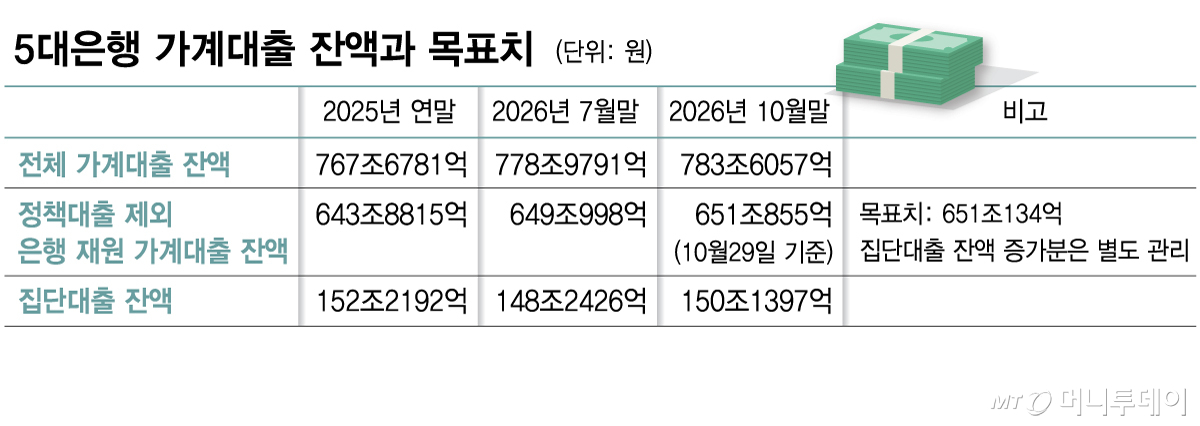
According to financial industry sources on the 2nd, the household loan balance at KB Kookmin Bank, Shinhan Bank, Hana Bank, Woori Bank, and NH NongHyup Bank as of the end of October was 783.6057 trillion won, an increase of 2.7717 trillion won from the end of the previous month. This marked a shift to growth after a decrease of 1.2852 trillion won in September.
The mortgage loan balance rose by 1.7005 trillion won over the past month to 623.988 trillion won. Credit loans also increased by 66.87 billion won, reaching 108.8990 trillion won.
On the surface, the annual household loan growth target has already been exceeded. The household loan balance at the five major banks, excluding policy loans and based on bank-funded sources—which serves as the benchmark for target management—was 651.855 trillion won as of October 29, an increase of 7.2040 trillion won from 643.8815 trillion won at the end of last year. This exceeds the annual net growth target of 7.1319 trillion won, which was expanded following the the 13th measures, by 7.21 billion won.
However, it is difficult to conclude that loan limits have been exhausted based on this figure alone. This is because financial authorities have managed the net increase in group loans, such as moving-in costs, interim payments, and final payments, separately from each bank’s household loan total volume target since August.
The group loan balance at the five major banks decreased from 152.2192 trillion won at the end of last year to 148.2426 trillion won at the end of July this year. It then increased to 150.1397 trillion won by the end of October. The increase from August to October was 1.8971 trillion won. If this increase is excluded from total volume management performance, the five major banks can still increase their household loan balance by another 1.8250 trillion won.
Accordingly, the banking sector believes that a situation similar to last year’s year-end, when “loan shutdowns” occurred consecutively for total volume management, will not happen. KB Kookmin Bank suspended new applications for home purchase mortgages to be executed within the year via non-face-to-face channels on November 22 and face-to-face channels on the 24th of last year. Hana Bank also blocked new applications for home purchase mortgages and housing deposit loans to be executed within the year at its branches starting from the 25th of the same month. Shinhan, Woori, and Nonghyup banks also strengthened household loan regulations around the same time.
Year-end loan demand is also expected to decline. According to Zigbang, the number of apartment units scheduled for move-in nationwide in November is 11,559 households, a 30% decrease from October and a 49% decrease from the same month last year. The volume in the metropolitan area is 4,031 households, down 49% from the previous month, while Seoul accounts for only 488 households. The number of units scheduled for move-in nationwide in December is 16,211 households, an increase from November, but the total for the fourth quarter is approximately 44,300 households, which is 39% less than the same period last year.
The growth rate of credit loans has also slowed compared to the first half of the year. Credit loans at the five major banks increased by 2.1741 trillion won and 2.1550 trillion won in May and June, respectively, but the increase in October was only 66.87 billion won. In September, they decreased by 1.3415 trillion won. Typically, when surplus funds such as year-end performance bonuses are used for loan repayment, the growth in balances is further limited.
Banks are partially lifting loan restriction measures they had introduced on their own. Hana Bank resumed new processing of non-face-to-face mortgage products and refinancing for mortgages and residential officetels starting from the 2nd of this month. Previously, Nonghyup Bank also resumed new processing of variable-rate mortgages in August.
A senior official at a major bank said, “By strengthening various measures related to household loans in June and July, the increase in household loans in September and October decreased significantly,” adding, “Some banks have plenty of room until year-end and are even considering how to fill it.”

 in FINANCE
