

With the push for a fund-type retirement pension system officially underway, major financial holding companies are preparing to form consortiums centered on their banks. This comes as the introduction of the system is expected to open the door for subsidiaries to invest in trustee corporations. Combining the customer base of banks with the asset management capabilities of securities and asset management subsidiaries is seen as a key variable that will determine future competitiveness.
According to financial industry sources on the 3rd, the Ministry of Employment and Labor will convene major bank CEOs on the 6th to hold a meeting on fund-type retirement pensions. This is a follow-up measure after the government officially announced its intention to push legislation to promote fund-type retirement pensions as part of its plan to strengthen retirement pension functions.
According to the government's proposal, fund-type retirement pensions are categorized into three types based on the legal entity: △Open type involving financial institutions, △Joint type involving labor unions and non-profit corporations, and △Open type involving public institutions. In this context, it was proposed that private financial companies could establish trustee institutions not only individually but also by forming separate consortiums.
Currently, under the Fair Trade Act, multiple subsidiaries under a financial holding company cannot jointly invest in a grandchild company, but the government plans to create an exception clause to resolve this legal hurdle. At a briefing on fund-type retirement pensions for retirement pension operators held on the 30th of last month, the Ministry of Employment and Labor stated that it plans to establish exceptions during the legislative amendment process to allow trustee corporations to be set up in the form of financial holding company subsidiaries.
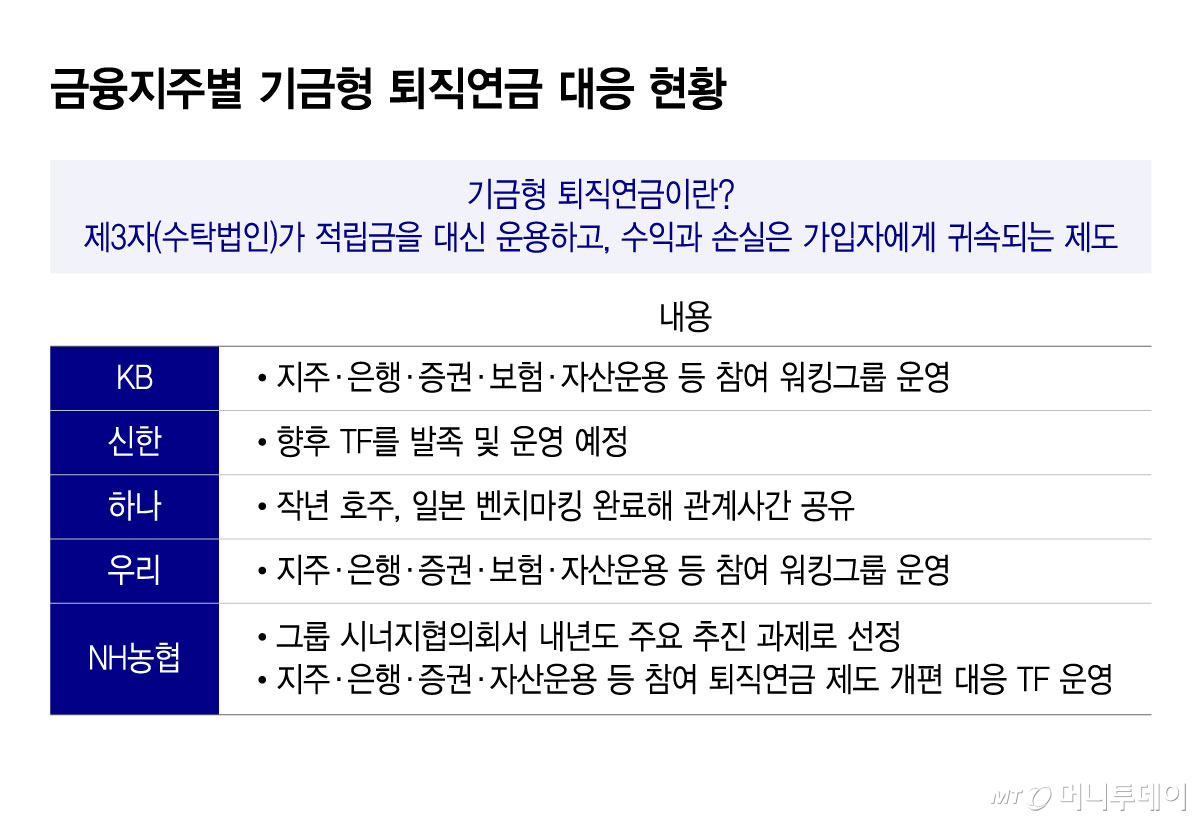
In response, financial holding companies are establishing group-level response systems. First, NH Nonghyup Financial selected "Active Response to the Fund-Type Retirement Pension System" as one of its core response tasks for next year through its Business Strategy and Synergy Promotion Council last month. Additionally, it is operating a "Retirement Pension System Reform Response TF" composed of subsidiaries including banks, securities, and asset management, centered on the holding company's business strategy department.
KB Financial and Woori Financial are operating working groups in which all subsidiaries, including the holding company, bank, securities, insurance, and asset management divisions, participate.
Hana Financial visited Australia and the United Kingdom, which introduced fund-type retirement pensions earlier last year, completed local investigations, and is currently sharing findings and discussing response strategies among its group affiliates. Shinhan Financial plans to formally establish and operate a TF as government policies become more specific.
Currently, response systems are being organized centered on banks with large retirement pension reserve scales, but synergy with capital market subsidiaries such as securities and asset management is emerging as the key factor. This is because, unlike existing contract-type pensions, fund-type retirement pensions have a structure where a separate trustee corporation oversees asset management, making capabilities in asset allocation and investment product composition crucial.
In fact, the growth of securities subsidiaries in the retirement pension market is notable. The DC (Defined Contribution) and IRP (Individual Retirement Pension) reserves of the top five financial holding companies reached 174 trillion 143.5 billion won, a 15.5% increase compared to the end of last year. During the same period, securities subsidiary reserves increased by 36.4%, more than doubling the growth rate of total holding company reserves. As a result, the share of securities companies in holding company reserves rose from 11.2% to 13.2%.
The proportion of securities subsidiaries varies by holding company. In the case of NH Nonghyup Financial, the securities share reaches 35%, while KB Financial and Shinhan Financial are recorded at the 14% range. On the other hand, Hana Financial and Woori Financial remained in single digits.
As specific requirements for establishing trustee corporations and management methods have not yet been finalized, attention is focused on the legislative bill. A financial industry official said, "Since it is essentially a structure of creating one massive new fund, strategies may differ depending on whether banks or securities subsidiaries lead, based on the capabilities of the subsidiaries held by each financial holding company," adding, "We will refine our response while watching the detailed content to be determined in the enforcement decree."

 in FINANCE
