

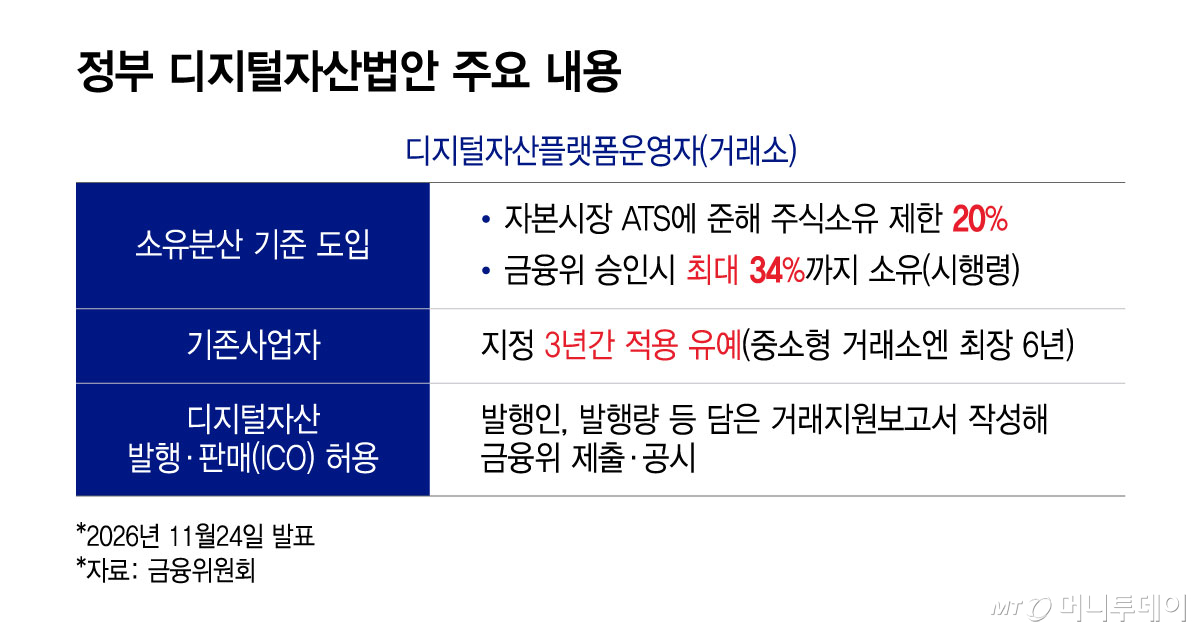
As the government has capped major shareholders' stakes in virtual asset exchanges at a maximum of 34%, a variable has emerged in Naver Financial's acquisition of Dunamu. Observers predict that Hana Bank, which secured its stake in Dunamu preemptively, could play a larger role if Naver Financial changes its transaction structure to acquire shares by dividing them with other shareholders rather than making Dunamu a wholly owned subsidiary.
According to financial industry sources on the 27th, the Financial Services Commission set the cap on major shareholders' stakes in virtual asset exchanges at 20% through the Act on Innovation and Consumer Protection of the Digital Asset Industry announced the previous day. However, it explicitly stated that financial institutions and others may hold up to a maximum of 34% with approval from the Financial Services Commission.
The deal directly affected by this regulation is Naver Financial's acquisition of Dunamu. Naver Financial had planned to make Dunamu a 100% subsidiary through a comprehensive share exchange by March next year. Had the transaction concluded as scheduled, existing Dunamu shareholders would have transferred their shares in exchange for new Naver Financial shares.
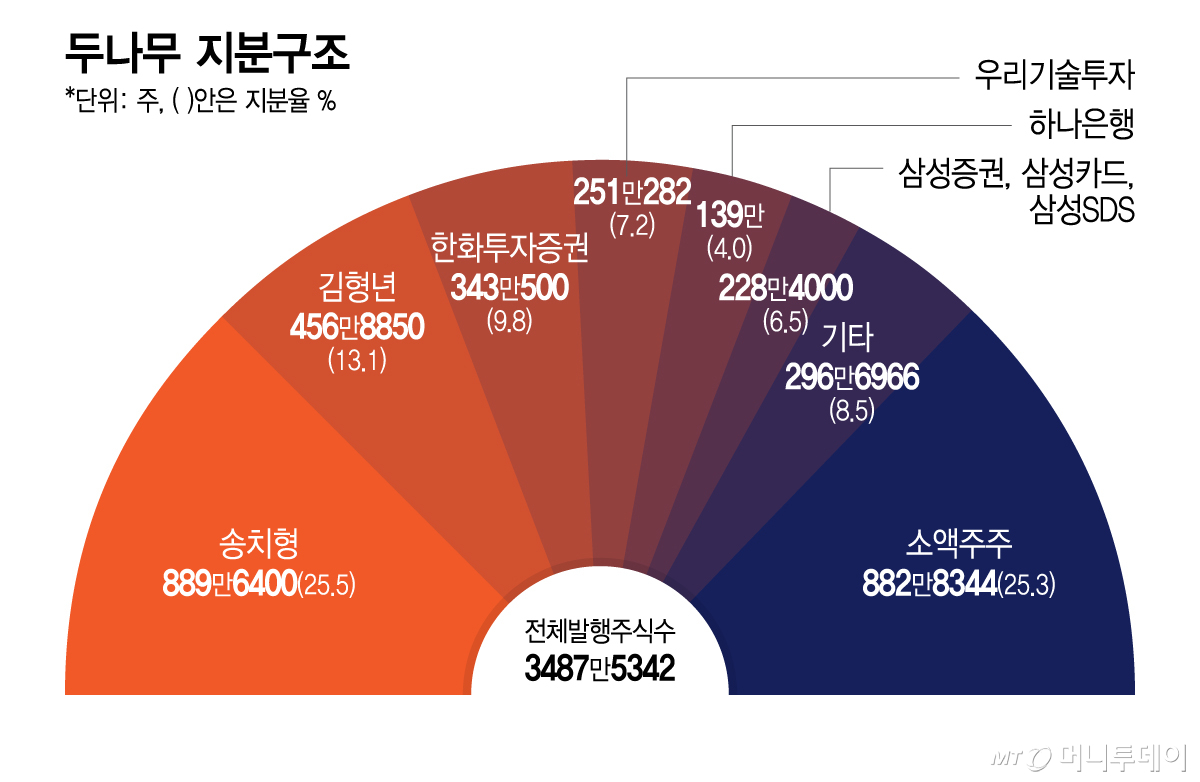
However, if the government's bill is applied, restrictions will arise on Naver Financial holding 100% of Dunamu's shares long-term, even if it secures full ownership through a share exchange. Even if it initially holds 100%, it would eventually be required to hold only up to the cap and transfer the remaining shares to other corporations. If Naver Financial does not relinquish its stake in Dunamu, the most likely realistic alternative mentioned in the market is that Naver Financial obtains an exception approval to directly hold up to 34% and secures the remaining shares by forming a consortium with friendly shareholders.
Hana Bank is mentioned as a cooperation candidate in this process. Hana Bank invested 1 trillion 32 billion won to purchase 2,284,000 shares (6.55%) of Dunamu and is currently the fifth-largest shareholder of Dunamu. This is because it already holds shares and, as a financial holding company with sufficient capital strength, has the capacity to provide cash support, resulting in a lower burden for additional purchases.
The implication of lifting the "15% rule" restriction also serves to broaden Hana Bank's room for maneuver. Under the Banking Act, banks can only hold up to 15% of non-financial companies' shares, but the Financial Services Commission has decided as a policy to review lifting the 15th% rule in the future. A financial authority official stated, "Under current law, the virtual asset industry is not classified as a finance-related sector, so both stablecoin issuance consortiums and trading platforms are restricted from investing more than 15%," adding, "To lift this restriction, discussion is needed in each sector-specific law."
Given that Hana Financial has actively continued business cooperation in the digital asset field, its proactiveness in business is also highly evaluated. Hana Bank completed a Proof of Concept (PoC) for overseas remittances using Kiwachaen, developed by Dunamu, and recently applied for regulatory sandbox review. It has also expanded collaboration with Hana Card to verify stablecoin card payments and merchant settlement.
Meanwhile, it is pointed out that whether banks will participate as friendly shareholders depends on business practicality. Adjustment of management rights and voting rights is cited as the key issue. A financial industry official said, "From the bank's perspective, it could lead to cannibalization (erosion of its own market), so it is questionable how cooperative they will be with the digital asset industry," adding, "Sufficient carrots are needed to maintain clear management control while simultaneously recruiting banks as white knights."
A Hana Bank official said, "There is nothing we can decide at this point," adding, "A three-year grace period has been given, and it depends on how Naver Financial structures Dunamu's governance."

 in FINANCE

