

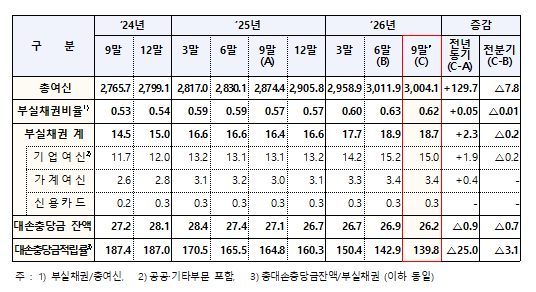
While the non-performing loan ratio of domestic banks in the third quarter of this year rose compared to the same period last year, the allowance for credit losses coverage ratio, which serves as a buffer against future defaults, fell sharply over the past year. The financial authorities plan to guide the banking sector to strengthen its loss-absorbing capacity during the year-end settlement and the formulation of next year's business plans.
According to the Financial Supervisory Service on the 26th, the non-performing loan ratio of domestic banks as of the end of September this year was 0.62%, down by 0.01 percentage points (p) from the end of the previous quarter (0.63%). It rose by 0.05%p compared to the same period last year (0.57%).
The scale of non-performing loans (NPLs) was 18.7 trillion won, a decrease of 200 billion won from the end of the previous quarter. Corporate loans accounted for the largest share at 15 trillion won, followed by household loans (3.4 trillion won) and credit card receivables (300 billion won).
The allowance for credit losses coverage ratio, which indicates banks' loss-absorbing capacity, continued its downward trend. The coverage ratio as of the end of September was 139.8%, down by 3.1%p from the end of the previous quarter (142.9%) and by 25.0%p from the same period last year (164.8%). It fell by 47.6%p compared to two years ago, when it recorded 187.4%. The balance of allowances for credit losses was 26.2 trillion won, a decrease of 700 billion won from the end of the previous quarter.
Newly generated non-performing loans (NPLs) in the third quarter amounted to 5.3 trillion won, down by 1.9 trillion won from the previous quarter (7.2 trillion won). New corporate loan defaults totaled 3.7 trillion won, a decrease of 2 trillion won from the previous quarter. New defaults for large corporations and SMEs (small and medium-sized enterprises) decreased by 900 billion won and 1 trillion won, respectively. New household loan defaults were 1.4 trillion won, at a level similar to the previous quarter.
The scale of non-performing loan resolution in the third quarter was 5.4 trillion won, down by 700 billion won from the previous quarter. This included write-offs (1.9 trillion won), sales (1.3 trillion won), loan recovery through collateral disposal (900 billion won), and loan normalization (800 billion won).
By sector, the non-performing loan ratio for corporate loans was 0.77%, similar to the end of the previous quarter. The ratio for large corporate loans fell by 0.03%p to 0.50%, while the ratio for SME (small and medium-sized enterprise) loans rose by 0.01%p to 0.93%. In particular, the non-performing loan ratio for individual business owner loans rose by 0.05%p from the end of the previous quarter and by 0.11%p from the same period last year, reaching 0.72%.
The non-performing loan ratio for household loans was 0.33%, at a level similar to the end of the previous quarter. Mortgage loans maintained a rate of 0.22%, but credit loans and others rose by 0.03%p to 0.70%.
The deterioration in the soundness of regional banks was also prominent. The non-performing loan ratio for regional banks was 1.15%, up by 0.02%p from the end of the previous quarter and by 0.23%p from the same period last year. The allowance for credit losses coverage ratio fell by 31.7%p from the same period last year to 84.1%. All five regional banks, including Busan Bank, Gwangju Bank, Jeju Bank, Jeonbuk Bank, and Gyeongnam Bank, had an allowance for credit losses coverage ratio below 100%. Among commercial banks, Hana Bank's allowance for credit losses coverage ratio dropped by 29.5%p from the same period last year to 106.5%.
The Financial Supervisory Service assessed that "given economic conditions such as the persistence of high interest rates and the trend of rising market interest rates, it is necessary to proactively prepare for the possibility of further expansion of credit risk."
The Financial Supervisory Service plans to guide the banking sector to fully consider the possibility of expanding credit risk when conducting year-end settlements and formulating next year's business plans, thereby strengthening loss-absorbing capacity such as capital and allowances for credit losses. It intends to encourage active debt restructuring to support the improvement of repayment capacity for vulnerable borrowers and to actively resolve non-performing loans (NPLs) that are difficult to recover.

 in FINANCE
