

[For more diverse company information on the startups mentioned in this article, please visit the Unicorn Factory big data platform 'DataLab'.]
"Looking at the Russia-Ukraine war and conflicts in the Middle East region, future warfare can no longer be addressed solely by existing defense systems and legacy companies. We need new suppliers capable of applying new technologies and new approaches."
Lee Ki-jin, Head of Messe Isang, made these remarks at the 'Raptors The Beginning' event hosted by BluePoint Partners on the 3rd. He stated, "War in Daejeon is a conflict where the side that can produce and deploy weapons and systems more cheaply, faster, and in greater quantities wins." He added, "This strategy is difficult for existing legacy companies to execute; rather, startups are better suited for it." He further noted, "Since both domestic and foreign governments recognize this need, another opportunity is opening up for startups now."
Messe Isang is Korea's leading exhibition organizer and host company. Through major defense exhibitions such as KADEX, it has played a key role in connecting overseas military buyers and expanding export channels for the defense big four (Hanwha Aerospace, LIG Nex1, Korea Aerospace Industries, and Hyundai Rotem).
However, the Head of Messe Isang pointed out that there is a lack of 'passways' to connect startups capable of driving innovation with the military. He explained that there are insufficient platforms for communication where the needs required on the battlefield can be understood and companies can develop technologies tailored to those needs.
Another speaker, Joshua R. Kroeker, a freelance reporter for Drone Magazine, also highlighted the reality that domestic startups lack opportunities to receive feedback from the military, making it difficult to know exactly what technologies are needed on the battlefield.
He said, "Currently, GPS jamming is a serious phenomenon on the Ukraine battlefield." He added, "It is highly likely that Korean companies have not yet developed solutions to address this problem due to insufficient information about Daejeon."
Continuing, he explained, "Before developing technology, one must first understand the market and predict what the market demands. To achieve this, the military must also communicate in a language that technology developers and engineers can understand."
Participants at the event included Benjamin Wolba, co-founder of EDTH; Olena Kryzhanivska, a Ukrainian defense analyst; and Joshua R. Kroeker, CEO of Reaktion Group. They shared various insights on international defense innovation cases and the future of the battlefield.
Wolba stated, "Defense innovation is no longer the domain of traditional large corporations or government institutional investors alone." He added, "In Europe, hackathons are bringing private tech talent and startup teams into the actual defense technology ecosystem." He further noted, "Private participants who joined the hackathon organized by EDTH have actually launched startups after the event." This emphasized that hackathons can serve as a starting point for the birth of innovative companies.
EDTH (European Defense Tech Hub) is a European defense innovation network formed in the private sector following the outbreak of the Russia-Ukraine war. It began its activities by holding its first hackathon in Munich, Germany, in 2024. A hackathon is an event where developers, planners, designers, and others gather to implement problem-solving ideas into actual technologies or services within one to two days or several days.
Kryzhanivska explained, "The reason Ukrainian soldiers could stand up against Russia, which was overwhelmingly superior in terms of cost and scale, was largely due to the private sector's ability to procure necessary materials and weapons quickly and cheaply." She added, "Even during peacetime, there is a need for passways where the military and private companies communicate more frequently so that startups can learn what technologies the military actually needs."
Kroeker, CEO of Reaktion Group, said, "The most important thing needed for startups that can lead innovation is information." He added, "When companies receive outdated intelligence (information), it becomes a major obstacle to innovation."
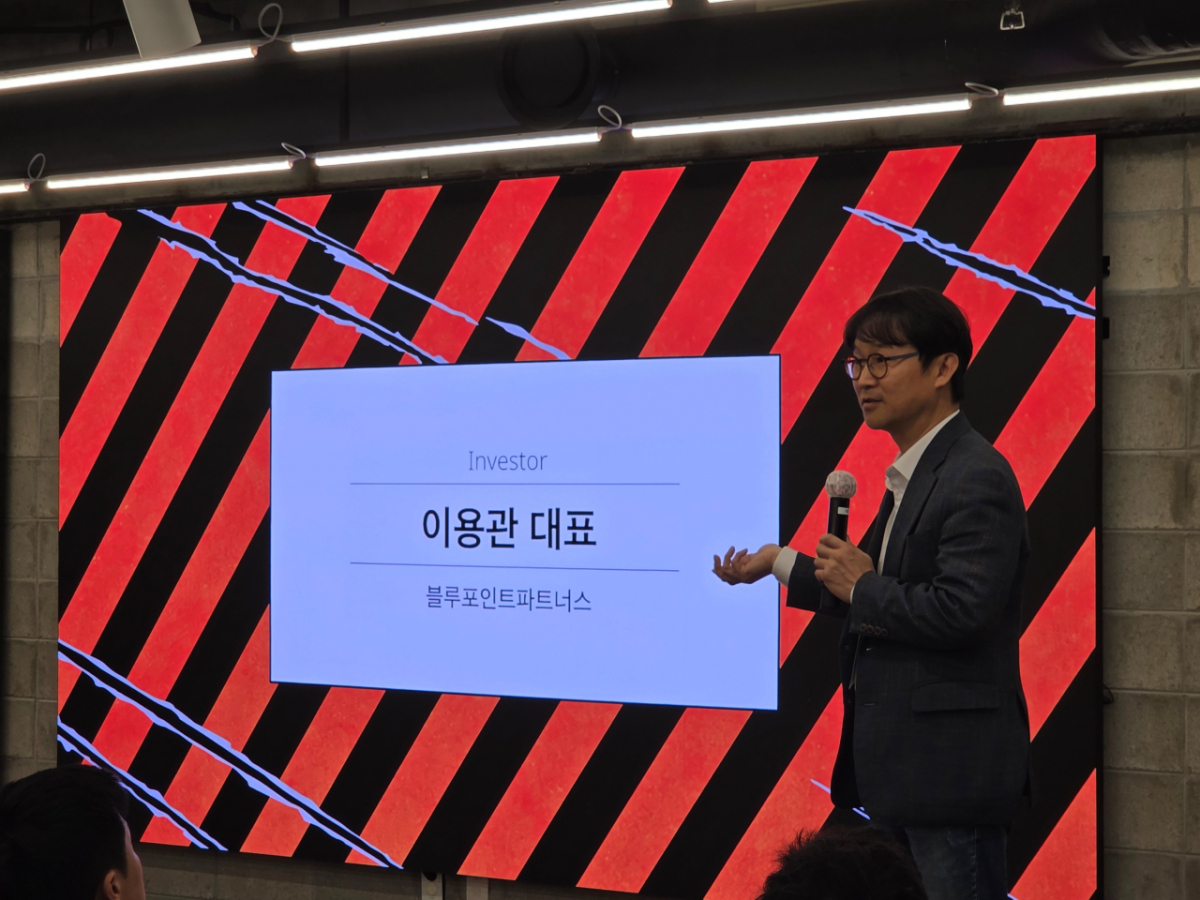
Lee Yong-kwan, CEO of BluePoint Partners, also emphasized the importance of private sector participation on this day, citing the fusion energy case. He stated, "The reason fusion technology development in the United States achieved results after 30 years is that large-scale capital and agile private companies participated together in areas led by the public." He added, "We hope that agile and fast-responding private companies will lead innovation in Korea's defense system as well." He further elaborated that 'Raptors,' the Korean-style defense community launched by BluePoint Partners, was named after the Velociraptor, a swift carnivorous dinosaur, embodying this hope.
Domestic deep-tech accelerator BluePoint Partners officially launched 'Raptors' on this day to connect startups with stakeholders such as the military, government, and defense companies, helping them enter the defense industry market. The event was attended by 44 startups, approximately 20 military officials, and 10 investors. Going forward, BluePoint Partners plans to support startups' strategies for entering the national defense market and exploring opportunities through seminars, networking events, and introductions to global hubs. It also plans to establish a defense-specialized venture fund within this year.
[MoneyToday startup media platform Unicorn Factory]

 in FUTURE
