

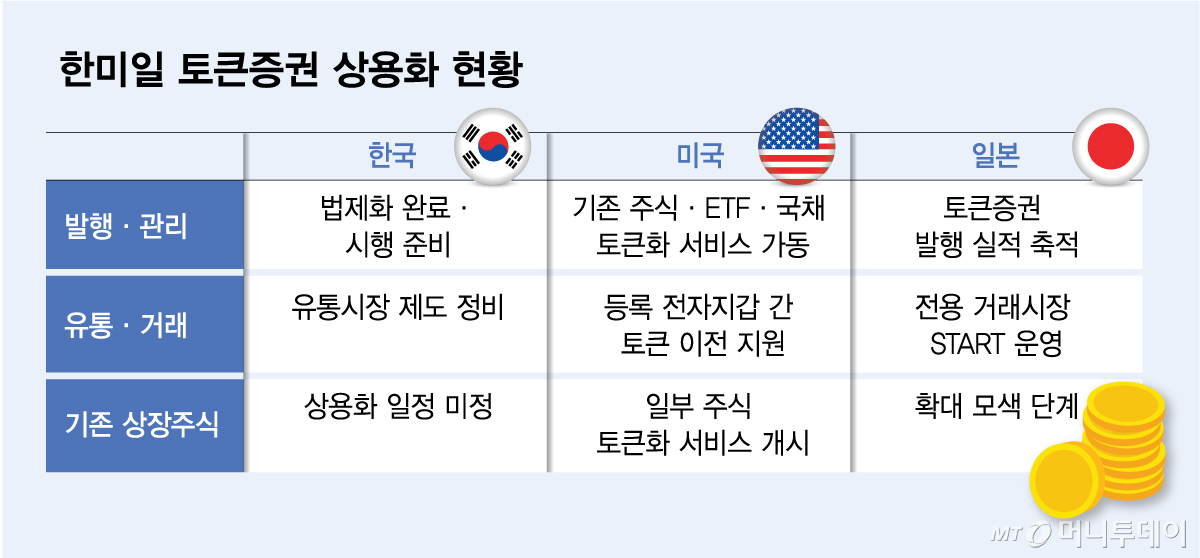
Although the government has prepared a draft bill for the Digital Asset Act that includes the introduction of won-denominated stablecoins, the commercialization level of Korea's digital capital market still lags significantly behind that of the United States and Japan. The U.S. has begun tokenization services for existing stocks and government bonds, while Japan is expanding its tokenized securities issuance and distribution markets and even considering the tokenization of government bonds. In contrast, Korea remains at the stage of building the systems and infrastructure necessary for the issuance and distribution of tokenized securities.
With the implementation of the tokenized securities system scheduled for February next year, a legislative proposal for the introduction of stablecoins has also been presented. However, schedules for the tokenization of existing listed stocks and blockchain-based securities settlement have not yet been determined. Experts point out that to close the gap with the U.S. and Japan, specific commercialization strategies are needed that go beyond establishing regulations and lead to the actual issuance and trading of financial products.
Japan Issues Over 3 Trillion Won in Tokenized Securities… U.S. Expands Tokenization to Existing Listed Securities
According to the Financial Services Commission on the 25th, the draft "Act on Innovation in the Digital Asset Industry and Protection of Users" includes provisions for introducing won-denominated stablecoins and institutionalizing digital asset trading, brokerage, custody, and management businesses. While the institutional foundation for the development of the digital financial industry has progressed, there remains a significant gap with the U.S. and Japan regarding the commercialization of securities tokenization and blockchain-based trading and settlement services.
Japan, which was previously considered slow in its digital transformation, is ahead of Korea in the tokenized securities market. Since implementing regulations related to tokenized securities in 2020, it has grown its issuance and distribution markets, focusing on real estate and other assets. Tokenized securities are securities where rights to securities are recorded and managed on a blockchain-based distributed ledger. While Korea also issues and trades fractional investment securities for real estate, these are still operated under the existing electronic securities system.
According to Japanese fintech company Boostree (BOOSTRY), as of the end of September last month, there have been 92 public offerings of tokenized securities, with a total issuance amount of 404.9 billion yen (approximately 3.4 trillion won). The market capitalization of listed stocks on "START," the tokenized securities trading market of the Osaka Digital Exchange (ODX), reached 140.5 billion yen (approximately 1.2 trillion won) as of the 1st of last month. Japan's Ministry of Finance also launched a research group in the same month to discuss blockchain-based trading and settlement of government bonds.
The United States is expanding its tokenization targets to include existing listed securities. The Depository Trust & Clearing Corporation (DTCC), a U.S. securities depository and clearing agency, launched a service on the 28th of last month to convert rights in existing securities into blockchain-based tokens. The targets include some constituents of the Russell 1000 Index, major index-tracking exchange-traded funds (ETFs), and U.S. government bonds. Financial institutions can create digital tokens representing rights to stocks or bonds they hold and transfer them between registered digital wallets.
On the 12th, DTCC also announced plans to integrate with the Solana blockchain network. Starting in the second half of next year, it plans to tokenize eligible stocks, ETFs, and government bonds on Solana as well. The New York Stock Exchange (NYSE) is also promoting a platform that supports 24-hour trading and immediate settlement for tokenized stocks.
Schedule for Tokenization of Korean Listed Stocks Undetermined… Brokerages Seek Opportunities in the U.S.
Korea completed the public comment period for amendments to subordinate regulations related to tokenized securities on the 11th last month. The relevant system will take effect from February 4 next year. Initially, tokenization efforts will focus on institutional investors-only private money market funds (MMFs), corporate bonds, unlisted stocks, and fractional investment securities. Although the government has prepared a plan for the institutionalization of stablecoins, subsequent regulatory adjustments and infrastructure construction are needed to use them as a payment method for securities trading. The commercialization schedule for tokenizing existing listed stocks and blockchain-based securities settlement remains undetermined.
The establishment of a new distribution market for securities is also delayed. Korea Exchange postponed the opening of its new securities market, which was originally scheduled for the 16th last month. This new securities market will trade investment contract securities and other instruments under the existing electronic securities system, distinct from the blockchain-based tokenized securities market.
In this year's digital asset regulatory environment assessment conducted by the Asia Securities Industry and Financial Markets Association (ASIFMA) and KPMG prior to the government's announcement of the Digital Asset Act, Japan ranked third (7.05 points) among 13 Asia-Pacific markets, while Korea ranked fourth (6.44 points).
Domestic brokerages are seeking business opportunities in the United States, where tokenization services were introduced first. Mirae Asset Securities' U.S. subsidiary was included among the initial 20 financial institutions that signed contracts to use DTCC's tokenization service. Kakao Pay Securities is promoting a business to tokenize Korean stocks for overseas distribution in partnership with U.S. brokerage Sibert Financial, while also researching related plans with U.S. tokenization specialists Dinari and OnDo Finance. Meritz Securities is also considering introducing tokenization and digital asset custody infrastructure in collaboration with U.S.-based Ripple.
Experts point out that for the establishment of digital asset-related systems to lead to enhanced competitiveness in the actual capital market, a commercialization strategy covering the entire process of financial product issuance, distribution, and settlement is necessary. An official from the financial investment industry stated, "We need a specific roadmap that goes beyond building the foundation for issuing and distributing tokenized securities to expanding into the tokenization of existing stocks and bonds," adding, "It is also important to connect issuance, distribution, and settlement infrastructure so that they can be utilized in actual financial markets."

 in STOCK
