

[For more diverse company information on the startups mentioned in this article, please visit the Unicorn Factory Big Data Platform 'Data Lab'.]

"Cosmobi is a company developing technology that enables free movement in space. It is an essential technology for launching new businesses in space, such as On-Orbit Services (OOS). If the era comes when humans reside on Mars in the future, I want to engage in logistics delivery from Earth to Mars."
Park Dong-ha, CEO of Cosmobi, recently made these remarks while meeting with MoneyToday's startup media platform, Unicorn Factory. The company's vision and ambition are also reflected in its corporate name, which means "Space Bee."
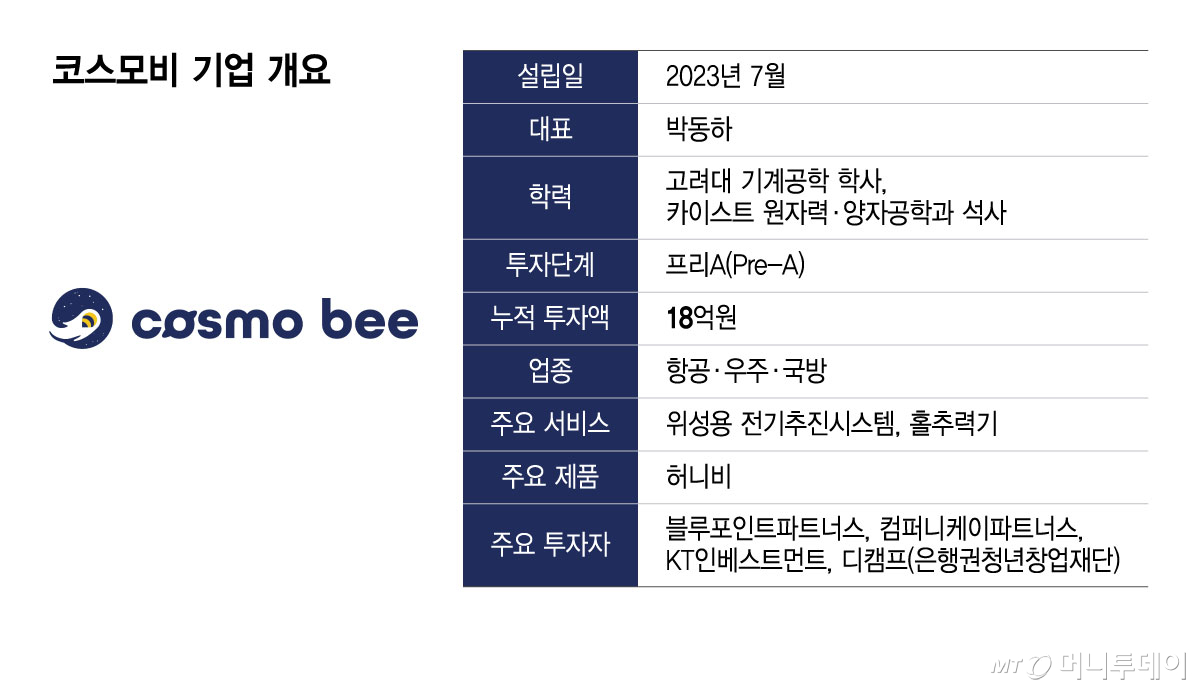
Established in 2023, the space startup Cosmobi succeeded in developing Korea's first Hall thruster (electric propulsion) for ultra-small satellites. This is a propulsion system that adjusts satellite movement, including orbit maintenance and correction.
While rockets can lift satellites from Earth into space orbits by burning fuel, separate propulsion technology suitable for the space environment is required for satellites to move to other orbits or head toward the Moon or planets in the oxygen-free space after launch. The Hall thruster is essential at this stage.
Unlike conventional chemical-fuel engines, a Hall thruster ionizes gaseous fuel (gas) and accelerates it using an electric field to create movement. Thanks to its high thrust, it has been adopted for low-orbit satellite constellations and is the most widely used technology.
Using a Hall thruster allows satellites to carry less fuel, offering the advantage of making them smaller and lighter. SpaceX, which operates Starlink satellites, also uses Hall thrusters but specializes in medium-to-large satellites.
Park (CEO) stated regarding their company's technology, "It is one of the technologies that Korea must secure to build a business model (BM) in the space industry during the New Space era."
Core Technology for Space Business: Hall Thrusters Essential for National Security

Park (CEO), who grew up playing StarCraft since middle school and watching the movie Interstellar, naturally harbored dreams of space from an early age. As he pursued a bachelor's degree in mechanical engineering at Korea University, his vision for space became even clearer.
While working as a research assistant at the Korea Aerospace Research Institute (KARI), he observed the Danuri satellite and felt drawn to technology that enables rapid movement in space. He then entered the electric propulsion research laboratory of Choi Won-ho (Prof.) from KAIST's Department of Nuclear Engineering & Quantum Engineering, the only person in Korea developing this technology, to pursue a master's degree.
Park (CEO) explained the background of his entrepreneurship: "While attending graduate school, I became convinced that technology for movement within space would become more important than simply transporting satellites into space using rockets. This electric propulsion technology is needed not only for on-orbit services but also for space exploration. I believed that developing and commercializing such technology could greatly contribute to the advancement of Korea's space industry."
Cosmobi's Hall thrusters are gaining attention as private satellite services in Korea begin to fully bloom. In particular, Hall thrusters are essential for "low-orbit satellite constellations." Low orbit refers to altitudes between 160 and 2,000 kilometers above the ground. To improve observation accuracy, dozens of satellites are often launched into a single orbit.
Park (CEO) stated, "To maintain proper spacing between multiple satellites within the same orbit, speed must be regulated appropriately while using fuel efficiently." He added, "This is why Hall thrusters that minimize payload by using fuel efficiently are necessary."
Furthermore, with geopolitical tensions rising globally due to recent conflicts such as the war between the U.S. and Iran, space has emerged as a field of national security. Consequently, demand for low-orbit communication and reconnaissance satellite constellations for security purposes is higher than ever before. Park (CEO) said, "Hall thrusters will be essential in future defense and security sectors and can also be expanded as export items overseas."
From Future Mars Logistics… The Path Opened by Hall Thrusters
Currently, Cosmobi's technology is yielding rapid results. In November last year, Cosmobi's Hall thruster was applied to the K-Hero CubeSat mounted on the fourth launch of Korea's Nuri rocket (KSLV-II). The "hollow cathode" module, one of the core components that operate Cosmobi's Hall thruster, is scheduled to be mounted on the fifth Nuri rocket launch in August this year. By participating in major government-led projects and conducting PoC (proof of concept) for the overall Hall thruster system, Cosmobi is rapidly accumulating space heritage.
Currently, most satellites in Korea use foreign-made Hall thrusters. Cosmobi aims to gradually accumulate space heritage and pave the way for domestic localization. He stated, "We will prove our technology through future Nuri rocket launches, including the fifth and sixth missions, and continue to build space heritage. Ultimately, we aim to succeed in commercialization and contribute to the localization of Korea's space industry."
The ultimate goal is Mars. He said, "In the medium-to-long term, if humans come to reside on Mars, a system for sending logistics from Earth to Mars will be established. I hope Cosmobi, a Korean company, becomes one of the central pillars of that era."
[MoneyToday startup media platform Unicorn Factory]

 in FUTURE


