

[For more diverse corporate information on startups mentioned in this article, please visit the Unicorn Factory big data platform 'Data Lab'.]
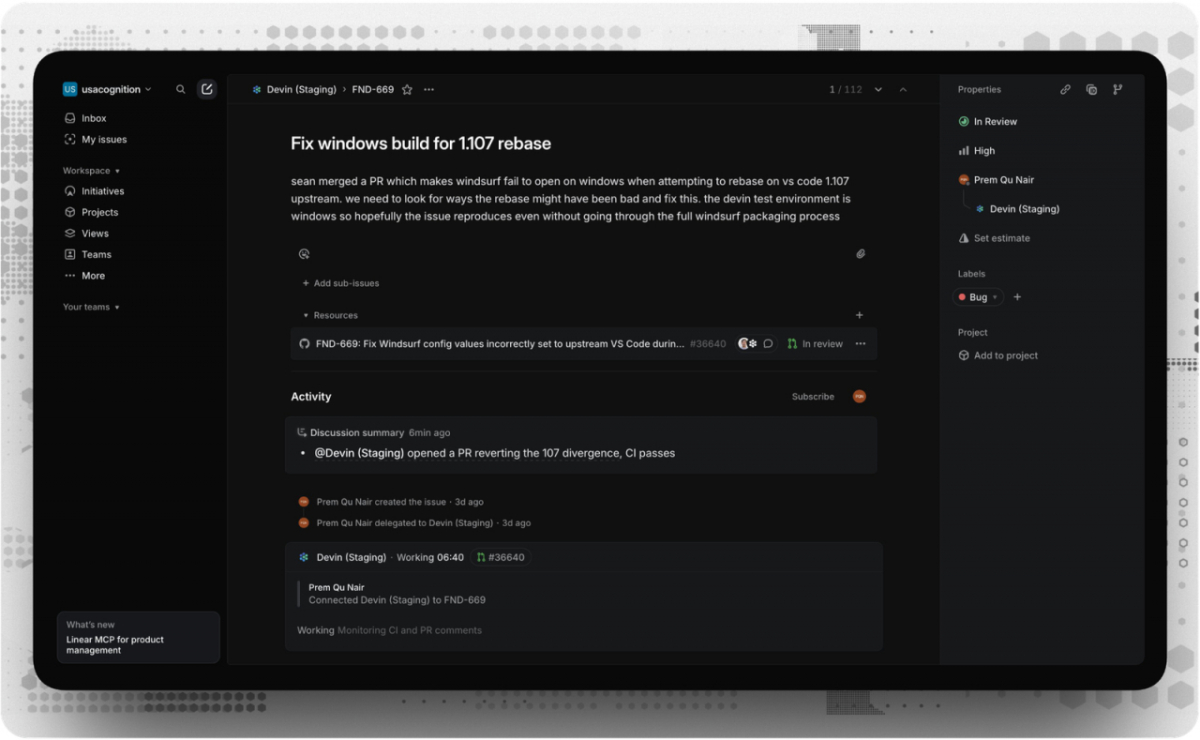
While major players like OpenAI and Anthropic lead the AI (artificial intelligence) coding market, large-scale funding is also flowing into related startups. Although the prevailing view was that AI coding would be reorganized around large foundation model companies similar to LLMs (large language models), recent VCs are increasingly recognizing the independent growth potential of specialized AI coding startups.
According to Bloomberg and other foreign media on the 29th, Cognition AI, which introduced AI developer 'Devin', recently raised $1 billion in new funding, securing a corporate valuation of $26 billion (approximately 39 trillion won). This represents more than double the valuation from its investment round last September. To date, Cognition AI has attracted cumulative investments exceeding $2.5 billion (approximately 380 billion won).
This investment round was jointly led by Lux Capital, General Catalyst, and 8VC. Other participants included River Capital and Artadeus Management.
Surging 50% monthly… Devin carves out a niche between Claude Code and Codex
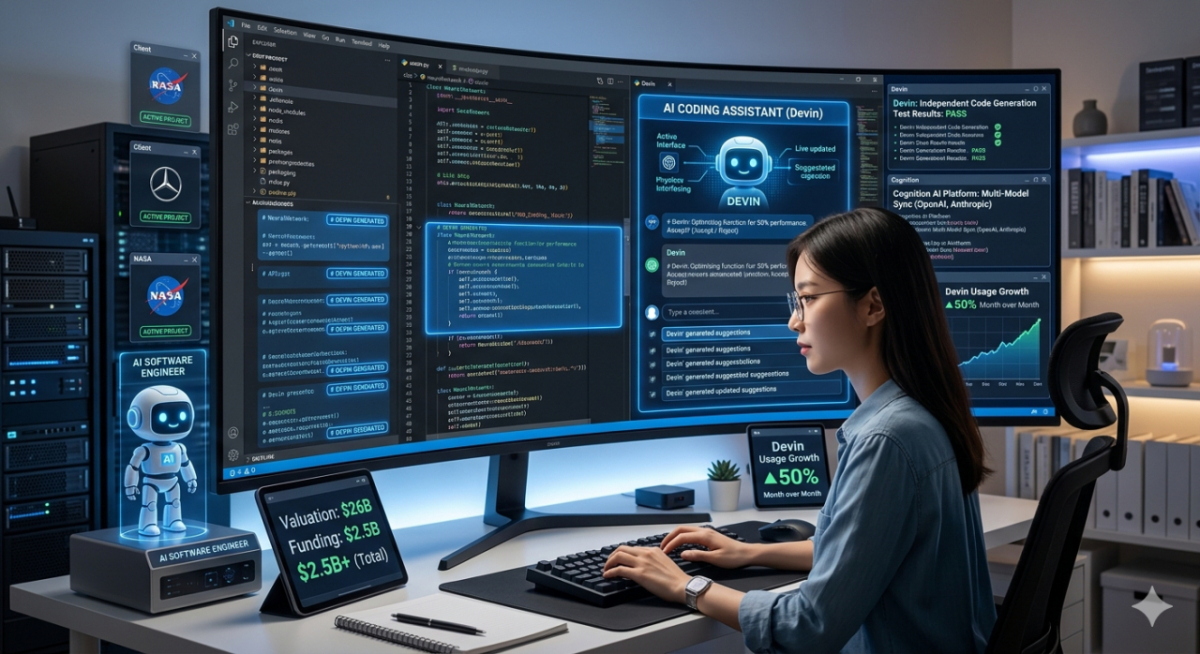
Founded in 2023, Cognition AI's flagship product is Devin, an AI software engineer. Devin is an AI agent designed to automate the coding process for software developers. It handles all aspects of software development work, from writing code and testing to error correction.
The company's growth trajectory is steep. Cognition AI's annualized revenue surged from $37 million (approximately 56 billion won) in May last year to $492 million (approximately 740 billion won) currently. This surge is attributed to a 50% month-over-month increase in enterprise customer usage of Devin over the past six months. Major current clients include Mercedes-Benz and Goldman Sachs. It is also reported that the U.S. government has secured institutional investors as customers.
Cognition AI aims to break through $1 billion (approximately 150 billion won) in annualized revenue by the end of this year. Currently, it utilizes not only its own models but also those from OpenAI and Anthropic. Scott Wu, co-founder and CEO of Cognition AI, stated, "Combining multiple models is more effective than relying on a single model."
This investment round occurred amidst predictions that the AI coding market would be reorganized around major AI model companies. Major AI model developers such as OpenAI and Anthropic also view AI coding software as a next-generation growth market and are strengthening related services. Notable examples include OpenAI's 'Codex', Anthropic's 'Claude Code', and Google's 'Jules'.
Previously, in February last year, Google secured key personnel and technology licenses from AI coding firm Windsurf through a $2.4 billion (approximately 361 billion won) contract. In the same year, Cognition AI acquired Windsurf's remaining business to expand its operational scope.
Furthermore, interest from investors in the related market has grown even more after SpaceX, led by Elon Musk last month, pushed forward plans to acquire AI coding startup Cursor for up to $60 billion (approximately 900 trillion won).
Cognition AI plans to deploy the funds secured this time toward AI model enhancement, product improvements, and strategic M&A (mergers and acquisitions).
"AI tokens are now traded like futures, just as gold and crude oil"
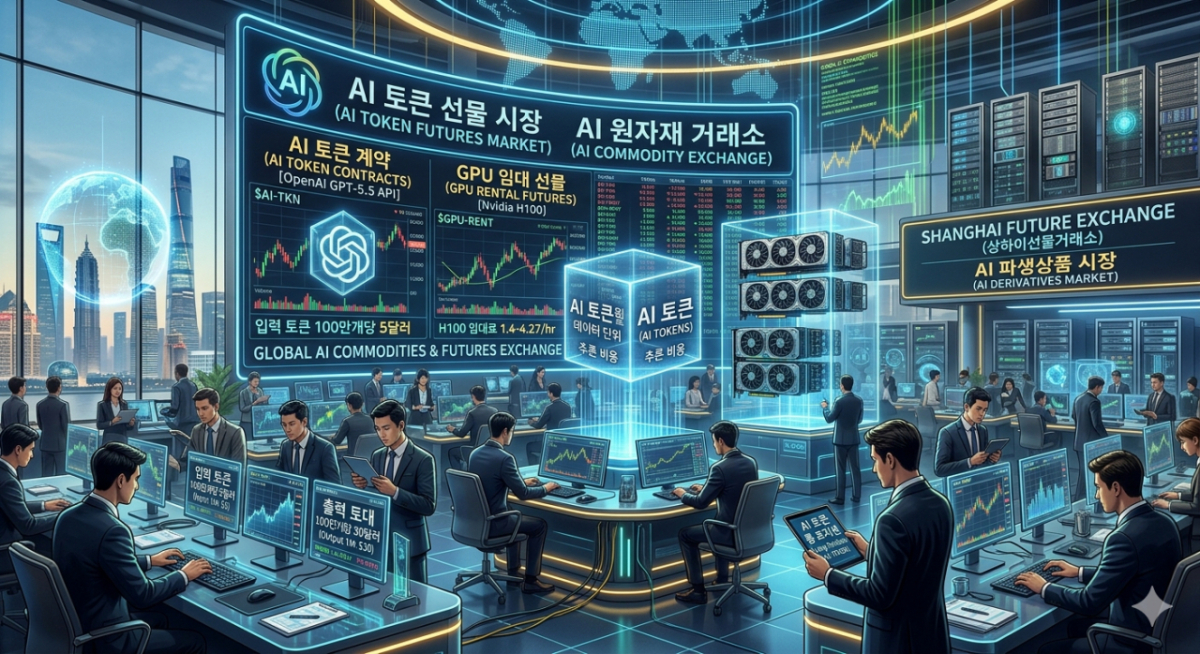
As generative AI models like OpenAI's ChatGPT generate responses, the 'tokens' they consume are emerging as a new raw material for the financial industry.
According to Reuters and TechCrunch, the Shanghai Futures Exchange is recently pushing to establish a derivatives market based on AI tokens as underlying assets. If a token futures and derivatives market becomes a reality, it would become the first case of buying and selling the operational costs of AI services themselves.
This move is noteworthy as global financial markets begin to view AI infrastructure as a new asset class for investment. Previously, the Chicago Mercantile Exchange Group, the largest U.S. derivatives exchange, announced plans to launch a futures market based on GPU (graphics processing unit) rental prices. ICE (Intercontinental Exchange), which operates the New York Stock Exchange, is also considering launching futures products based on the GPU rental market.
Currently, the GPU rental market in the AI industry is growing rapidly. Companies operate AI services by building their own data centers or renting external GPUs. According to AI infrastructure data firm AIMining Company, the hourly rental rate for NVIDIA H100 GPUs ranges from $1.4 to $4.27 depending on the platform. Next-generation H200 GPUs are also trading at $2.34 to $5 per hour.
Conversely, market infrastructure for trading tokens, the core unit of generative AI, remains in its early stages. Tokens are the smallest units of text processing used by AI models when understanding and generating sentences. Major AI companies already price their services on a token basis. For example, OpenAI charges $5 per 1 million input tokens and $30 per 1 million output tokens for using the GPT-5.5 API.
The background for the growing attention on token trading markets lies in the explosively increasing demand for AI infrastructure investment. Currently, cloud companies, private equity firms, and data center operators are investing hundreds of billions of dollars in data center construction to prepare for rising AI demand. With the emergence of dedicated AI cloud companies like 'NeoCloud', competition over AI computing resources is also intensifying.
In this process, companies are increasingly needing to manage risks associated with rising GPU prices and increased inference costs. The token derivatives promoted by the Shanghai Futures Exchange are analyzed as targeting this demand.
U.S. government directly invests in drone startups… Considering equity stakes
The U.S. Donald Trump administration has launched direct funding support for drone startups to expand domestic drone production. Moving beyond simple purchases, the government is considering loans and equity investments, signaling a full-scale effort to nurture the drone industry as a national strategic sector.
According to the WSJ and Reuters, the U.S. Department of Defense has been discussing funding support plans with private drone companies for production expansion over recent months. Negotiations are currently in the early stages, with the Department of Defense reviewing target companies. The Strategic Capital Office (OSC) under the Department of Defense, established during the Joe Biden administration to support key national security supply chain companies, is also participating in these discussions.
Some transactions are being considered that combine loans and equity investments. If finalized, the U.S. government could directly hold stakes in drone startups. This differs from previous Department of Defense investments, which were conducted through conditional loan arrangements.
Companies currently under review for support include Performance Drone Works (PDW), which secured a contract to supply Army reconnaissance drones; Unusual Machines, a drone parts company where Donald Trump Jr. participates as a shareholder and advisor; and Neros Technologies, an FPV (first-person view) drone startup invested in by Sequoia Capital.
The purpose of this support is to boost domestic manufacturing capabilities, expand production volumes, and lower prices. This aligns with the 'Drone Dominance' program being pursued by the U.S. Department of Defense. The Department plans to invest $1.1 billion (approximately 165 billion won) by 2027 to secure a low-cost attack drone force of 300,000 units.
The issue is price. While the Department of Defense aims to reduce the price per drone to around $5,000, many currently sold U.S.-made drones are priced tens of thousands of dollars higher. Production capacity is also insufficient. Based on last year's data, annual U.S. drone production capacity is at most 100,000 units, contrasting sharply with Ukraine, which produced approximately 4 million drones during the same period.
The drone industry has long pointed out that the Department of Defense's passive purchasing policy has hindered production expansion. Companies found it difficult to aggressively invest in production facilities amid uncertain demand.
Meanwhile, if this support materializes, it is expected to become the first major case where the U.S. government directly steps up to nurture drone startups. Until now, the Department of Defense's presence in the U.S. drone market has been minimal. According to the Defense Innovation Unit (DIU), prior to the inauguration of Trump's second administration, the Department of Defense's share of drone purchases accounted for less than 2% of total sales in the entire U.S. commercial and public drone market.
However, the situation is changing rapidly. The Department of Defense recently requested over $54 billion (approximately 810 trillion won) in its budget for the Defense Autonomous Warfare Group (DAWG), a dedicated organization for autonomous weapons. This significantly exceeds this year's budget of $225 million (approximately 34 billion won).
[MoneyToday startup media platform Unicorn Factory]

 in FUTURE


