

"[For more diverse corporate information on the startups mentioned in this article, please visit the Unicorn Factory big data platform 'Data Lab'.]"

"Huawei, which leads China's semiconductor industry, recently caused a stir in the industry by announcing a new semiconductor development theory called 'Tau's Law.' This theory aims to improve computing speed by optimizing data movement instead of increasing semiconductor integration density, meaning it is no longer necessary to rely on cutting-edge lithography equipment to manufacture semiconductors. If this theory holds true, it could break through U.S. export controls on semiconductor equipment, leading to expectations in China that it will become the 'DeepSeek moment' for semiconductors."
"The semiconductor industry refers to Huawei's data movement optimization technology as 'interconnect' technology. In the past, numerous servers within a data center handled their own tasks independently, but with the development of AI (artificial intelligence), workloads have grown exponentially, and thousands of servers now engage in 'team play,' bringing this technology to the forefront. This is because how quickly and stably GPU (graphics processing unit) chips exchange data determines overall performance."
"This is also why optical cables using light signals have become a hot topic in the recent data center industry, replacing copper wires that use electrical signals. However, optical cables have drawbacks such as high cost and high power consumption. Consequently, development of new materials or technologies to improve the efficiency of interconnect methods is underway. In the domestic startup sector, Point2Technology, Pansia, and MangoBoost are challenging this market."
"Eliminating Copper Wire Bottlenecks... K-Communication Semiconductor Backed by NVIDIA"
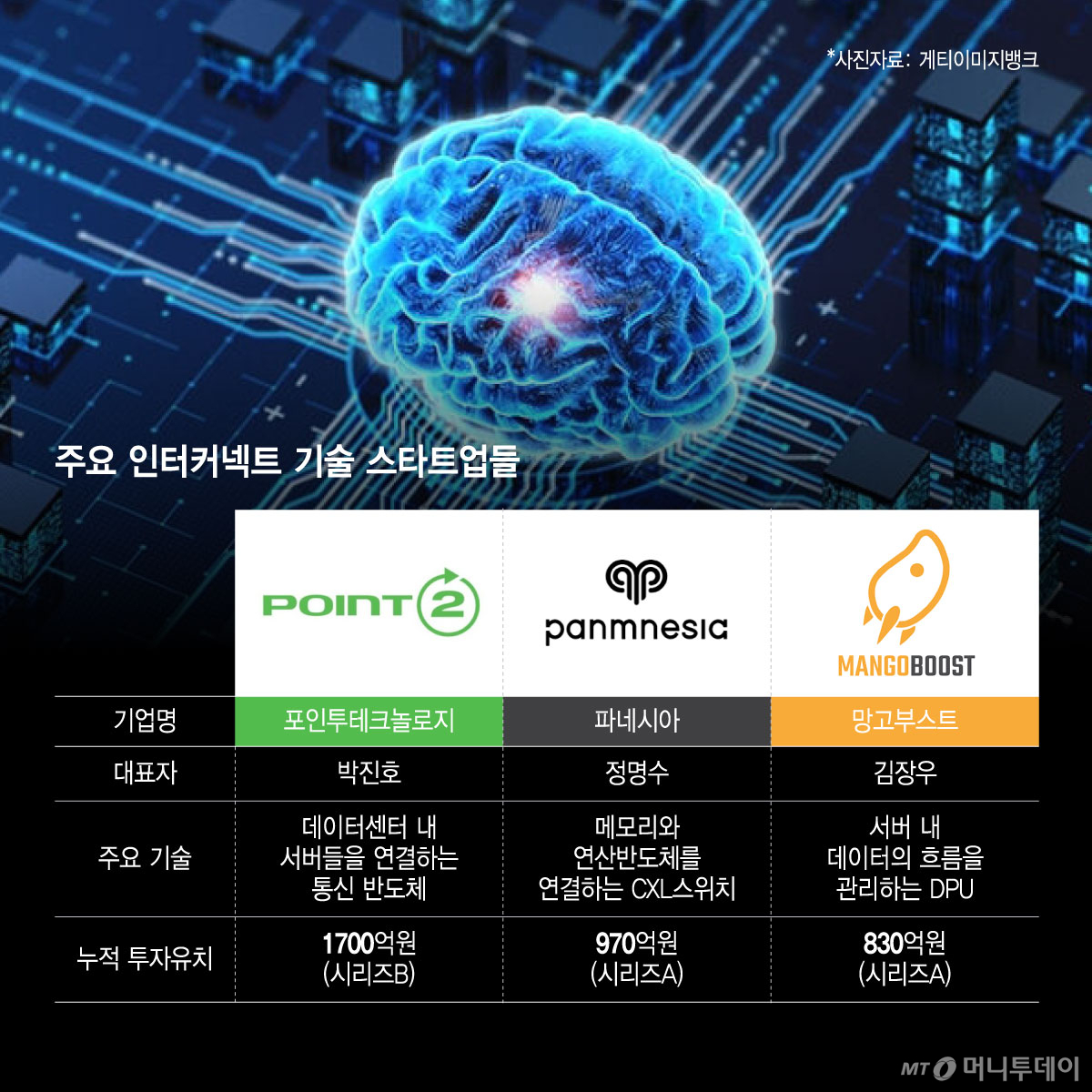
"Point2 is developing a technology to transmit data through special plastic cables. The research team, led by Professor Bae Hyun-min of the Department of Electrical and Electronic Engineering at KAIST (Korea Advanced Institute of Science and Technology), who also serves as the founding director of the KAIST Startup Incubator, established the company in the United States in 2014. Currently, the company is led by Park Jin-ho (CEO), a former head of product development at Marvell Semiconductor."
"Point2 converts data into RF (radio frequency) signals using its own developed semiconductor and transmits it through special plastic cables. Its key feature is the ability to exchange 10 times more data over the same distance compared to existing copper wires. Compared to optical cables, its price and power consumption are only one-third of those. Point2 explains that this will become a realistic alternative before optical cable prices drop."
"The investment industry is also paying attention to Point2's technological capabilities. In April, Point2 secured Series B funding of $76 million (approximately 100 billion won). Notably, NVIDIA's CVC (corporate venture capital), NVentures, participated in the investment, making headlines. Previously, Point2 had also received investment from Molex, the world's No. 1 global communication cable company, in 2024."
"Switches and DPUs that 'Optimize Data Flow'"
"Pansia and MangoBoost are enhancing interconnect efficiency through semiconductors that coordinate data movement. Pansia is developing switch semiconductors related to CXL (Compute Express Link), the next-generation interconnect standard. A switch is a semiconductor that groups multiple GPUs, memory chips, and other components into one unit and allocates them as needed to optimize data flow. This process follows the CXL standard specification, so it is also referred to as a CXL semiconductor."
"Pansia secured 80 billion won in investment during its Series A round in 2024. Founded in 2022 by Professor Jung Myung-soo of the Department of Electrical and Electronic Engineering at KAIST, who has been researching related technologies since 2015, the company is highly regarded for its technological expertise. Pansia is accelerating commercialization by producing sample chips in the second half of this year."
"MangoBoost, founded by Professor Kim Jang-woo of the Department of Electrical and Information Engineering at Seoul National University, is improving interconnect efficiency using DPU (data processing unit) semiconductors. A DPU is a semiconductor that takes over data movement and flow management tasks previously handled by CPUs (central processing units). This concept aims to enhance CPU efficiency. The company has secured cumulative Series A funding of over 80 billion won from AMD and Samsung Electronics."
"Competition for Interconnect Technology Expected Across Various Units and Methods"
"Interconnect innovation is occurring not only at the server level but also at the 'chip' unit. Huawei revolutionized physical interconnect technology in semiconductors through a process called 'logic folding,' which stacks various circuits into multiple layers. Domestic AI semiconductor startup HyperXcel has developed an architecture semiconductor called LPU (Large Language Model Processing Unit) that minimizes data movement during chip computation, thereby improving computational efficiency."
"The industry expects this trend to continue for the foreseeable future. A semiconductor industry executive stated, 'Recently developed GPUs have such fast computing speeds that data communication speeds sometimes fail to keep up,' adding, 'This means high-performance GPUs are simply idling because data arrives too slowly.' The executive further predicted, 'As solving the data bottleneck phenomenon emerges as a key challenge, technologies that optimize interconnects across various units will gain attention.'"
"[MoneyToday Startup Media Platform Unicorn Factory]"

 in FUTURE

