

[For more diverse corporate information on startups mentioned in this article, please visit Unicorn Factory's big data platform 'Data Lab'.]

"Most digital healthcare startups design an app first and then proceed with clinical trials and regulatory approval processes. However, when the product finally reaches the market, patients do not use it well because it is not user-friendly."
Lee Sang-su, CEO of iPIXEL, pointed out this limitation in Korea's digital healthcare market. He explained that although several digital therapeutic devices (DTx) for conditions such as sleep disorders have been launched, there are many cases where prescriptions by medical professionals have not increased as expected. From the supplier's perspective, even if the technology is meaningful, it is difficult to establish a market if patients do not consistently use the product and medical professionals do not prescribe it.
iPIXEL took the opposite approach. It first introduced its products into hospital settings to accumulate actual usage data from medical professionals and patients. Afterward, it proceeds with clinical trials and regulatory approval by the Ministry of Food and Drug Safety.
Lee (CEO) explained, "Even in a situation where health insurance reimbursement rates have not yet been applied, hundreds of prescriptions are being issued monthly at hospital sites." He added, "This is a method that verifies actual market demand, response, and usability first before proceeding with clinical trials and regulatory approval." He further noted, "Once we obtain Ministry of Food and Drug Safety approval in the future, hospitals will be able to prescribe and adopt our solutions more actively."
Introduced in March 2024 as a featured segment on MoneyToday's startup media platform 'Unicorn Factory', iPIXEL operates 'ExerSite Care', an AI rehabilitation exercise platform. When hospitals prescribe individualized exercise programs for patients, patients perform the exercises via TV or smartphones at either the hospital or home. The AI analyzes joint movements and exercise accuracy in real time and provides feedback. Medical professionals can review patient exercise performance data in report form to continuously manage rehabilitation progress. Based on this, they can also prescribe additional exercise intensity and programs tailored to each patient's condition.
Currently, this service has been adopted by major hospitals including Gangnam Severance Hospital, Bundang Seoul National University Hospital, Chung-Ang University Hospital, Bucheon Sejong Hospital, and Jeju National University Hospital. It is also being utilized in welfare centers and local government rehabilitation centers. In particular, at Bucheon Sejong Hospital's physical therapy department, cases of operation based on actual patient prescriptions are accumulating rapidly.
Bucheon Sejong Hospital's physical therapy department recorded cumulative prescriptions exceeding 1,000 cases over approximately six months from July last year to February this year. The hospital also presented these findings at academic conferences based on the data. Lee (CEO) explained that inquiries about adoption from other hospitals have continued since then.
Currently, iPIXEL is also participating in the Ministry of Science and ICT's medical AI project 'Doctor & Answer 3.0'. It is involved in the field of AI agents for managing post-surgical patient rehabilitation exercises and is conducting confirmatory clinical trials based on the innovative medical device track of the Ministry of Food and Drug Safety. The company aims to obtain Ministry of Food and Drug Safety approval by the first quarter of next year.
"Hundreds of prescriptions monthly even without reimbursement rates… AI rehabilitation platform sought out by hospitals first"
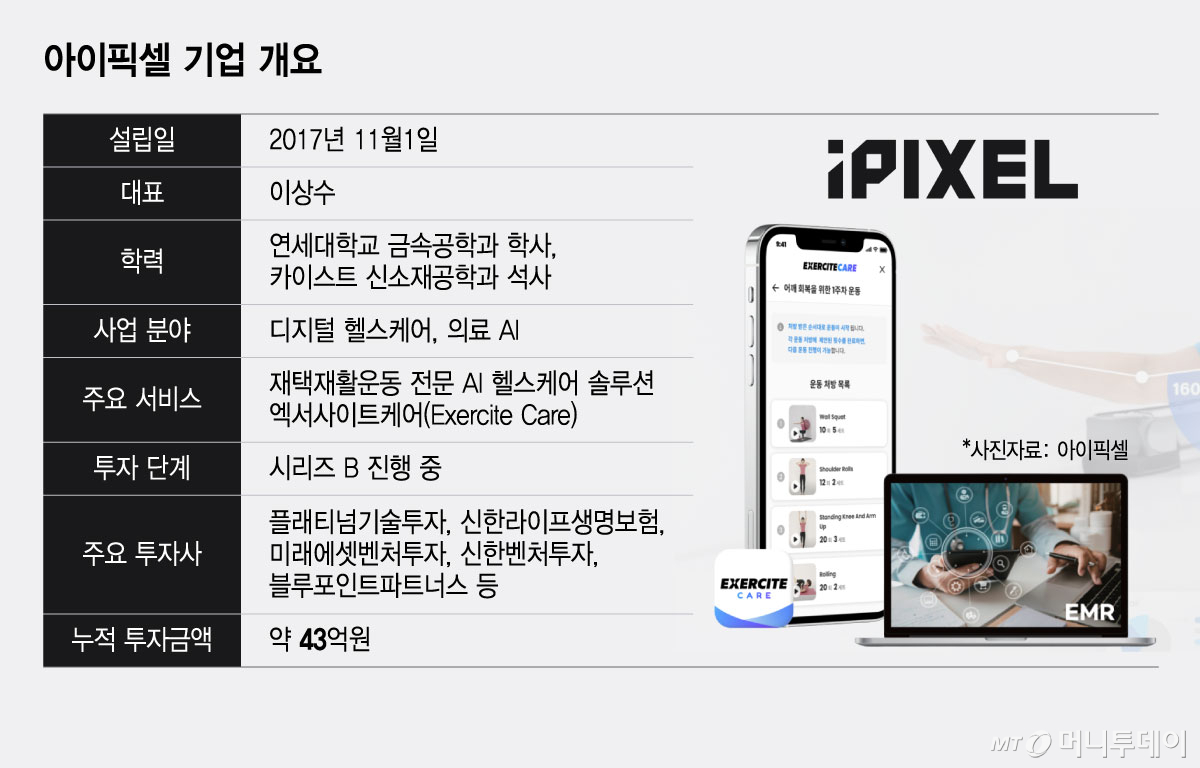
The background to iPIXEL's rapid establishment in the hospital market lies in its precise identification of actual demand from medical professionals and gaps in on-site operations.
In its early days, iPIXEL anticipated growing demand for daily joint and spine health management among general consumers and launched 'How Fit', an AI home training app for general users. How Fit gained rapid growth through word-of-mouth among female users aged 40 and above and won Google Play's "Self-Improvement App of the Year" Choi U (수상) in 2021.
However, unexpected contact came from an unlikely source: hospitals. Hospitals began reaching out to explore using this technology for managing rehabilitation therapy patients.
Lee (CEO) stated, "Rehabilitation patients after surgery must continue exercising consistently at home for several months after discharge, but in reality, many fail to do so continuously." He added, "From the medical professionals' perspective, there was almost no way to verify whether patients were performing exercises correctly at home."
He further explained, "There were also many cases where patients worsened their condition due to incorrect posture or exercise methods and had to return to hospitals. Hospitals had a strong demand for solutions that could continuously manage the rehabilitation process of patients and allow them to verify data."
For patients, having a 'service they can continue using' was crucial. iPIXEL went beyond simply showing exercise videos; it enhanced usability by analyzing users' exercise performance processes in real time and enabling interaction.
For example, ExerSite Care analyzes joint angles and movement ranges in real time when a user performs squats, scores the accuracy of the exercise, and provides feedback on posture execution levels. It 'quantifies' the extent to which patients are performing prescribed exercises accurately so they can verify it themselves.
The foundation enabling this is approximately 2,400 pieces of exercise metadata. The AI has learned and standardized muscles used per exercise, joint movements, and exercise intensity, using these as benchmarks to compare and analyze user movements.
This interaction-centered philosophy is also reflected in the company's name. iPIXEL (iPIXEL) is said to carry the meaning of 'me (i) interacting with content'.
Another differentiating factor is the 'AI lightweighting' technology. While general AI-based exercise analysis services are optimized for high-spec smartphone environments, iPIXEL has implemented the same level of AI analysis functionality even in large-screen smart TV environments.
Lee (CEO) explained, "Rehabilitation exercises ultimately need to be performed on large screens like TVs to ensure usability among elderly patients. However, TVs have lower computational performance (AP) than smartphones, making it difficult to run AI at the same level."
He continued, "The company lightweighted the AI so that real-time exercise analysis and feedback are possible even in low-performance TV environments. This was designed to ensure smooth operation even with semiconductor performance capable of implementing AI functions being relatively low."
iPIXEL believes that this AI quantification and lightweighting technology will serve as a differentiating factor compared to global digital rehabilitation platform companies.
The company is particularly watching U.S. digital rehabilitation platform firm Hinge Health. Listed on the New York Stock Exchange (NYSE), Hinge Health recorded revenue of approximately $600 million (about 900 billion won) and an operating profit margin in the 20th% range last year through its remote rehabilitation exercise management services.
iPIXEL also expects to secure both profitability and growth like Hinge Health. Due to the nature of software-based platform businesses, even as the user base grows, additional fixed cost burdens do not increase significantly.
In particular, the company anticipates that after obtaining Ministry of Food and Drug Safety approval in the first quarter of next year, if linked with the health insurance reimbursement system, there will be a greater possibility of expanding prescriptions within hospitals.
Lee (CEO) stated, "After surpassing the fixed cost threshold, the structure is such that profitability improves as the number of users increases." He added, "Even now, revenue from hospital-oriented services is being generated despite the absence of reimbursement rates, and we aim to achieve break-even point (BEP) by the end of next year on a quarterly basis."
He further remarked, "As aging intensifies, the rehabilitation and exercise management market will inevitably grow larger. Our goal is to become the leading company in AI-based motion analysis and exercise coaching fields."
[MoneyToday startup media platform Unicorn Factory]

 in FUTURE

