

[For more diverse corporate information on startups, visit Unicorn Factory's Big Data Platform 'Data Lab'.]

Amazon founder Jeff Bezos and the UK sovereign AI (artificial intelligence) fund invested $450 million (approximately 660 billion won) in CuspAI, based in Cambridge, UK. This Series B round for CuspAI was led by prestigious Silicon Valley VCs Kleiner Perkins and NEA.
Through this investment, CuspAI, now in its second year of operation, has been valued at $2.6 billion (approximately 3.8 trillion won). This represents a fivefold increase in just ten months compared to the $520 million (approximately 760 billion won) valuation it received after raising $10 thousand won (approximately 150 billion won) last September.
'Inverse design' of candidate materials matching desired properties

CuspAI develops technology that combines generative AI with molecular simulation to identify materials with specific properties. The founding team refers to this as a "search engine for the material world." It employs an 'inverse design' approach, where desired physical properties are defined first, and candidate materials that satisfy them are designed in reverse.
Typically, discovering and commercializing a single new material takes decades and hundreds of millions of dollars. CuspAI aims to compress this process into just a few months. Key targets include battery electrolytes, semiconductor materials, and substances for carbon capture.
Notably, CuspAI is placing significant emphasis on identifying materials that reduce or eliminate the use of rare metals such as iridium and ruthenium in the semiconductor supply chain. This stems from the concern that bottlenecks in the AI industry ultimately originate from physical materials.
The founding team is equally impressive. CEO Chad Edwards previously co-founded Cambridge Quantum Computing, while CTO Max Belling is a world-renowned expert in deep learning who served as Vice President of AI Research at Qualcomm.
This Series B round saw major new investors join, including Lux Capital, AMD Ventures, and Singapore's sovereign fund Temasek. In effect, Silicon Valley VCs, semiconductor companies, sovereign funds, and UK government funding all entered in a single round.
The UK government provides not only financial support but also access to the supercomputer 'Jazba-AI' built at the University of Bristol. Selected startups can use up to 10 thousand won GPU (graphics processing unit) hours free of charge per company.
Computing infrastructure is an asset that specialized AI startups for materials need most urgently and only governments can provide. Analysts suggest this reflects a strategic judgment by the UK government aimed at preventing promising deep-tech companies from leaving for the United States.
Based on this investment, CuspAI plans to open a new office in Singapore and expand its workforce in Cambridge, Amsterdam, Berlin, Tokyo, and the United States.
Meanwhile, CuspAI has also launched an 'AI Materials Foundry' alliance involving over 48 companies and institutional investors, including NVIDIA, Meta, and Hyundai Motor. The alliance's advisory board includes Nobel Prize and Turing Award laureates Geoffrey Hinton and Yann LeCun, former BP CEO John Brown, and former ASML President Martin van den Brink.
"Japan's last chance"... Japan mobilizes national resources for physical AI 'Noetra'
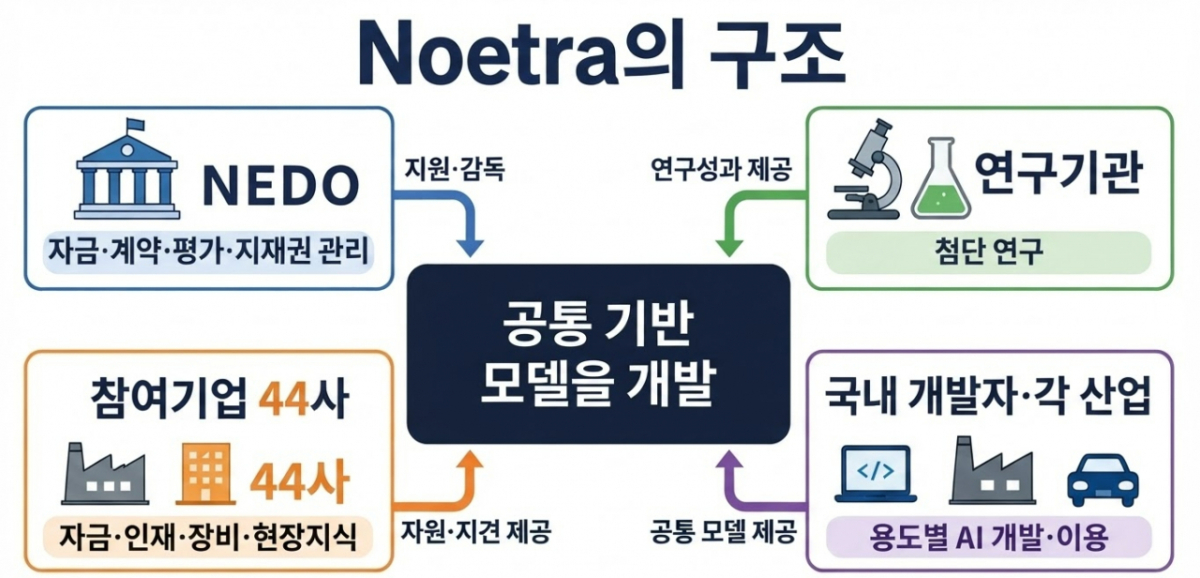
Japan is mobilizing its national capabilities for 'Noetra,' a government-led company developing foundation models for robots and machinery. Sony, SoftBank, NEC, Honda, and others have emerged as key partners, with 44 companies and institutional investors in the manufacturing sector joining as shareholders, including these partners.
The figure leading Noetra is CEO Hiroshi Tambo. Having led LLM (large language model) development at SoftBank, he left to bet on 'moving machines' rather than chatbots. He described this project as "Japan's last chance to survive the upcoming wave of AI."
Japan's Ministry of Economy, Trade and Industry (METI) has entrusted Noetra with a project worth 387.3 billion yen (approximately 3.46 trillion won) this year. Depending on performance, it plans to provide up to 1 trillion yen (approximately 9 trillion won) over five years until 2030. This is considered the largest-scale publicly announced national AI investment.
Noetra's R&D organization is built around engineers seconded from participating companies, along with researchers from the National Institute of Advanced Industrial Science and Technology (AIST) and Preferred Networks, Japan's AI unicorn. It is essentially a 'dream team' that gathers talent and data scattered across Japan's industrial sector.
The technology roadmap consists of three stages. This year, it aims to launch a core reasoning model strong in logical inference and Japanese language understanding. By the 2028 fiscal year, it plans to release an omni-modal model covering text, images, video, and audio. By 2030, it targets 'real-world native AI' capable of understanding space and physical properties.
The computing infrastructure for training this will be a data center with a capacity of 140 MW. It will consist of 27,500 NVIDIA Rubin GPUs and 13,750 Vera CPUs, aiming to begin operations in June 2028 to serve as an AI factory.
An industry insider stated, "Japan's decision to throw its full weight behind Noetra, already a powerhouse in the industrial robot market, is interpreted as a calculation to compete in the physical domain where it holds an advantage, rather than creating general-purpose chatbots on Western software platforms."
This analysis aligns with the recently revised 'AI Robot Strategy.' The Japanese government has set a goal to deploy 10 million AI robots across 18 sectors—including manufacturing, shipbuilding, logistics, construction, healthcare, caregiving, dining, food, and medical services—by 2040.
A 'humanoid unicorn' born in Europe... backed by Bosch and Schaeffler
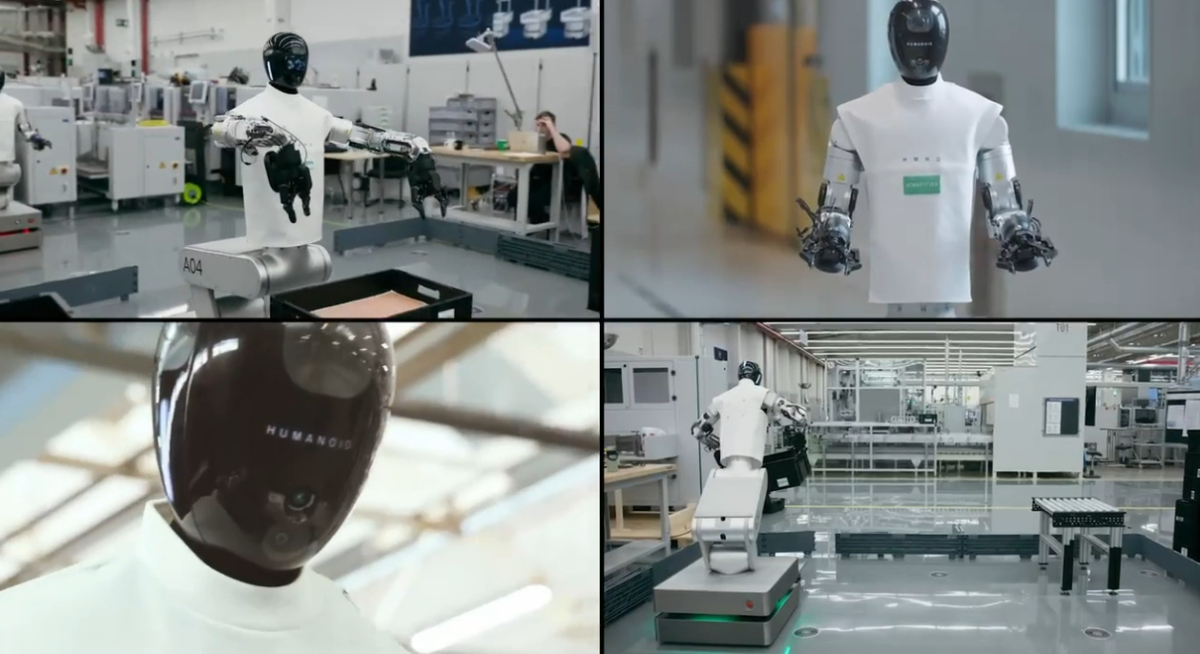
London-based robot startup 'Humanoid' has secured a Series A investment of $152 million (approximately 220 billion won), achieving a corporate valuation of $1.35 billion (approximately 1.98 trillion won) and becoming a unicorn.
This round was led by Prime Mover Labs, which invested in Figure AI, with participation from German giants Bosch and Schaeffler, VC Aglaé Ventures owned by LVMH chairman Bernard Arnault, and Taiwan's Fubon Financial. This is an exceptional growth trajectory for a company only two years old and still before the official launch of its commercial product.
Humanoid's first robot platform, 'HMND 01,' comes in wheeled and bipedal versions. The wheeled version stands 220 cm tall, weighs 300 kg, has 29 degrees of freedom in its joints, reaches a top speed of 2 m/s, and can carry loads up to 15 kg, targeting applications in logistics, manufacturing, and retail.
The bipedal version stands 179 cm tall and weighs 90 kg, aiming for service and home use. Its hand area is designed as a modular unit that can be fitted with either a 12-degree-of-freedom five-fingered hand or a 1-degree-of-freedom parallel gripper.
Humanoid has also developed 'KinetIQ,' the brain (framework) that drives its robots. KinetIQ features a 'cross-embodiment' structure where multiple robots of different types are controlled by a single system, and data learned by one robot is shared across all robots.
From the start, Humanoid has established strategic relationships with Bosch and Schaeffler. Bosch handles contract manufacturing for Humanoid's products, providing hardware design, production capabilities, and supply chain support. With Schaeffler, it has signed a contract to deploy thousands of robots in global factories by 2032.
Notably, this contract is designed around the 'RaaS (Robot as a Service)' model, where robots are provided as a service rather than sold as finished products. The initial deployment will begin at year-end at Schaeffler's factories in Herzogenaurach and Schweinfurt, Germany. Schaeffler also participates as Humanoid's priority supplier for joint actuators.
Humanoid has previously collaborated with Siemens, SAP, NVIDIA, and others, completing a Proof of Concept (PoC) with automotive parts maker Martur Formpack. Currently, it is working with Siemens on a project to deploy Humanoid robots on factory floors using NVIDIA technology.
A Humanoid representative stated, "By partnering with leading global industrial companies, we have built the most robust order pipeline in the industry. Based on this investment, we will accelerate efforts to ensure robots become established not merely as 'groundbreaking technologies' but as everyday tools."
[MoneyToday startup media platform 'Unicorn Factory']

 in FUTURE


