

[For more diverse corporate information on startups mentioned in this article, visit Unicorn Factory's Big Data Platform Data Lab.]
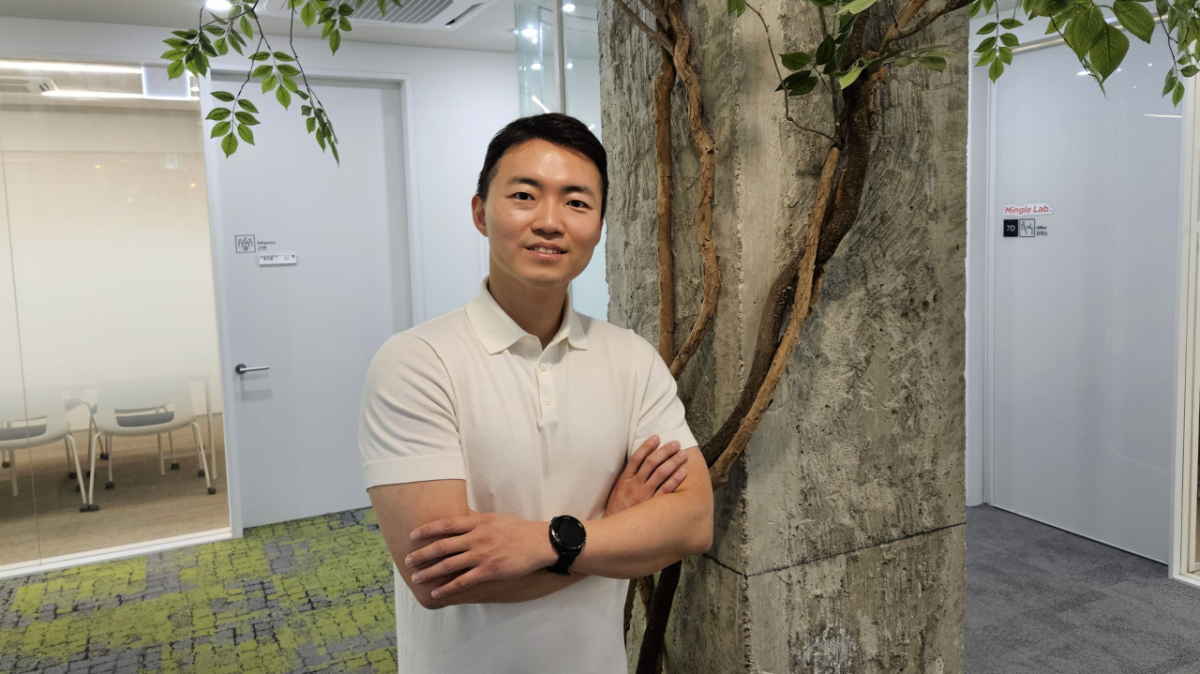
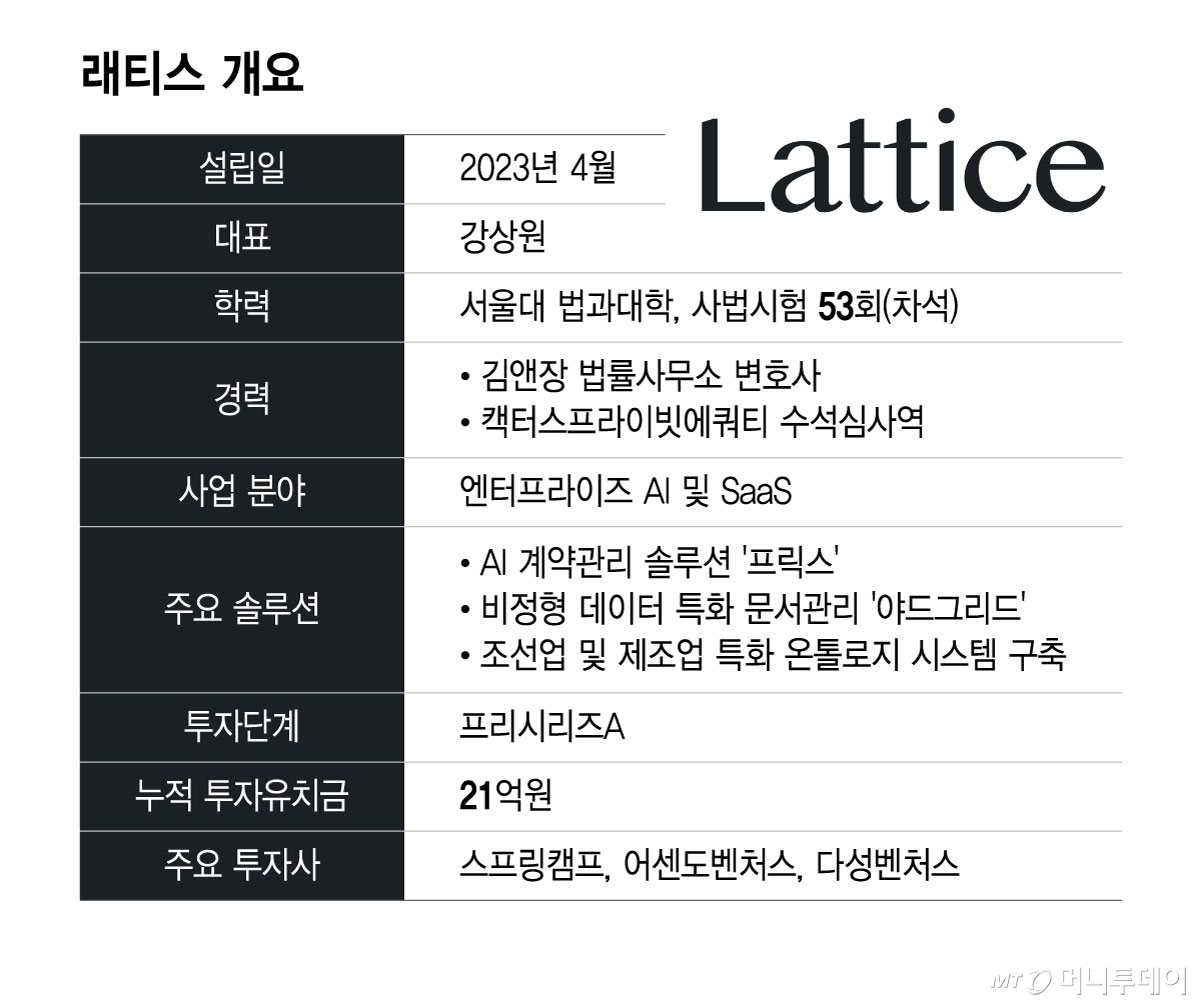
A figure who left Korea's largest law firm 'Kim & Chang' to venture into entrepreneurship has drawn attention. Kang Sang-won (CEO) is the founder of Lattice, which began with the CLM (Contract Lifecycle Management) solution 'Prix' and now expands into SI (System Integration) businesses that support corporate AX (Artificial Intelligence transformation).
The company name Lattice embodies the meaning of 'grid.' It was inspired by the 'Latticework of Mental Models' emphasized by Charlie Munger, Vice Chairman of Berkshire Hathaway, whom Kang Sang-won (CEO) admires. Kang (CEO) stated, "To think wisely, one must be able to weave multiple frameworks together like a grid."
He recalled, "As a lawyer, I had to grapple daily with the inefficiencies of contract management. We signed countless advisory contracts and litigation engagement agreements, but each client had different payment cycles and methods, making management extremely challenging."
Unable to find a solution, he opened Excel himself to create a management program, which became the beginning of Prix. Kang (CEO) pointed out, "Most domestic companies still create contract ledgers using Excel and store physical copies in cabinets. This makes it impossible to grasp the status of contracts, which are core assets for enterprises."
Contract Lifecycle Management... Pioneering the CLM Market in Korea
At the time of founding in early 2023, there were already several strong players in the electronic signature market. Kang (CEO) noted, "In the U.S., electronic signatures and CLM are completely distinct services. However, Korea lacked a clear CLM presence. We wanted to challenge this empty space."
While existing electronic contract solutions digitized the act of 'stamping seals,' Prix handles the entire lifecycle of contracts within a single system—from internal reviews and approvals required for contract creation, negotiations with external parties, post-signature expiration and renewal management, issuance of tax invoices, key schedule notifications, to risk analysis.
He explained, "Without such a system, contract versions circulate via email, messengers, and Slack. It becomes difficult to identify the final version, and signed files are often lost. Ultimately, companies resort to combining Excel and Google Drive, but once both enter folders, they become visible to everyone without proper permission management."
Prix aims to resolve this 'fragmented management.' The primary adopters are corporate legal departments. Kang (CEO) said, "What legal teams dislike most is when unsigned contracts suddenly appear. From an internal control perspective requiring all contracts to be centralized, adoption becomes necessary."
The number of contracts managed through Prix has surpassed 100,000. The company has secured over 140 paid clients and aims to reach 300 by the end of this year. Major clients include listed companies and mid-sized firms such as KB Credit Information, SOOP Co., Ltd., Q-ROAD, and DODI.
Turning scattered documents into data... Proven by 100,000 contracts and 140 customers
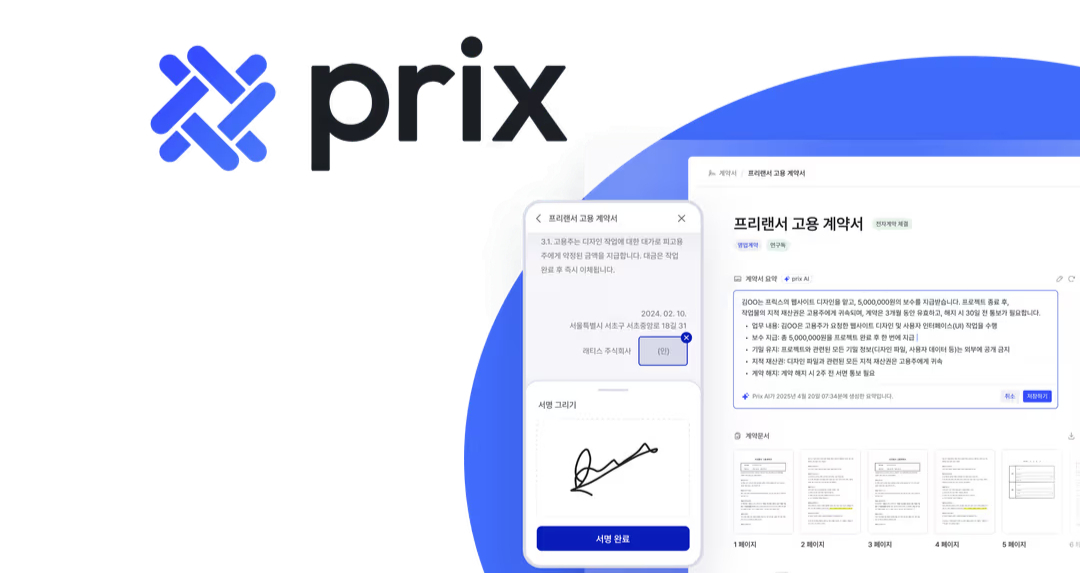
AI is also actively utilized. Kang (CEO) stated, "Creating or reviewing contracts can be handled well even with ChatGPT. The key is naturally integrating AI into the customer's business systems."
He elaborated, "We divide tasks processed by AI into areas where errors are acceptable and those where absolutely no errors are allowed. While AI assists with summarizing entire content, information directly linked to risks such as amounts or periods requires user final approval of AI recommendations before being entered as data."
Lattice's core competency lies in its ability to convert vast unstructured data (documents) within PCs into data according to customer specifications. Going beyond simple text extraction, it identifies key information like 'delivery dates' or 'price adjustment conditions' from complex contracts and inputs them accurately into specific fields without errors.
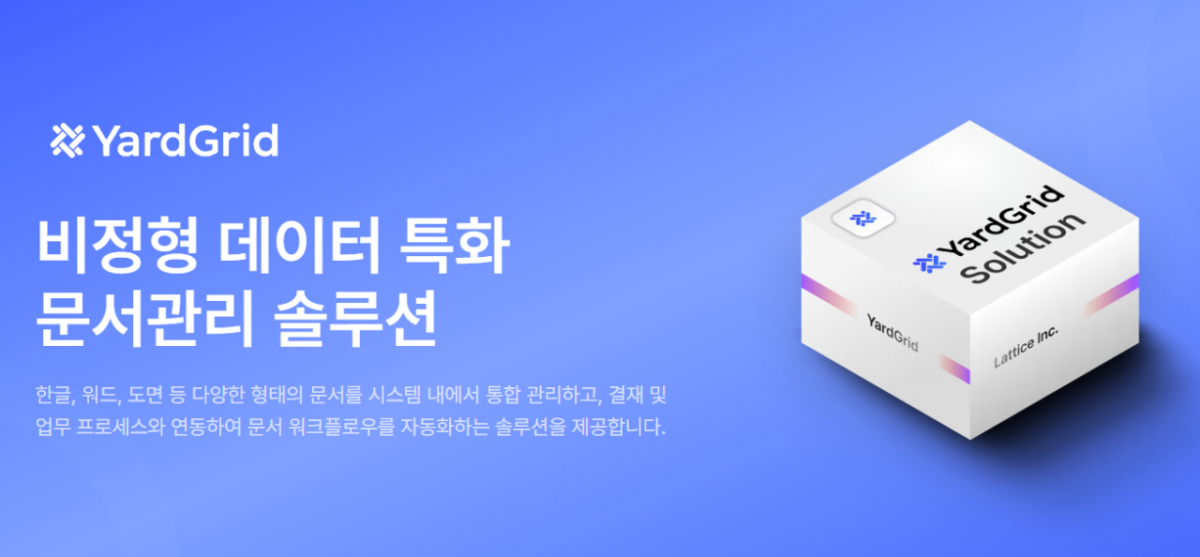
This capability is built as a specialized unstructured document management solution called 'YardGrid,' which operates alongside Prix. YardGrid integrates documents in various formats such as Hangul, Word, and blueprints within the system, automating document workflows by linking with approval and business processes.
Kang (CEO) emphasized, "While existing solutions remain limited to managing individual contracts, we implemented 'project-level integrated management' considering scenarios where numerous contracts intertwine, such as in construction and real estate projects. This enables enterprise-wide contract governance through integration with external collaboration tools and internal systems."
Expanding domains through customized SI... Breathing together with customers
Lattice has expanded its business into SI services that enhance work productivity through corporate AX, leveraging the performance of Prix and the strengths of YardGrid. A representative client is Hanwha Ocean.
Kang (CEO) explained, "If Prix is a solution for processing large volumes of documents with multi-user permission and access control, YardGrid's core lies in building customized systems tailored to complex workflows of large enterprises, specializing in shipbuilding, manufacturing, and defense sectors."
He added, "The sheer volume of blueprints and technical documents poured into building a single ship is beyond imagination. YardGrid systematically structures and automatically indexes vast design drawings and technical documents generated on shipbuilding sites like a grid."
When customers using Prix request customization or on-premise (internal installation) deployment, this can be realized through YardGrid. Kang (CEO) stated, "We communicate extensively not only with customer IT staff but also with operational personnel, often deploying to client sites for extended periods."
He diagnosed, "Companies do not simply choose solutions based on low cost. They comprehensively consider security, detailed permission settings, ERP integration, and AI compatibility. The ability to breathe together with customers and adapt to their workflows will become even more important in the future."
"Aiming to be Korea's Palantier, reducing social costs as well"
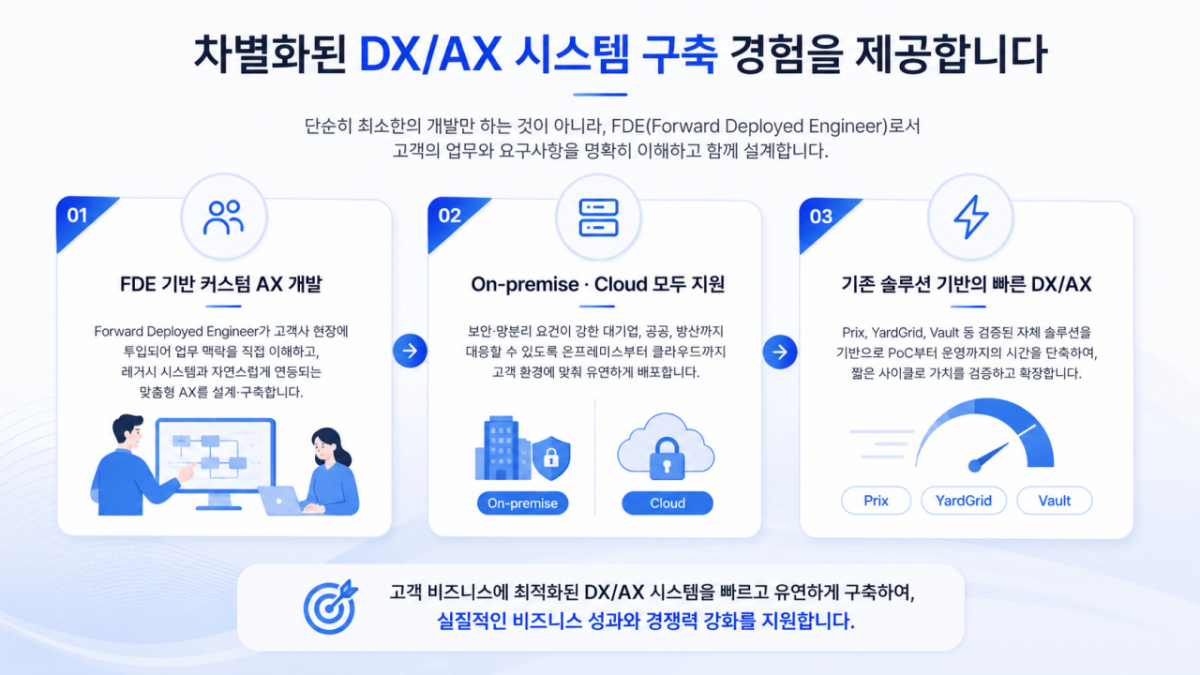
The company Kang (CEO) admires as a role model is Palantir of the U.S. He said, "Palantir's work ultimately involves Forward Deployed Engineers (FDEs) being dispatched to sites to understand customer business processes. Lattice will become Korea's Palantir."
He continued, "It is crucial to deeply understand and codify a company's unique tacit knowledge (knowledge latent in the mind) into structured forms. We will not merely develop solutions for clients but also act as consulting partners and Product Managers (PMs) providing support."
Lattice has also begun actively exploring overseas markets. It signed strategic partnerships with Rakuten Symphony's marine cybersecurity platform 'Rakuten Maritime' and marine security company Cydome, launching global sales of YardGrid.
Kang (CEO)'s ultimate goal is to change how companies work. He emphasized, "A major reason for adopting CLM in the U.S. is shortening deal cycles. Reducing a four-week sales cycle to one or two weeks and minimizing contract-related disputes can not only reduce social costs but also significantly benefit the entire economy."
[MoneyToday startup media platform 'Unicorn Factory']

 in FUTURE


