

[For more diverse corporate information on the startups featured in this article, please visit the 'Data Lab' of the Unicorn Factory big data platform .]
"The ability to utilize space according to our own will without relying on external forces—securing space sovereignty—is no longer a matter of choice, but of survival. We must build a Low Earth Orbit (LEO) satellite communication network in a manner where the private sector leads technology and business development under government support."
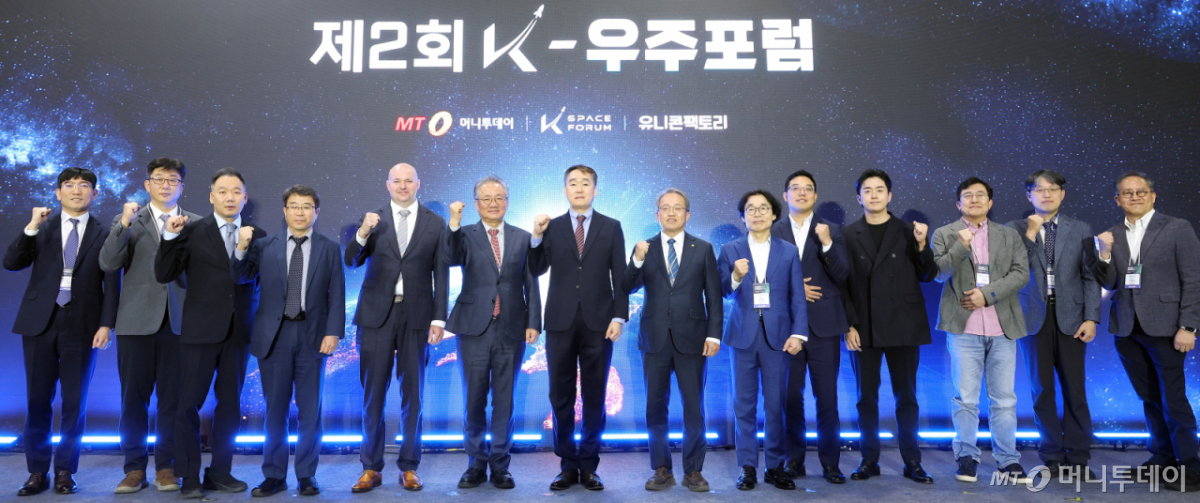
Kim Sun, Vice President and Head of Space Business at Hanwha Group, said this while speaking at the 'Second K-Space Forum' held on the 28th at Hall B Plus Stage in COEX, Samsung-dong, Seoul. He stated, "The government should not be the main body of development, but rather the main body of market formation; that is, it must become a service buyer."
Held under the theme 'Low Earth Orbit Industrial Revolution: The Daejeon Loop of the Space Ecosystem,' this forum was attended by over 200 people, including domestic and international venture capital (VC) firms, space companies, academics, and military officials. The K-Space Forum, which brings together industry, academia, research, and government, previously assessed 'How far has the space industry come?' at its first forum in April.
The forum on this day provided a multi-dimensional perspective on the single topic of Low Earth Orbit from the viewpoints of market, policy, industry, technology, and investment. It focused less on the launch vehicle itself and more on what is carried on it, what data is created, and who will purchase it.
"Space industry, a sovereign domain that determines national security… Private investment essential"
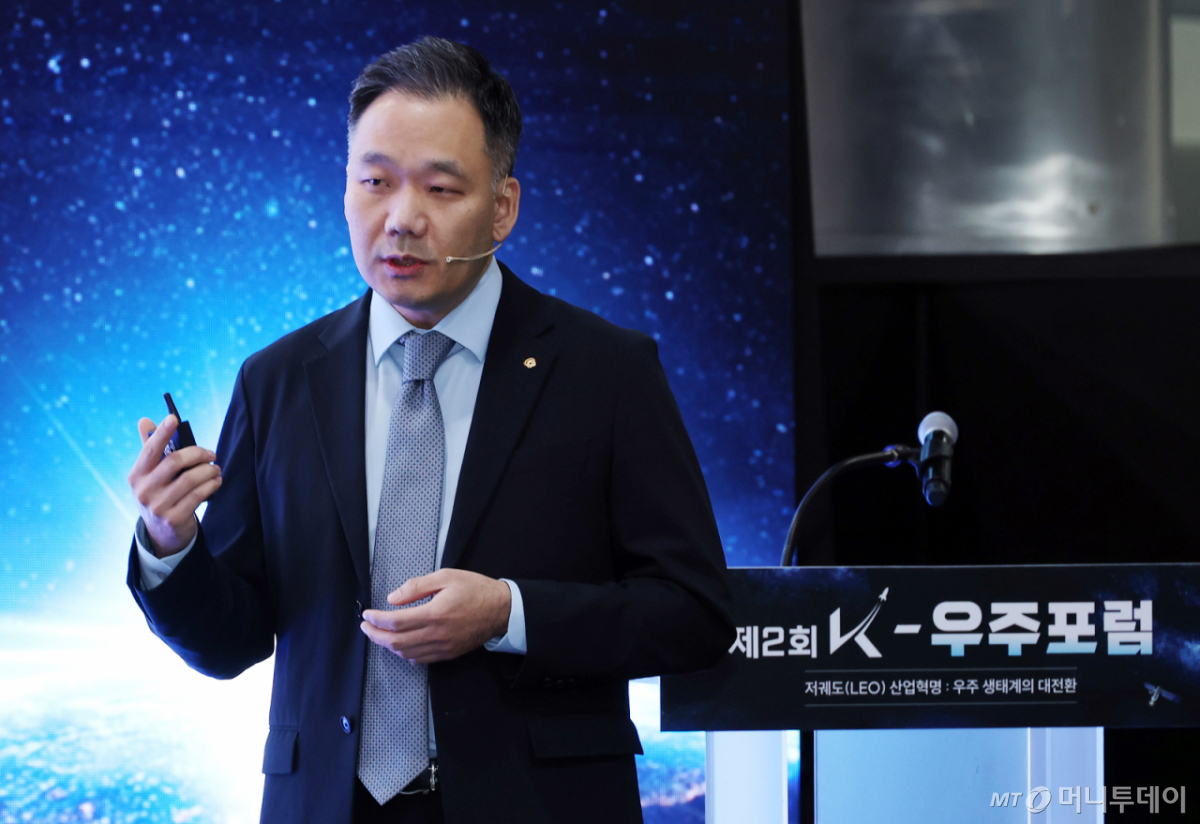
Vice President Kim diagnosed that the space industry has evolved into a sovereign domain that determines national interests and security. He pointed out that just as Low Earth Orbit satellite communications and satellite imagery directly influenced the battlefield situation in the Ukraine war, failing to secure independent space assets could lead to dependence on external forces for control over communications and information.
He presented the conditions for securing space sovereignty: △the capability for self-reliant space transportation that can launch into desired orbits at desired times; △orbits and frequencies available for satellite use; and △stable demand capable of attracting private investment.
Hanwha currently aims to expand Korea's space transportation capacity, which is approximately 2 tons per year on a Low Earth Orbit basis, to 100 tons per year by 2030. The plan involves developing the high-efficiency liquid launch vehicle HLV alongside Nuri to reduce launch waiting times and flexibly respond to demand by mission and altitude.
Vice President Kim emphasized, "We need to boldly entrust areas where private sector technology maturity is high to the private sector." He added, "Attracting private capital is essential to accelerate the securing of space sovereignty. If the government becomes a stable service buyer, the private sector can proceed with proactive and bold investments by trusting government demand."
He further stated, "Rocket launches should not become a nationwide event that happens only once a year," adding, "Rocket launches must become routine, like aircraft traveling to and from airports or trains moving through stations."
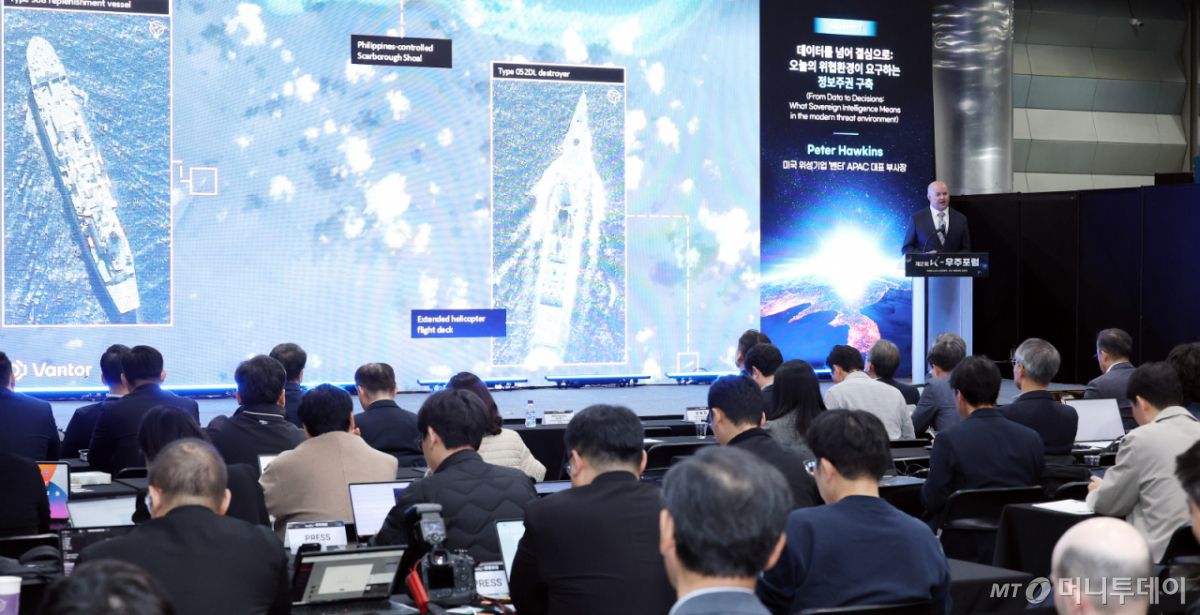
Peter Hawkins, Asia-Pacific (APAC) Representative of Vantor (formerly Maxar), who delivered the keynote speech at the forum on this day, emphasized that the competitiveness of the Low Earth Orbit satellite industry does not end with simply possessing satellites or data.
Vantor operates 10 satellites providing ultra-high-resolution imagery at the 30th cm level. The company is expanding its scope into a business that fuses and analyzes optical imagery, Synthetic Aperture Radar (SAR), high-frequency observation satellites, and data held by various countries on a single geospatial information platform.
Representative Hawkins explained that different sensors must be combined so that high-frequency observation satellites first detect changes in wide areas, and ultra-high-resolution satellites identify the type and status of those objects. He stated that operating one's own satellites, satellites from other private companies, and national assets on a single common platform is necessary to increase the value of information and the speed of decision-making.
"Orbits and frequencies must be managed as national strategic assets"
Kwon Hyun-jun, Deputy Director of the Korea AeroSpace Administration, who appeared as a speaker in the policy session, diagnosed that approximately 95% of currently operating satellites are concentrated in Low Earth Orbit, and that new Low Earth Orbit industries such as space data centers and on-orbit manufacturing, assembly, and services are emerging in addition to communications, observation, and defense sectors.
The government is promoting a plan to build a Korean-style Low Earth Orbit satellite communication network by 2035. The satellite network sizes currently under consideration are 128, 256, and up to 512 units. However, as the number of Low Earth Orbit satellites surges, competition among countries and companies to secure available orbits and frequencies first is also intensifying.
Deputy Director Kwon stated, "Space is not an infinite resource," adding, "We must view orbits and frequencies as scarce resources and national strategic assets, and prepare a long-term securing roadmap."
In the subsequent session titled 'LEO Economics: The Space Economy That Actually Makes Money,' chaired by Ahn Hyeong-jun, Head of the Space Public Team at the Science and Technology Policy Institute (STEPI), discussions on the realistic profitability of Low Earth Orbit projects took place with participation from Park Jae-pil, CEO of Nara Space Technology; Lee Kang-soo, CEO of Company K Partners; and others.
In the final session, three domestic startups that challenged the changing Low Earth Orbit value chain stood before investors. These include CSO, which developed ultra-small high-resolution satellite cameras; Space Lab, targeting on-orbit refueling with electrically controlled chemical thrusters; and Walkerin Space, preparing a space satellite repair shop.
Kang Ho-byung, CEO of Money Today, who attended the forum, said, "Low Earth Orbit is the hottest space in the space competition and a battleground with infinite possibilities." He added, "I hope today's forum serves as an opportunity to find ideas and lay the foundation for Korea to emerge as a space power and a key player in the Low Earth Orbit era."
Song Ki-heon, Chair of the National Assembly Committee on Science and Technology, Information and Broadcasting Communications, stated in his congratulatory speech, "Space was once a field of mere interest, but it has now become a national and strategic field significant enough to be included among the government's seven major tasks." He promised, "The National Assembly Committee on Science and Technology, Information and Broadcasting Communications will support you together through budget, laws, and policy."
Lee Bok-jik, Professor in the Department of Aerospace Engineering at Seoul National University and Chair of the K-Space Forum, said, "When policy illuminates the direction of the market, companies build sustainable businesses, and investment helps those businesses grow even larger." He added, "I hope today's discussions serve as an opportunity to bring these three entities closer together."
[Money Today startup media platform 'Unicorn Factory']

 in FUTURE


