

[More diverse corporate information on the startups mentioned in this article can be found on Unicorn Factory's big data platform 'Data Lab'.]
Venture capital is designed on the premise of failure. The structure requires that even if nine out of ten investments fail, a single success can be significant enough, which is why it is called "risk capital." However, domestic venture investment practices are far removed from risk-taking. Overly designed investor safety mechanisms directly link company failures to the personal bankruptcy of founders.
This is attributed to the domestic investment ecosystem's tendency to make it difficult to easily forgive failures in venture capital investments. While the government has recognized such issues and made efforts, including revising standard contracts, criticism also arises that policy finance institutional investors' policy direction fails to keep pace with these changes.
"Mountain upon mountain" investment protection clause that ties down founders
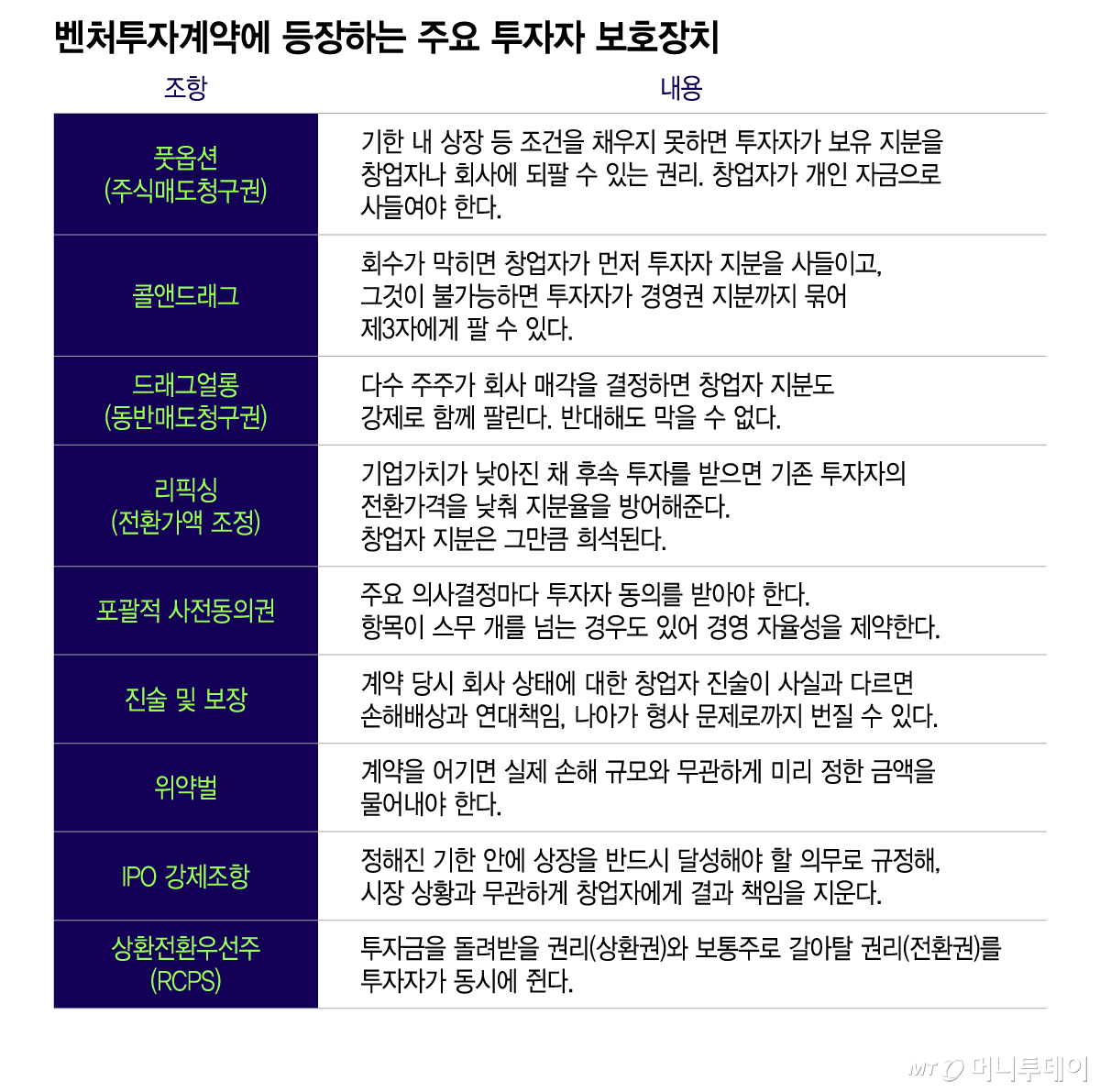
In venture capital contracts, joint and several guarantees by founders were once standard practice. Although this trend is disappearing from a regulatory standpoint, a workaround remains in which major shareholders or management personnel effectively assume the same obligations under the guise of "interested parties." Other mechanisms designed to protect investors also impose burdens on founders, such as put options (the right to demand stock repurchase), which allow investors to force founders to sell their shares, and drag-along rights (co-sale rights), which require founders to sell their stakes if a majority of shareholders decide to sell the company.
In addition, practices such as repricing (adjusting the conversion price to lower the conversion price for existing investors and defend their shareholding ratio when receiving follow-on investment while corporate valuation has declined) and penalty clauses that require founders to pay a predetermined amount to investors regardless of the actual scale of damages are also cited as vicious habits that pressure entrepreneurs.
The same applies to redeemable convertible preferred shares (RCPS), the most commonly used venture investment vehicle in Korea. Investors hold both the right to reclaim their investment if conditions are not met (redemption right) and the right to convert into common stock at a favorable time (conversion right).
Kim Sung-hoon, a lawyer at Mission Law Firm, stated, "The right of redemption is only possible within the scope of distributable profits, and since startups do not have such profits, the actually destructive clauses are conversion rights and repricing." He added, "When raising follow-on investment through a down round (subsequent investment conducted with a lower corporate valuation), if repricing is triggered, the corporate governance structure can be overturned. Consequently, when requesting existing investors to waive or exempt themselves from repricing, they may refuse cooperation, leading to the collapse of the follow-on investment itself."
Lack of consensus on the failed "Yongin" initiative appears as an investor protection measure.
Unlike in Korea, there is a shared understanding in overseas venture investment circles such as Silicon Valley that most startup investments fail. This is why contracts that attribute individual failures solely to the entrepreneur's personal responsibility are difficult to establish. According to local investors, the U.S. venture capital (VC) industry never had joint and several liability clauses in the first place.
South Korea is in a different situation. The spectrum of investors ranges from pure private venture capital firms to funds mixed with policy capital and investment companies affiliated with financial holding groups, each capable of absorbing different levels of loss. There is no uniform consensus across the entire ecosystem to accept failure.
A VC investment screening officer stated, "There have even been cases where individual investors in a private investment fund, unable to distinguish between investment and loans, grabbed the screening officer by the collar and demanded, 'Give me back my money.'" The officer further pointed out, "It is not just individual investors; institutional investor managers also sometimes act like creditors rather than investors."
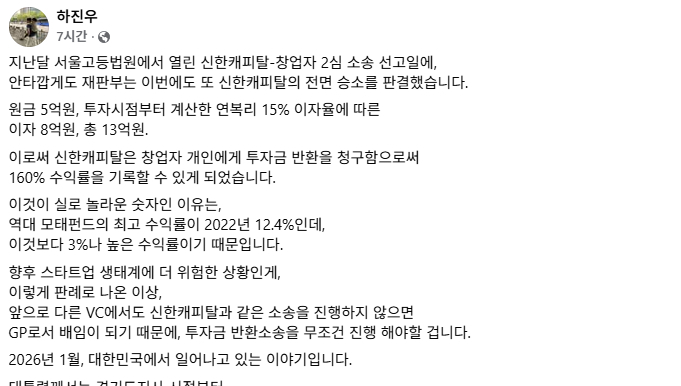
Cases where founders personally assume liability due to joint guarantee or related-party clauses in investment contracts continue to emerge. Urban Base, a proptech startup, faced conflicts with investor Shinhan Capital over joint guarantee issues. OhjiQ, a content startup, found its founder Shin Cheol-ho named as a "related party" during the process of signing a conditional investment contract, leaving him in a situation where he must repay the 9 billion won invested amount plus late fees from his personal funds.
"The culture of 'investment failure in Yongin' must take the lead with 'policy finance.'"

The government also recognizes the need to ease such investor protection measures. On the 30th last month, the Ministry of SMEs and Startups proposed revisions to the standard venture investment contract that recommend using CPS (convertible preferred shares) instead of RCPS. Rather than defining an IPO as a mandatory result obligation, the proposal changes it to an obligation to make diligent efforts, thereby protecting entrepreneurs from penalty clauses triggered by external factors such as market stagnation.
However, the startup industry says that problems not included in contracts more often pressure actual founders. How put options and penalties are actually exercised remain in a management blind spot. The reality of fund of funds (Korea venture fund) sub-funds exercising put options or penalties against founders is also not being monitored.
Criticism arises that the policy direction of policy finance, including funds of funds (Korea Venture Fund), has encouraged investors' "self-preservationism." When a company in which they have invested faces insolvency, they pressure fund management companies by raising issues regarding post-investment management. If the corporate valuation falls below the acquisition price, they impose impairment losses and reduce management fees. Fund management companies demand stronger safeguards for entrepreneurs on the grounds that contributors require strict oversight, and these demands ultimately return as harsh clauses that strangle entrepreneurs.
Lawyer Kim Sung-hoon stated, "It is true that VCs are not acting as venture capitalists but rather like creditors; however, this is not necessarily due to malicious intent on the part of the VCs." He further noted, "If policy LPs do not grant fund management companies the discretion and autonomy to make appropriate judgments and manage funds accordingly, fund managers will inevitably feel pressured and take excessive safety measures, ultimately creating a vicious cycle that damages the startup ecosystem."
[Money Today Startup Media Platform Unicorn Factory]

 in FUTURE


