

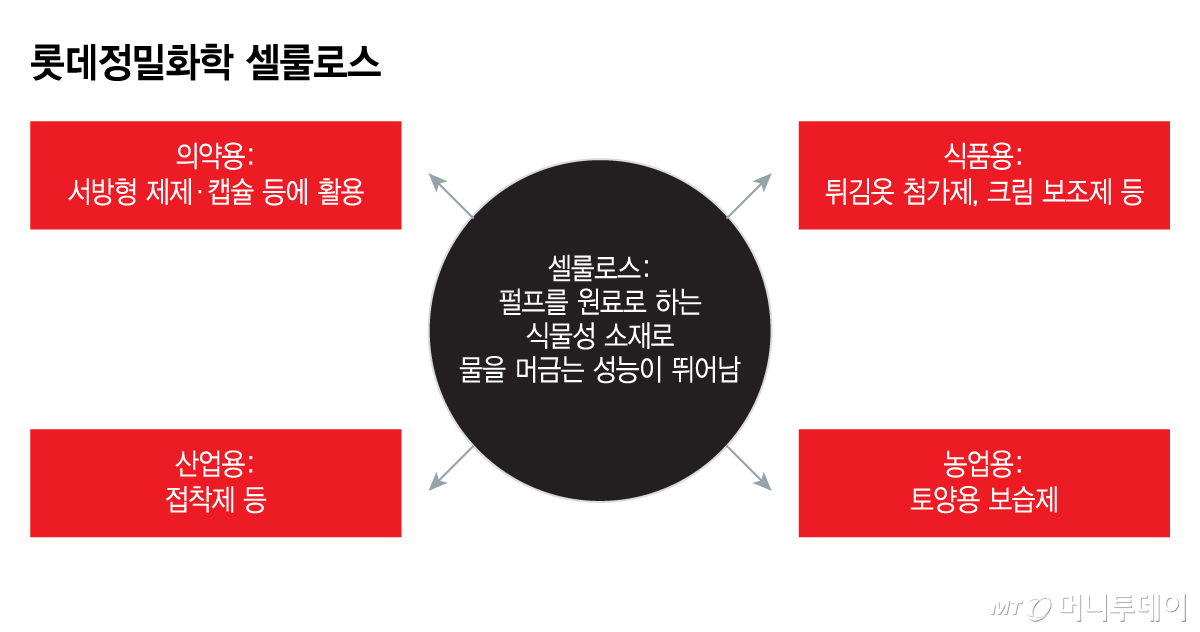
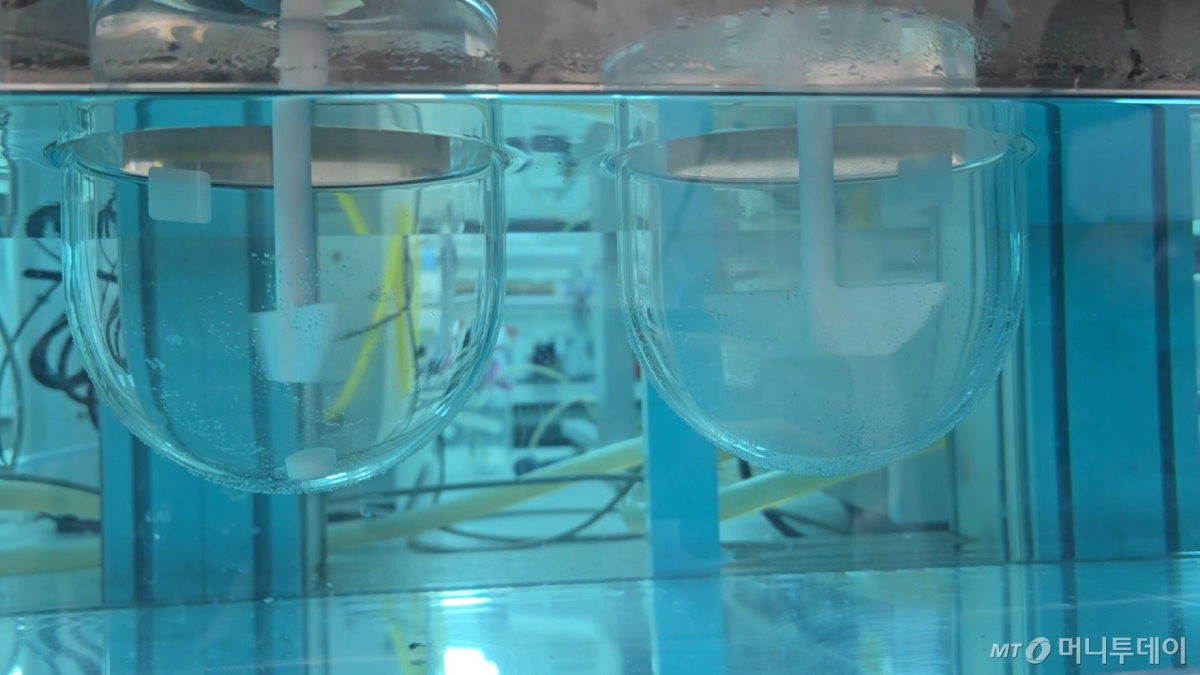
On the 17th of last month, at the Lotte Central Research Institute in Magok, Gangseo-gu, Seoul, researchers from Lotte Fine Chemicals dropped two white pills into a dissolution apparatus that resembled an aquarium. Bubbles immediately formed on one side, while the other showed little change. As the dissolution apparatus rotated the solution inside the tank at a constant speed, the pill that had bubbled dissolved to the point where its shape was unrecognizable. In contrast, the other pill continuously maintained its original form.
The secret behind the pill’s resistance to dissolving and retention of its shape lay in “Anicoat,” a cellulose material from Lotte Fine Chemicals that coats the pill. Anicoat is a plant-based material made by Lotte Fine Chemicals using natural pulp as a raw material. Choi Nak-un, Head of the R&D Division at Lotte Fine Chemicals, explained, “Anicoat has special functions such as high moisture retention and gel layer formation capabilities.” He added, “These functions are utilized in sustained-release formulations and capsules to ensure that drug ingredients dissolve at the desired time.”
As demand continued, centered on pharmaceutical companies, Lotte Fine Chemicals expanded its production scale. In December last year, Lotte Fine Chemicals completed an expansion of its food and pharmaceutical-grade cellulose production capacity from 12,000 tons to 18,000 tons. This represents the world’s largest scale in terms of annual production capacity. Senior Executive Choi emphasized, “We expect to take the top spot in sales volume as well soon.”
Cellulose has now established itself as a representative specialty (high-functionality) material business for Lotte Fine Chemicals. In particular, food and pharmaceutical-grade products must meet strict standards because they are used in products directly consumed by humans, making market entry difficult for latecomers. Senior Executive Choi stated, “It can be viewed as a business that creates value-added benefits more than 10 times the price of the raw material pulp.”
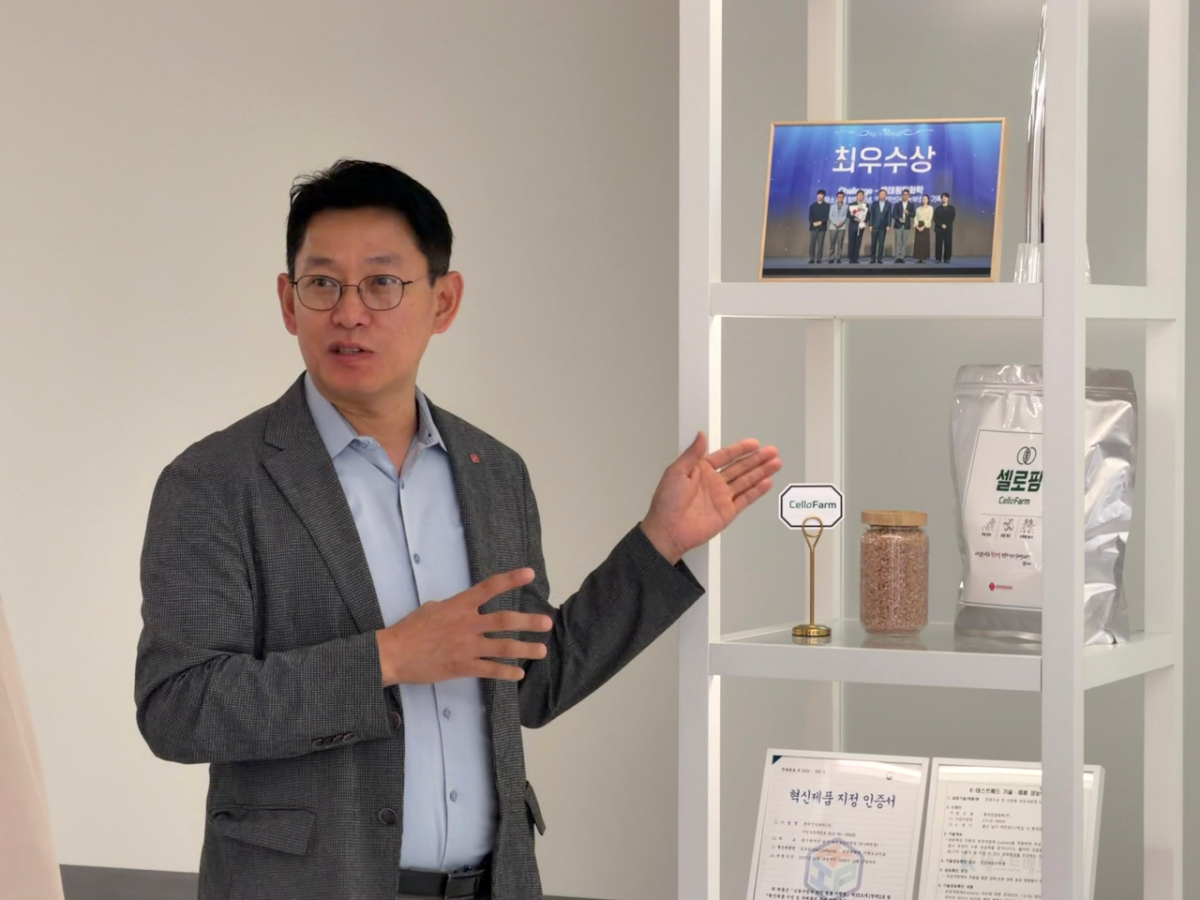
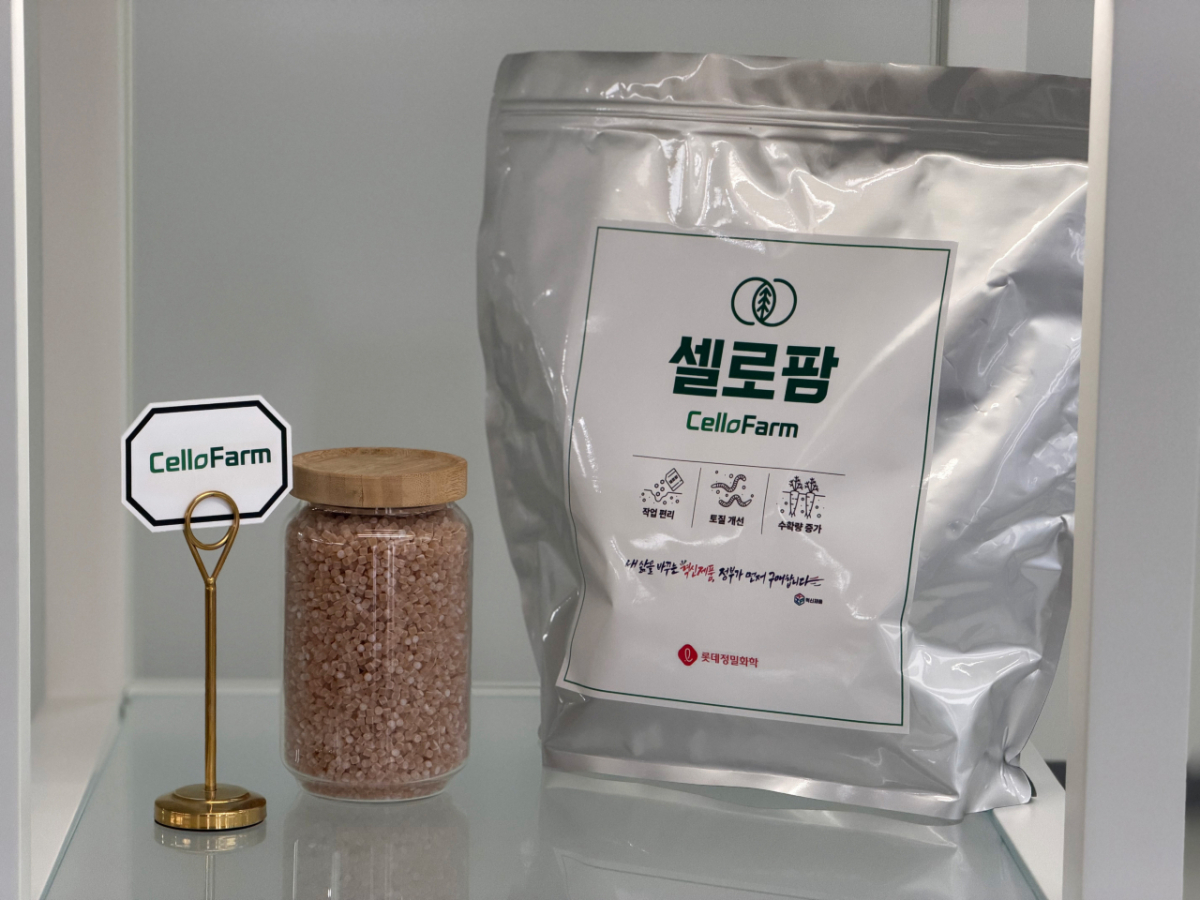
Because cellulose is made from pulp, a naturally derived substance, it has the characteristic of decomposing when returned to nature. Lotte Fine Chemicals focused on this aspect and developed “Celofam,” a soil moisturizer. Development began approximately three years ago, and field trials are currently underway targeting region-specific crops, including radishes in Sinan, garlic in Uiseong, peppers in Anyang, potatoes in Gimje, and perilla leaves in Geumsan, as well as the Gyeonggi region starting this year. Additionally, multiple demonstration projects are being conducted in cooperation with local governments and forestry cooperatives to apply the product to forest restoration in wildfire-affected areas, afforestation, and landscaping projects.
Senior Executive Choi introduced, “Celofam is an example of applying cellulose’s high moisture retention property to soil.” He then noted, “Acrylic-based superabsorbent resins used in existing soil moisturizers have the problem of being non-biodegradable microplastics, limiting their use in agriculture,” and expressed confidence that Celofam could serve as a substitute.
Lotte Fine Chemicals plans to expand domestic application while also seeking entry into overseas markets. Key targets include forest restoration in areas experiencing desertification and overseas Official Development Assistance (ODA) projects. Senior Executive Choi stated, “We are exploring the possibility of applying it to ODA projects such as establishing windbreak forests in regions with advanced desertification like Mongolia.” He added, “Cellulose’s moisture retention properties can also be helpful when planting trees in regions like the Middle East that require continuous water supply.”
A new application area recently gaining attention is batteries and semiconductors. Cellulose materials are used in the process of manufacturing copper foil by Lotte Energy Materials, a subsidiary of Lotte Fine Chemicals, and serve as an adhesive in the process of attaching graphite to battery anode materials. In the semiconductor sector, it is also used in silicon wafer polishing agents. Although usage volumes are not large, Senior Executive Choi explained that the company is expanding its application scope as a material providing functions necessary for processes in new industries.
He said, “Since industrial technology continues to change, our role is to identify what problems arise in new industries and propose solutions by utilizing cellulose’s functions.” He added, “We are striving to expand usability not only in mature industries but also in newly growing fields such as batteries and semiconductors.”

 in INDUSTRY


