

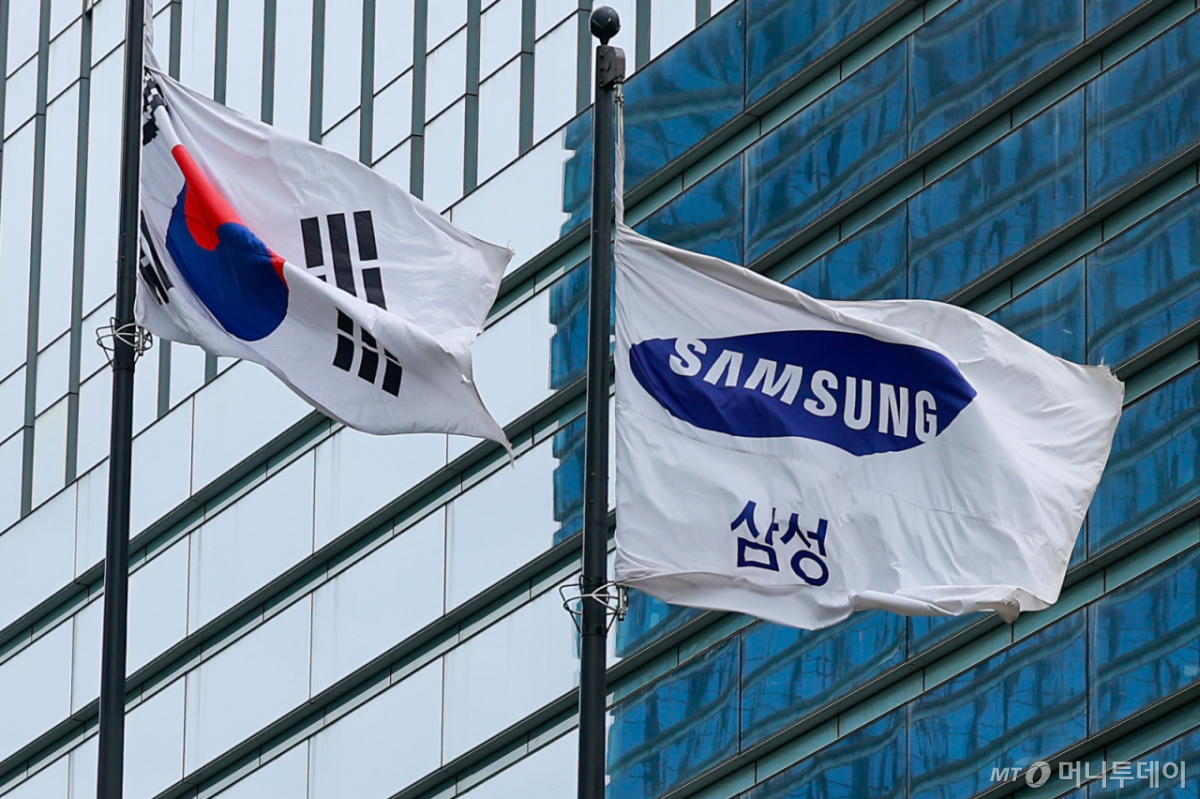
With one day remaining until Samsung Electronics' Q3 preliminary earnings release, the KOSPI is fluctuating wildly. This is due to a mix of expectations and caution. The securities industry has slightly lowered its Q3 earnings expectations for Samsung Electronics to reflect the decline in the won/dollar exchange rate. Nevertheless, forecasts indicate that Samsung Electronics' Q3 operating profit will exceed 100 trillion won and that growth will continue next year as well.
As of 11:03 a.m. on the 7th, the KOSPI is showing 6868.66, down 72.73 points (1.04%) from the previous day. The KOSPI, which opened down 1% on this day, switched to an upward trend during trading hours but is now showing a downward trend again.
Samsung Electronics is showing 271,250 won, down 750 won (0.28%) from the previous day's Korea Exchange after-market closing price. It has shown volatility, rising by more than 2% during trading hours before narrowing the gain. It appears that both expectations and caution are emerging simultaneously ahead of the earnings release on the 8th.
Experts in the financial investment industry estimate that Samsung Electronics' Q3 operating profit will exceed 100 trillion won. According to financial information provider FnGuide, Samsung Electronics' Q3 consensus estimate (average earnings forecast) is an operating profit of 106.6401 trillion won and revenue of 200.6417 trillion won. These figures represent increases of 776% and 133%, respectively, compared to the same period last year.
Experts estimated that Samsung Electronics' performance increased as DRAM and NAND prices rose by 15-18% each in the previous Q3. If Samsung Electronics' quarterly operating profit exceeds 100 trillion won, it will be the first among domestic listed companies.
However, opinions are divided on whether Samsung Electronics will meet the consensus estimate due to the decline in the won/dollar exchange rate. For Samsung Electronics, which has a high export ratio, performance may decrease if the won/dollar exchange rate falls. The won/dollar exchange rate was 1,372.5 won on August 28 last month and fell by 19.7 won to 1,352.8 won on September 30 last month within a month.
Kim Sun-woo, a researcher at Meritz Securities, analyzed, "Samsung Electronics' Q3 operating profit will record 106 trillion won," adding, "A hostile environment in terms of performance has been created due to the sharp strengthening of the won, but based on sales policies, memory prices once again exceeded the industry average."
On the other hand, Kim Un-ho, a researcher at IBK Investment & Securities, said, "Samsung Electronics' operating profit will be 101.7 trillion won, falling below previous forecasts," adding, "It is estimated that the impact of the won/dollar exchange rate acted as a major variable."
Securities firms have lowered their next year's earnings estimates to reflect the aftermath of the decline in the won/dollar exchange rate. However, experts advised that attention should be paid to the fact that memory demand is solid and Samsung Electronics' growth potential remains intact, rather than the exchange rate decline.
Kim Rok-ho, a researcher at Hana Securities, said, "Although we lowered next year's operating profit due to the exchange rate, as the weight of next year expands in 12-month forward earnings, the target price (480,000 won) can be maintained," adding, "Next year, it is necessary to pay attention to the increase in Samsung Electronics' HBM (High Bandwidth Memory) revenue."
Kim Yeong-geon, a researcher at Mirae Asset Securities, analyzed, "We judge this as an opportune time to expand our weight on Samsung Electronics," adding, "A significant portion of next year's shipment volume has already been committed, and allocation discussions with customers are trending beyond 2028 volumes, while new long-term contracts are being signed at higher prices than existing contracts based on first-half market conditions."
Forecasts indicate that shareholder returns will also have a positive impact on the revaluation of Samsung Electronics' stock price.
Kim Dong-won, head of the Research Division at KB Securities, said, "We expect Samsung Electronics' future shareholder return policy to exceed market expectations," adding, "It will act as a strong catalyst for corporate valuation reevaluation." He stated, "Assuming that the remaining resources for shareholder returns over the recent 3 years (2024-2026) are 110 trillion won, we expect returns of 70-80 trillion won in cash dividends and 30-40 trillion won in share buyback cancellations to be possible," adding, "Even assuming that the next 3-year shareholder return policy maintains the same level as before, returning only 50% of FCF (Free Cash Flow), Samsung Electronics' shareholder return scale is expected to expand by more than four times compared to the existing level."

 in STOCK
