

[For more diverse corporate information on startups, you can view it at the Unicorn Factory Big Data Platform 'Data Lab'.]
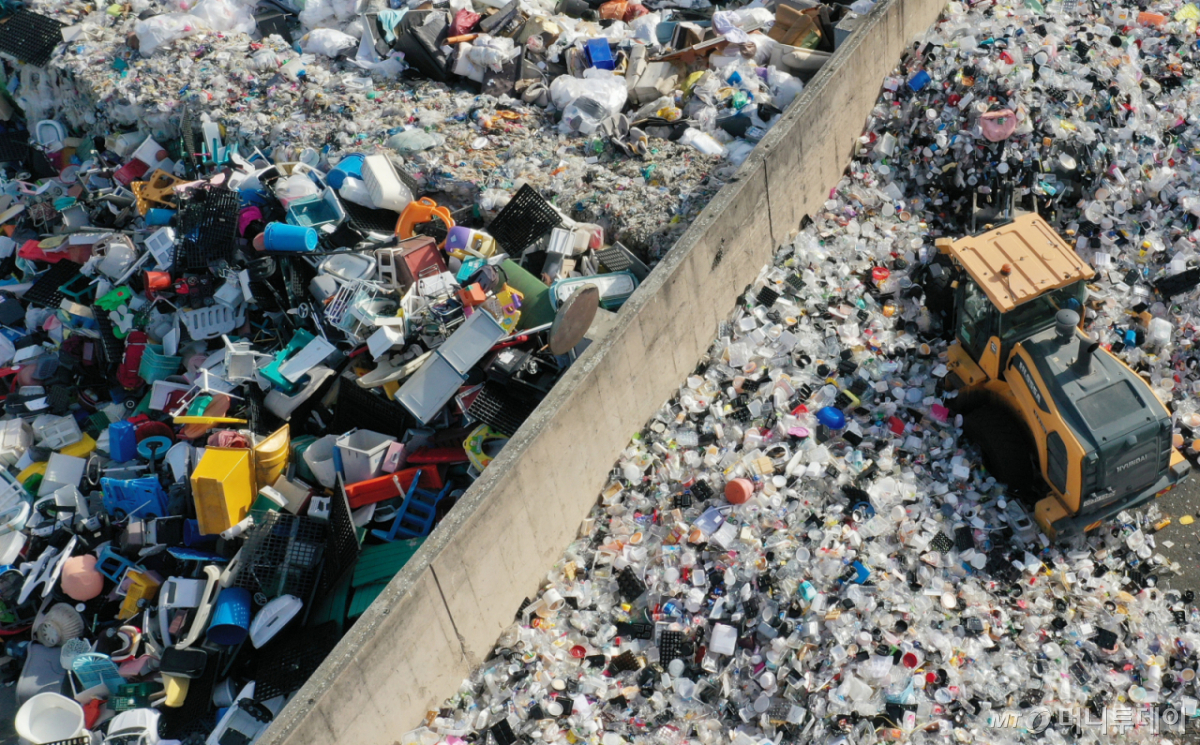
What percentage of daily trash is actually recycled? Only items that generate revenue, such as aluminum cans, PET bottles, and cardboard boxes, are partially recovered. Most household waste, including coffee capsules, cosmetic containers, and snack bags, is either incinerated or buried in the ground as is.
There is a company that views this discarded waste as a 'gold mine.' It is TerraCycle, a global recycling firm that collects only trash that no one touched due to the difficulty of recycling it and transforms it into new raw materials.
TerraCycle is praised for turning the 'Zero Waste' movement, which existed only as a slogan, into a complete business model. In particular, given that 85% of Korea's waste is incinerated or landfilled, TerraCycle views Korea as a vast market and has officially begun its market entry.
Started with 'worm fertilizer' 25 years ago... "The 85% that doesn't make money is our market"
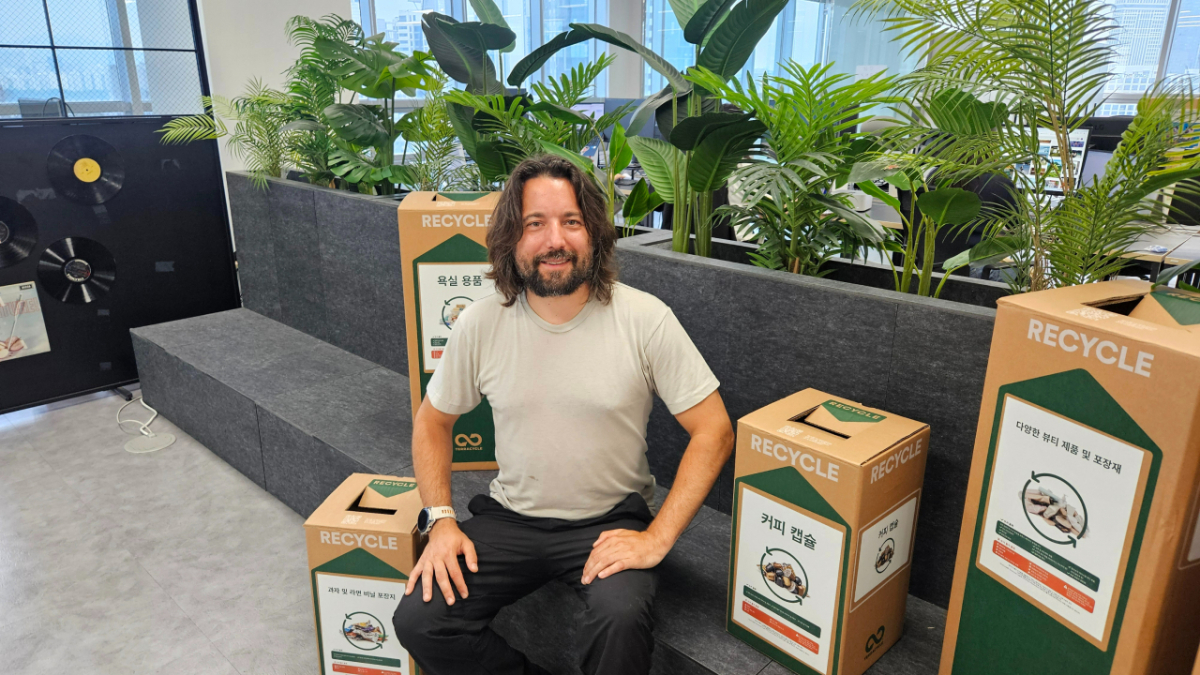
TerraCycle founder Tom Szaky's background is extraordinary. He started his first business at age 14, and after enrolling in Princeton University in the United States, he launched a startup with the idea of making fertilizer from earthworm excrement fed on food waste. He later dropped out of school and established TerraCycle in 2001.
He said, "At first, everyone thought I was crazy, but the experience of packaging worm fertilizer in discarded PET bottles and selling them to major retailers like Walmart became an opportunity to learn 'how to find business opportunities outside the existing system.'"
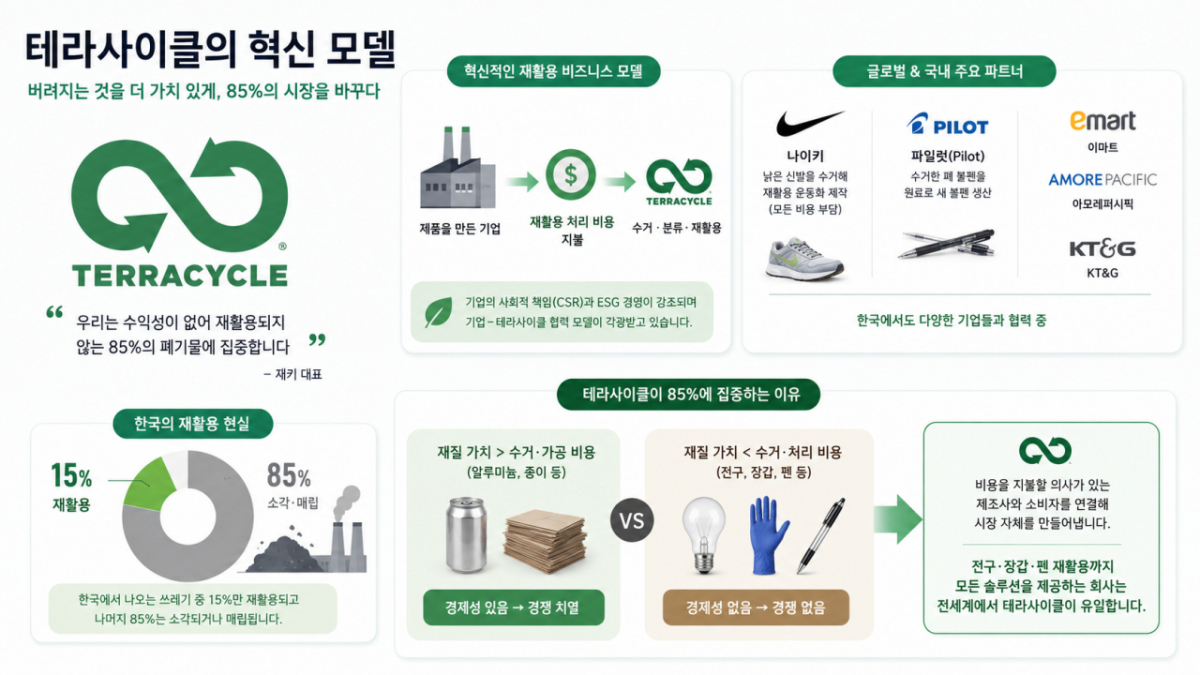
CEO Szaky emphasized, "The purpose of TerraCycle is to convert discarded items into more valuable uses. We devised a model where companies that manufacture products pay for recycling services. As corporate social responsibility and ESG management have gained prominence, this collaborative model is receiving attention."
In the case of Nike, the company bears all costs for collecting old shoes and making recycled sneakers. Japanese stationery brand Pilot creates new ballpoint pens using waste ballpoint pens collected by TerraCycle as raw materials. In Korea, E-Mart, Amorepacific, and KT&G have also partnered with TerraCycle.
He said, "Only 15% of the trash generated in Korea is recycled; the remaining 85% is incinerated or landfilled. The reason there is no competition is that it is not economically viable. We focus on that 85% which cannot be recycled due to lack of profitability."
According to CEO Szaky, items like aluminum and paper, whose collection and processing costs can be covered solely by material value, are fiercely competed over as everyone tries to take them. On the other hand, waste where collection and processing costs exceed the value of the resulting product appears economically unviable on the surface, so no one touches it.
He emphasized, "TerraCycle finds manufacturers and consumers willing to pay for recycling this waste, thereby creating the market itself. We are the only company in the world that provides all solutions simultaneously, from light bulbs and gloves to pen recycling."
Areas difficult to recycle become entry barriers
With this business model, TerraCycle has grown into a company with an annual revenue of approximately $100 million (about 150 billion won), employing about 500 people across 20 countries.
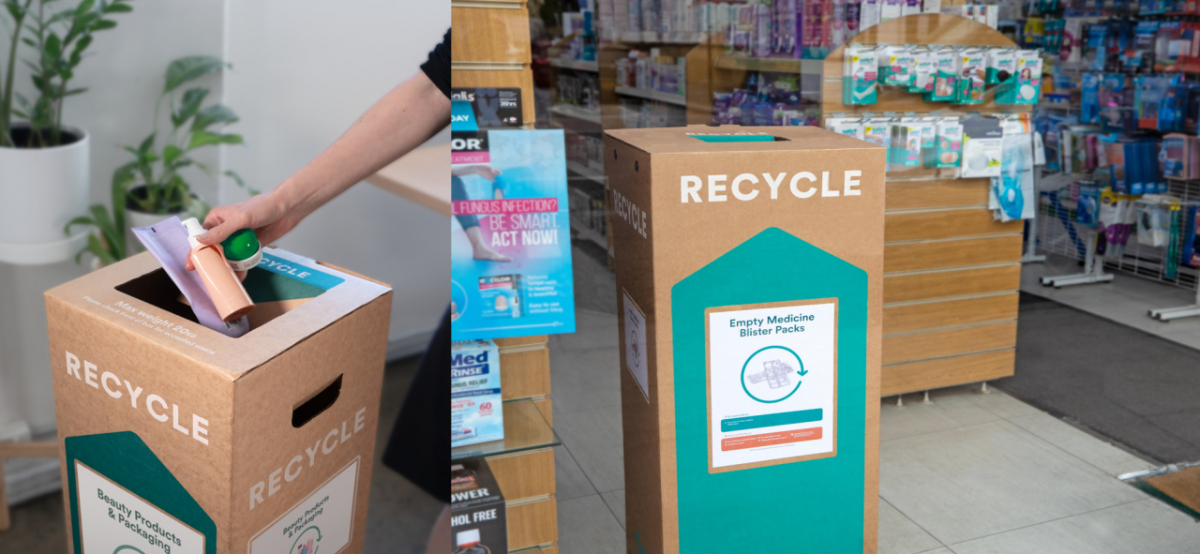
Recently, it launched the 'Zero Waste Box' in Korea for the first time in Asia to secure new growth momentum. The Zero Waste Box is a service where consumers or companies directly purchase collection boxes on a paid basis, collect recyclables, and send them to TerraCycle for collection and processing.
The concept of 'paying to recycle' may still be unfamiliar, but TerraCycle's perspective is that growing interest in the environment offsets this. This service handles all kinds of trash with no existing market, such as toothbrushes, pill packaging, sponges, and masks.
In Korea, it will start with 39 items and plans to expand to up to 2,300 categories in the future. Regarding criticisms that the concept of paying to recycle is unfamiliar, CEO Szaky replied, "It was a new concept everywhere at first, including in the United States, Canada, France, and Australia."
However, he explained that box repurchase rates in these countries are now approaching 90%. He said, "I felt the market was ready now. Our goal is to double the amount of waste collected and recycled in Korea. If we succeed in Korea, we will expand next to Japan and Thailand."
The response from domestic companies is also not bad. CEO Szaky stated, "Even before launch, many Korean companies have already purchased boxes. We currently have boxes for 39 items, including cosmetic containers, coffee capsules, and snack bags, and plan to significantly increase the number of items in the long term."
"Korea's strict regulations are actually an opportunity"
Regarding criticisms that Korea's regulations on waste are strict, CEO Szaky offered a positive response instead. He said, "The more regulations are created, such as the Extended Producer Responsibility (EPR) system where governments require companies to invest part of their packaging costs into recycling, the better TerraCycle and similar companies perform."
However, he established a principle not to provide services for items that can already be recycled by existing companies. The strategy is to avoid competing with recycling systems centered on local governments and to focus only on areas where recycling has not yet been achieved.
What CEO Szaky focuses on next after recycling is 'Reuse.' This involves not just recovering materials used to make products but cleaning and repairing items in their original form to put them back on the market. It is said that he invested approximately $50 million (about 73 billion won) solely in developing its own reuse platform, 'Loop'.
Loop operates on a system where consumers purchase products like whiskey, Coca-Cola, ketchup, and laundry detergent in dedicated reusable containers and receive their deposit back when they return the used containers. Since TerraCycle cleans the recovered bottles and sends them back to manufacturers, no waste is generated.
The image of Korea five years from now that CEO Szaky envisions is a market where the circular economy is deeply rooted. He said, "I want to maximize recycling rates and inspire other companies to compete and achieve greater growth. I hope this leads to better regulations and more funding support."
While it does not rely on investment fundraising due to its profitability, it remains open to external funding for accelerating growth in Korea. He conveyed, "If we find a suitable partner in Korea, we are interested in raising equity investments in the range of 0.1 billion won to $25 million (about 14.6 billion to 36.5 billion won)."
The ultimate goal that CEO Szaky pursues is 'to become a human who leaves a positive impact on the Earth.' He said, "I hope that when I leave this world, all stakeholders on Earth will miss me. If they miss my contribution because the impact I left behind was positive, then that is what a successful life is."
[MoneyToday startup media platform 'Unicorn Factory']

 in FUTURE


