

[For more diverse corporate information on startups, visit the Unicorn Factory Big Data Platform 'Data Lab'.]
Although the threshold for domestic startups to grant stock options to employees has lowered, it remains difficult to convert them into cash.
Most companies allow employees to exercise their rights after meeting the minimum period of two years permitted by law, yet nine out of ten employees who exercised their stock options and obtained shares have not sold a single share for even one week.
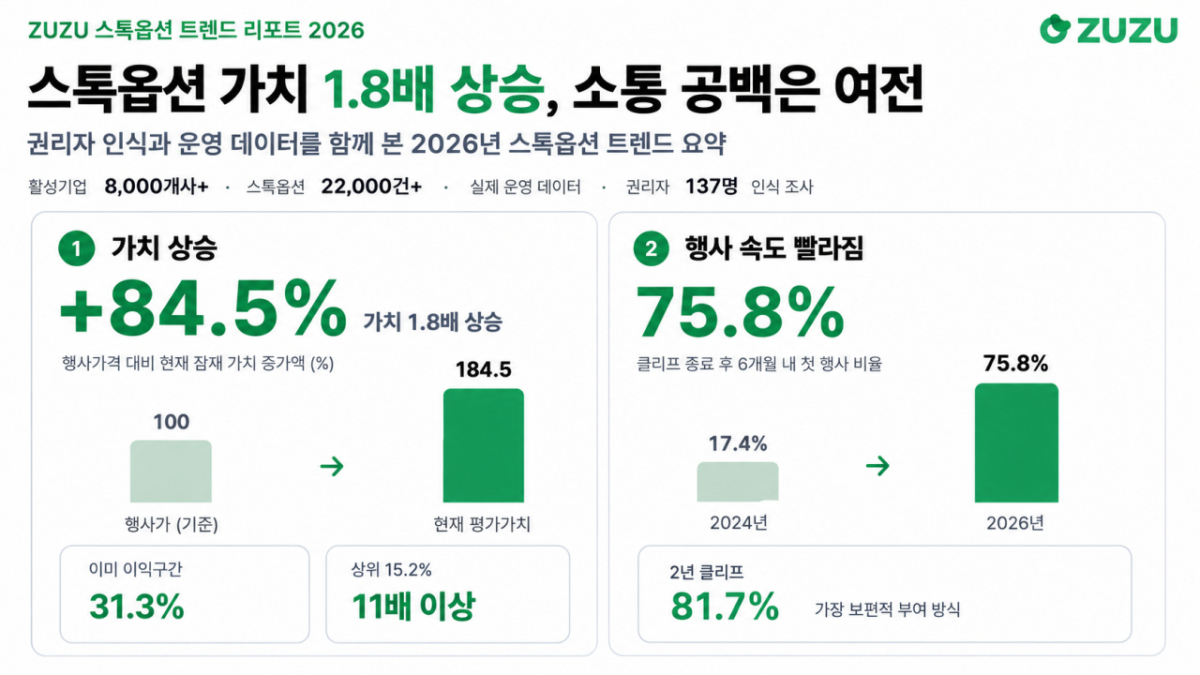
According to "Stock Option Trend Report 2026" released on the 6th by Codebox, which operates the integrated management platform 'ZUZU' (주주) covering stock compensation, registration, HR, and payroll, 81.7% of companies set the mandatory employment period for stock options at the minimum two years required by the Commercial Act.
The median time taken to actually exercise rights after two years was 1.64 months. The proportion of companies setting the stock option exercise price at par value also increased from 15.0% in 2024 to 23.6% this year.
Conversely, cases where shares were disposed of after exercising stock options were rare. Of those who exercised and participated in the survey, 90.9% held all acquired shares, and more than half (50.8%) answered that it was "because there is no market or opportunity to sell the shares." This ratio has risen compared to the 2024 survey (88.3%).
This report was compiled based on an analysis of 22,947 stock option grant cases from over 8,000 active companies (as of May 31) and a July survey conducted with 137 stock option right holders. Codebox published the related report for the first time in two years since 2024.
The stock option system is becoming increasingly simplified. The design is shifting toward enabling employees to secure rights quickly rather than encouraging long-term tenure.
A representative change is the vesting structure. The proportion of companies using a method where 100% can be exercised at once after two years, or a method where 50% is exercised first after two years and the remainder later, increased from 31.1% in 2024 to 54.3% this year.
Companies setting exercise prices at par value are also increasing. When stock options are granted at par value, the greater the corporate valuation rises, the larger the profit for employees. While this reduces the burden on employees, it may relatively weaken the effect of encouraging long-term retention from the company's perspective.
In fact, the behavior of right holders has also changed. The proportion of those who exercised stock options within six months after the mandatory employment period ended surged from 17.4% to 75.8%. Most exercise their rights as soon as they become eligible.
However, exercising stock options does not immediately realize profits. Although the value of the surveyed stock options was a median of 84.5% higher than the exercise price, this is merely an unrealized gain on paper.
This is because there is no clear way to convert unlisted shares into cash unless an IPO or mergers and acquisitions (M&A) occurs, or secondary share transactions take place. Among cases where actual market prices could be confirmed, 15.2% saw values jump more than 11 times, while 19.8% remained at levels lower than or similar to the exercise price.
In this process, significant burdens of exercise funds and taxes were also identified. Among respondents who had experienced stock options being cancelled or expiring, 28% cited exercise costs and tax burdens as reasons.
The most common reason was loss of eligibility due to job resignation or retirement (37%), while cases where rights were abandoned because the share price fell below the exercise price accounted for 24%.
Actual cancellation cases are also increasing. The cancellation rate relative to total stock option grants rose from 18.2% to 31.3%. Of cases where the timing of cancellation could be confirmed, 88.1% occurred before completing the mandatory two-year employment period.
It was also confirmed that returns accumulate over time. The median potential profit for right holders granted stock options in 2020 was 200%, while for those granted in 2024 it was 66%. However, since the annual average return rate was similar at 20.1% in 2020 and 19.8% in 2022, analysis suggests this is a result of steady corporate valuation growth rather than a sharp spike during a specific period.
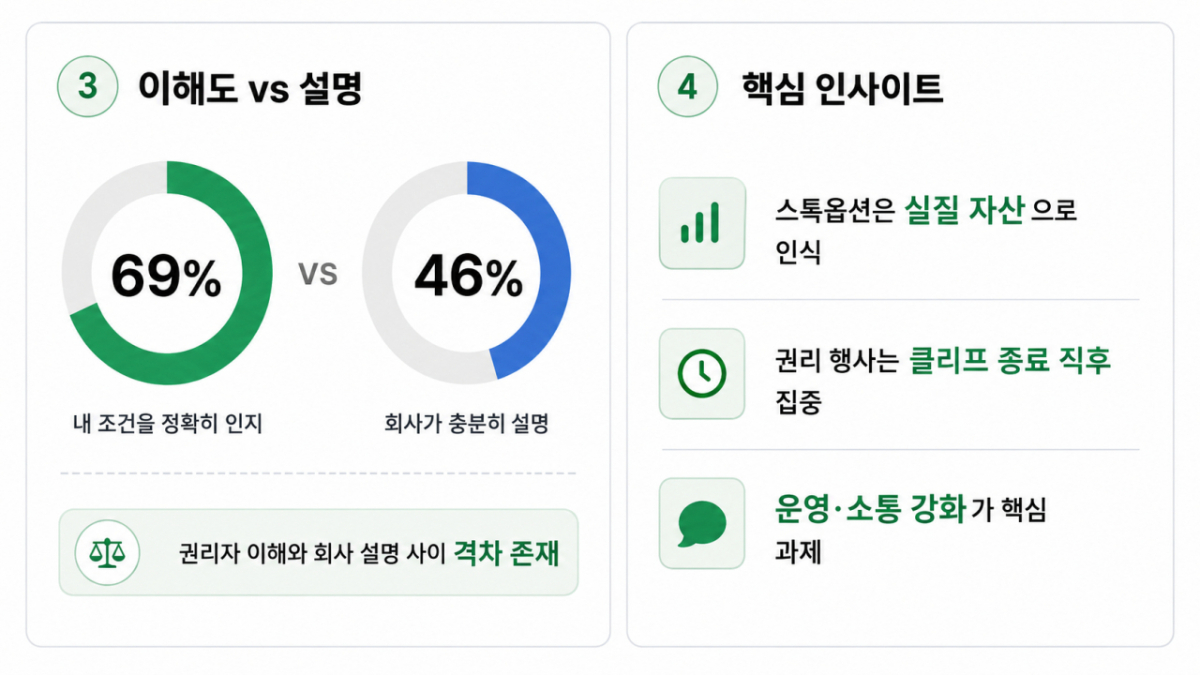
Criticism was also raised regarding insufficient explanation of the system. While 69% of respondents answered that they understand their stock option conditions, only 46% said they were sufficiently explained about grant and exercise conditions by their company, and only 47% said they were guided on the value and meaning of the system.
Seo Kwang-yeol, CEO of Codebox, stated, "Data analysis has verified the actual value of stock options, but gaps in operational processes to properly make employees aware of this value have also been identified." He added, "We must standardize complex stock option management digitally to resolve communication gaps between companies and right holders."
[MoneyToday startup media platform 'Unicorn Factory']

 in FUTURE

