

[For more diverse company information on the startups mentioned in this article, visit the Unicorn Factory big data platform 'Data Lab'.]
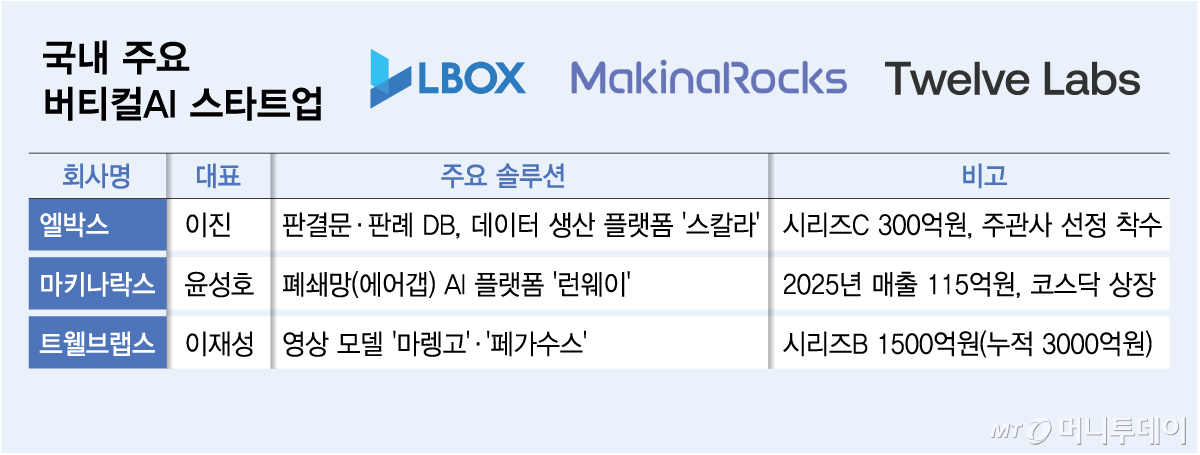
As investment enthusiasm for AI (artificial intelligence) continues in the venture capital market, vertical AI, which focuses on solving problems in specific industries rather than general-purpose AI, is emerging as a key investment target for venture capitalists. This trend is attributed to growing expectations that vertical AI can quickly demonstrate profitability at industrial sites, unlike general-purpose AI requiring massive capital.
This trend is also confirmed in global investment markets. Global venture capital firm Bessemer Venture Partners forecasts that the market size of specialized vertical AI will reach 10 times that of the existing SaaS (software-as-a-service) market. These expectations are also reflected in corporate valuations. U.S. legal tech startup Harvey received a corporate valuation of $8 billion (approximately 11.4 billion won) at the end of last year. Domestically, startups leveraging domain data to secure large-scale investments or pursue listings continue to emerge one after another.
One of the vertical AI companies recently highlighted by venture capitalists is Twelve Labs. The company develops multimodal AI technology that understands the context of video data for search, analysis, and reasoning. In its recently concluded Series B investment round, it secured 150 billion won, achieving cumulative investments of $200 million (approximately 308.7 billion won). Participants in this round included Naver Ventures, U.S. venture capital firm NEA, Amazon’s venture investment organization, Radical Ventures, Index Ventures, Quadrille Capital, and Red Bull Ventures. In Korea, Korea Investment Partners was listed as an investor.
Twelve Labs is a startup founded by Lee Jae-seong (CEO), a former officer from the Republic of Korea Army Cyber Operations Command, in March 2021. Headquartered in San Francisco, U.S., it targets the global market and has expanded its business by securing enterprise clients worldwide, including broadcasting and media companies as well as organizations holding large-scale video data such as the NFL. Its competitive edge lies in accumulating relevant domain data by leveraging video understanding AI technology that connects visual and audio information within videos to natural language with full contextual comprehension.
Equipped with its own developed video-native foundation models 'Marengo' and 'Pegasus', it possesses technology for recognizing, searching, analyzing, and reasoning about videos. Unlike general-purpose multimodal AI, it is evaluated for its strength in precisely understanding the context and temporal flow of video data.
Vertical AI company MachinaLax, targeting manufacturing and defense sectors, successfully listed on KOSDAQ in May this year based on improved performance. Revenue grew from 49.1 billion won in 2023 to 82.9 billion won in 2024, reaching 114 billion won in 2025. Over the same period, operating losses decreased from 112 billion won to around 80 billion won, improving profitability.
MachinaLax lowered barriers to AI adoption at manufacturing sites by leveraging its platform 'Runway', which enables AI development, deployment, and operation even in closed network (air-gapped) environments disconnected from external networks. It operates over 6,000 AI models across 12 industries where security and precision are critical, including automotive, semiconductors, secondary batteries, and defense, accumulating more than 25 TB of industry-specific data.
An industry insider stated, "Industrial sites such as manufacturing and defense are areas where AI adoption is extremely challenging due to concerns over information leaks, security issues, and data fragmentation." They added, "To achieve successful AX (AI transformation), it is crucial to build dedicated data infrastructure that can secure and analyze high-quality domain data while maintaining security."
The legal field is a representative data-intensive area where precedents, commentaries, and official interpretations are intricately intertwined. Applying general-purpose AI directly has limitations due to hallucination phenomena where non-existent laws or precedents are fabricated.
Legal tech startup Elbox solved this problem based on its domestic high- and low-court judgment document database (DB). Developing agentic AI that goes beyond precedent search to actively perform legal tasks based on judgment documents, it supplies solutions to major law firms, large corporations, and government institutional investors. Currently, it has secured over 1,600 clients including the top 10 domestic law firms, judicial institutional investors, and major companies, along with more than 15,000 registered lawyers. Based on these achievements, it secured a Series C investment of 30 billion won last year. Recently, it has begun preparing for an initial public offering (IPO) by selecting its lead underwriter.
An industry insider remarked, "While general-purpose AI models can be quickly replaced when superior competing models emerge, vertical AI that organically integrates specialized knowledge and data from industrial sites is difficult to replace easily." They concluded, "Companies that first secure core data for each industry and build solutions will lead long-term AX initiatives."
[MoneyToday startup media platform Unicorn Factory]

 in FUTURE
