

[For more diverse corporate information on startups, you can view it on the Unicorn Factory Big Data Platform 'Data Lab'.]
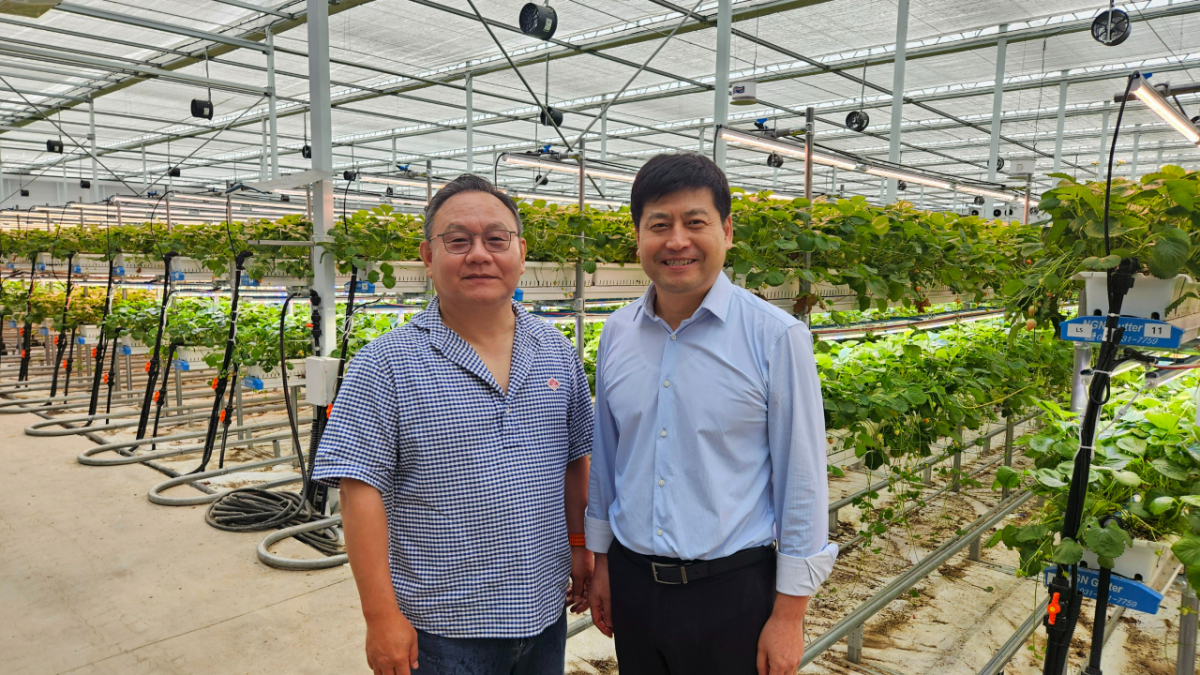
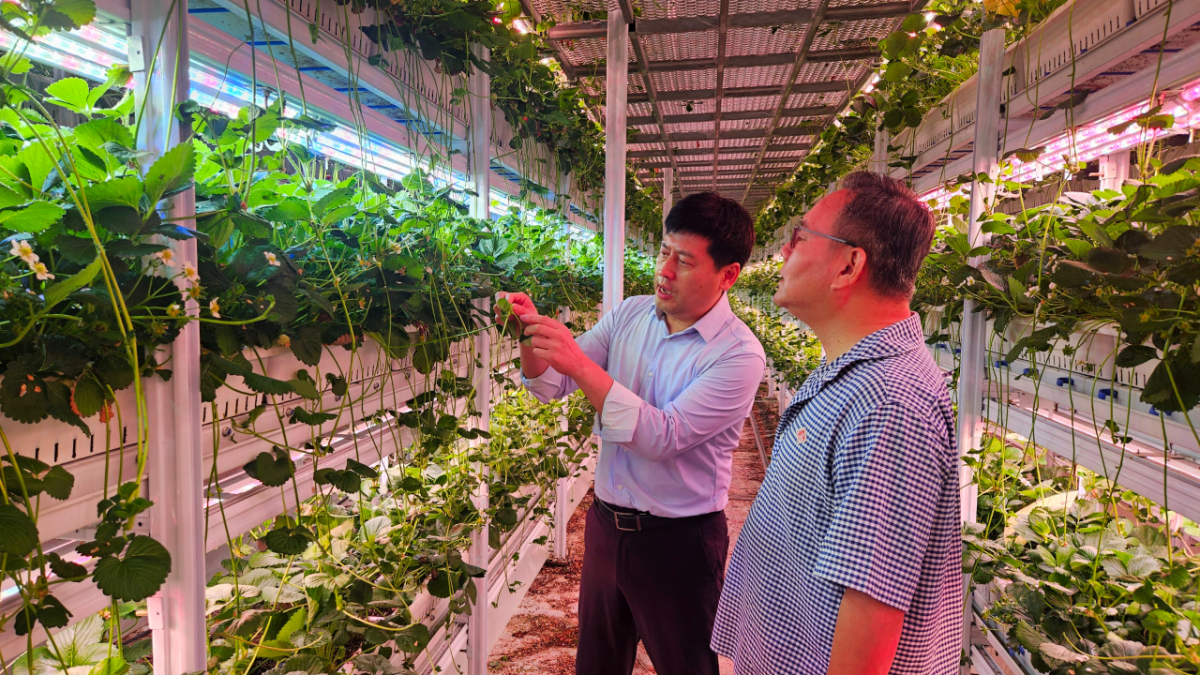
After driving for a while through the rice paddies in Seosan, Chungcheongnam-do where rice is ripening, a vast complex of high plastic greenhouses appeared. While it looked like a greenhouse from the outside, stepping inside felt more like entering a factory. Strawberries were ripening under LED lights, and robots moved between them.
This is the site of SP AGRI (SP AGRI), an agricultural corporation, operating a 7,000-pyeong high-tech farm. It is the world's largest strawberry smart farm combining air conditioning with LED light sources. This facility, which produces fresh strawberries even in midsummer, aims not just to be a simple farm but to become an 'agri-fab' where data and capital are combined.
When Kim Hong-il, CEO of K-Unicorn Investment, toured the site and asked Park Dae-sung, CEO of SP AGRI, "Why do you choose such a difficult path?" Park (CEO) replied, "It is because I cannot stand still. I want to forge a new path."
Park Dae-seong (CEO) is a 30-year veteran in the fresh produce industry who built his career after working at global fresh produce company Dole and serving as Han Guk-beop-in (CEO) at Sumifru. Sumifru Korea, established in 2003, grew to an annual sales volume of 170 billion won, and he founded a related company SP FRESH to expand its product range.
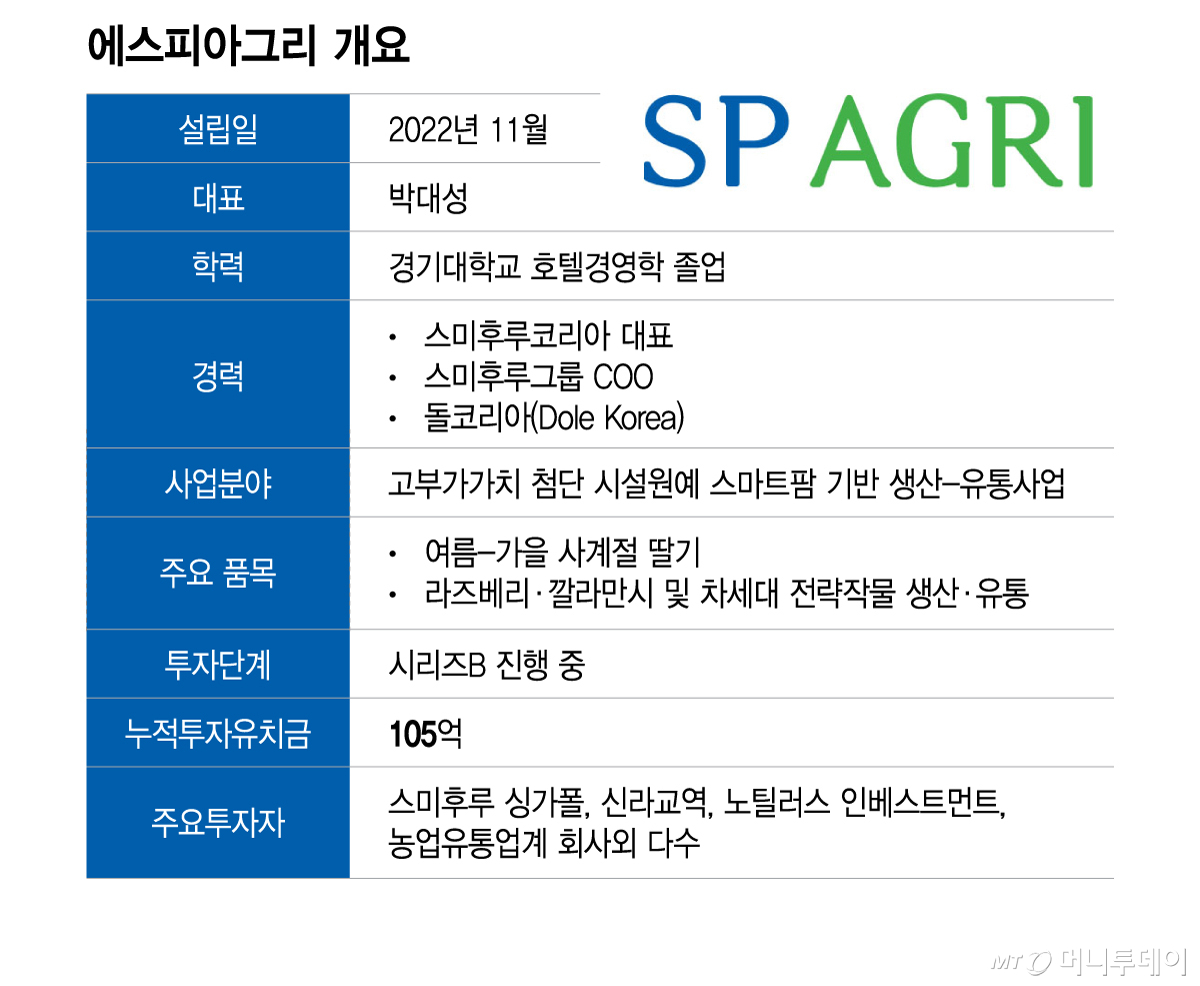
While operating SP FRESH, he experienced the limitations of agricultural distribution and made the decision to engage in direct production, establishing SP AGRI as a subsidiary. Park (CEO) stated, "The rules of agricultural distribution are reset every year," adding, "Accumulated experience does not become next year's asset; we must compete from scratch every year."
SP AGRI began its business by building a test greenhouse in Seosan. The next challenge was crop selection. He said, "To achieve high profits, the entry barrier must be extremely high," and explained, "The result of finding what others cannot enter was summer strawberries and raspberries."
Strawberries are cold-weather crops, making fresh cultivation virtually impossible from May to October. This is why all 150,000 tons of domestic strawberries flood the market in winter. Prices that reach 40,000 won per kilogram in November drop below 10,000 won by March. Conversely, the expected sales price for summer and autumn strawberries ranges from 25,000 to 35,000 won per kilogram.
Park (CEO) explained, "I believed that about 10% of winter demand exists even in summer," noting, "Only products supplied year-round like bananas and mangoes have year-round demand. Strawberries had no such fixed support base at all."
Securing a fixed support base for 'summer strawberries' after trial and error
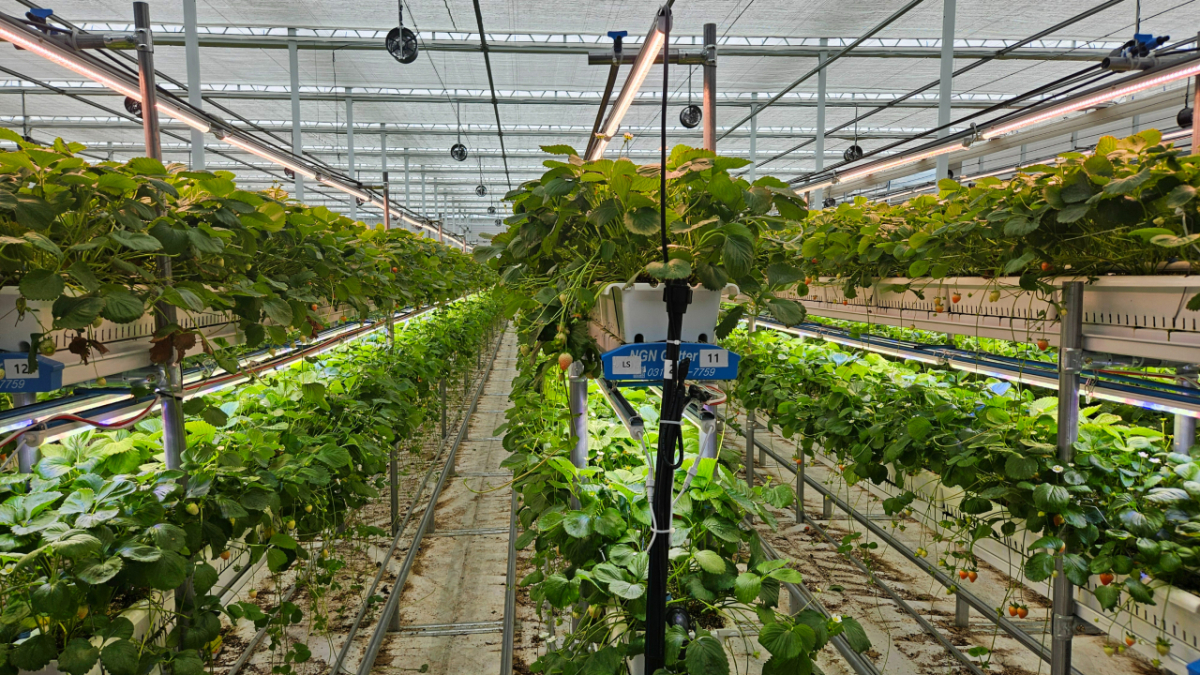
Inside the cultivation facility is equipped with advanced technologies such as the environmental control system from Dutch company PRIVA and AI automatic control from Blue Radix. A triple-layer shading screen, air-source heat pump, LED supplemental lighting, and large-scale cooling and humidification facilities work in tandem.
Instant light intensity in summer exceeds 1000W/㎡. Park (CEO) said, "Without any measures, the interior of the greenhouse reaches 50 degrees," adding, "The strategy of operating by combining three screens with 99%, 90%, and 75% shading is both know-how and data."
Sensors track in real-time the daily light integral (DLI) required by crops, substrate moisture content, and electrical conductivity (EC) of drainage. On cloudy days, insufficient light is supplemented with LEDs, and if drainage EC spikes, root conditions are checked to lower the nutrient solution concentration.
The cultivation beds have a two-story structure. The number of plants per pyeong has been increased to over 50 (, a unit for counting one rooted plant or one clump). This is more than double that of typical single-story greenhouses (around 23 plants). Additionally, a five-tier stacked vertical farm is also operated in a separate 200-pyeong space.
Last year alone, they tested over 40 varieties, incurring initial trial-and-error costs totaling about 20 thousand won. As a result, they secured data showing that the domestic variety 'Gosul' and some European varieties are most suitable for summer cultivation.
Park (CEO) emphasized that creating markets is as much of an adventure as production. He is working in parallel to persuade buyers who insist on selling seasonal fruits in summer, establishing a fixed support base for strawberries supplied year-round like bananas.
The results are showing in numbers. While daily harvests did not exceed 200 kg last year, they have risen to the level of 400–600 kg this year. The goal is to achieve a break-even point (BEP) with annual sales of 5–6 billion won this year.
Integrating robotics… Securing IP for strategic crops
Automation integrating advanced technologies is also underway. Partnering with AI agricultural robot startup Metafarmer, they are testing the harvesting robot 'OmniFarmer.' The robot selects and harvests ripe strawberries from 11 p.m. to 7 a.m., sorting them by size.
Early morning harvesting is directly linked to quality. Park (CEO) stated, "Strawberries must be picked in the cool early morning," adding, "If harvested after being exposed to the sun, they become mushy." This is where the strength of robots that do not tire at night is strongly demonstrated.
Unmanned pesticide sprayers and UVC sterilization robots are also in operation. Park (CEO) predicted, "In 10 years, humanoid robots costing 20–30 million won will enter all sites," noting, "At that time, labor will not be an issue. This business will become a battle of infrastructure, data, and distribution."
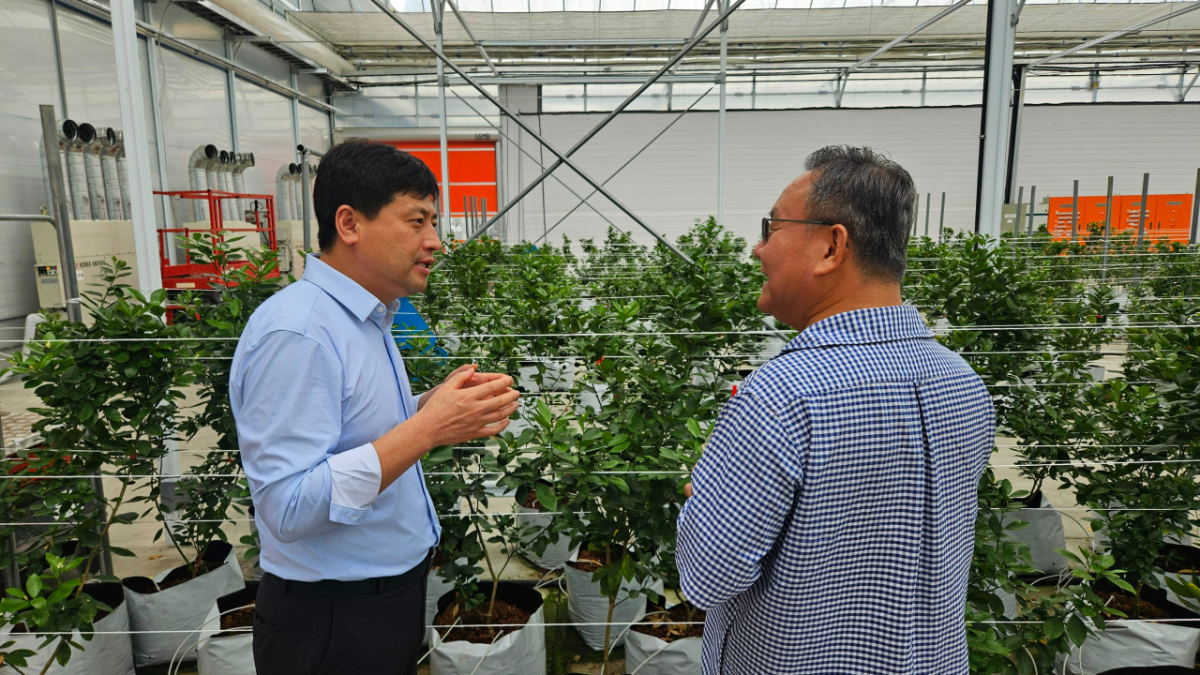
After summer strawberries, the next card SP AGRI targets is raspberries. Fresh raspberry imports are banned in Korea, so they only enter as frozen products. Having endured five years of quarantine cultivation to secure a license, they plan to begin mass propagation next year and introduce them to the market.
He emphasized, "Blueberries were also a fruit not available domestically, yet the current market size exceeds 500 billion won," adding, "Raspberries can at least reach half of that. Currently, we are the only ones in Korea holding a license for this variety."
Calamansi, whose fresh fruit imports are also blocked, has established a unique production system after three years of propagation processes. The plan is to offer fresh fruits of a quality far superior to imported juice concentrates, proposing new gastronomic experiences to consumers and seizing the market.
For calamansi, the fact that it blooms in all four seasons and is resistant to high temperatures, eliminating the need for summer cooling, is also cited as an advantage. Kim Hong-il (CEO) evaluated SP AGRI's strategy by saying, "Choosing crops that existing farmers do not grow is a way to avoid red oceans and does not infringe on farmers' profits."
"Limitations of Korean venture capital: Short patience"
The model Park (CEO) benchmarks is the U.S. berry specialist Driscoll's. As a private company with annual sales in the trillions of won, it dominates the global market based on powerful breeding research and variety IP.
SP AGRI has additionally secured 35,000 pyeong of land in Seosan. The first goal is to complete an additional 6,500-pyeong greenhouse by March next year and fill up to 100,000 pyeong by 2028. The long-term goal is 1 million won pyeong (330 hectares). Applying sales of 900,000–1 million won per pyeong, 1 million won pyeong translates to 1 trillion won in sales.
Park (CEO) said, "Even with 100,000 pyeong, sales would reach 1 million won," adding, "We will challenge the market dominated by global fresh produce companies like Sumifru, Dole, and Zespri as a domestic company." In particular, their strategy is to use 'vertical integration (value chain)' linking variety introduction, seedling production, cultivation, distribution, and export as a powerful weapon.
The key is capital. They raised 70 billion won in Series A funding in 2023 and are currently proceeding with the Series B round. Sumifru participates in every round as the largest shareholder. Park (CEO) reflected on the initial fundraising process, stating that raising large-scale capital in the agricultural sector is not easy.
At this point, Kim Hong-il (CEO) pointed out structural problems in the Korean venture ecosystem. He noted, "Early investors of SpaceX waited more than 20 years to recover their investment," adding, "In Korea, fund maturity is only five years, so the duration (recovery period) of capital itself is different, and patience is too short."
This means that for capital-intensive infrastructure projects like SP AGRI, which involve massive funds and infrastructure rather than simple agriculture, the capital market must view this as a new industrial standard and establish a structure for long-term investment.
Park (CEO) believes that once the corporate farming model is established, excellent talent will flow into agriculture and jobs will be created. He explained that 'scaled smart farms' can play a role as a concrete alternative to address regional decline and climate crisis.
He said he drew inspiration from an anecdote about Hyundai Group founder Chung Ju-yung building a shipyard with just one photo of a white sandy beach and a tanker blueprint. Just as he built a world-class shipyard in the barren land of shipbuilding, his goal is to overcome the current limitations of Korean agriculture and establish a new agricultural model where capital and advanced technology are combined.
Park (CEO) emphasized, "The problems currently facing agriculture are themselves opportunities," stating, "If we create large-scale, automated, data-based complexes, we can simultaneously possess domestic and export competitiveness. Starting with four-season strawberries, we will create a global fresh produce company that stands shoulder-to-shoulder with the world from Korea."
[MoneyToday startup media platform 'Unicorn Factory']

 in FUTURE


