

[For more diverse company information on the startups mentioned in this article, visit the Unicorn Factory big data platform 'Data Lab.]
"We plan to unveil driverless autonomous taxis with no one in the driver's seat in Seoul by the end of this year. If we succeed in commercialization, we expect to become the third country after the United States and China."
Park Jung-hee, CEO of RideFlux, made these remarks at 'KDB Next Round–Physical AI (Artificial Intelligence)' held on the 25th at the IR center of Korea Development Bank's headquarters in Yeouido-dong, Seoul. With technology optimized for domestic urban environments, RideFlux aims to catch up in the autonomous driving market where the U.S. and China are leading.
RideFlux is targeting the robotaxi and middle-mile logistics markets based on its autonomous driving software. It particularly highlights 'Dock-to-Dock' technology that enables fully autonomous driving from departure to arrival at logistics centers as a competitive edge. Following Korea's first approval for paid autonomous cargo transport, it has also secured permission for unmanned autonomous driving.
Park (CEO) stated, "Our goal is to launch driverless taxis with no one in the driver's seat in Seoul by the end of this year." In the future, the company plans to expand its business model beyond directly operating vehicles to supplying autonomous driving software and generating recurring revenue.
At the KDB Next Round event held today, domestic physical AI startups targeting industrial sites in manufacturing, logistics, mobility, and healthcare showcased their technologies and commercialization strategies. The event, co-hosted by Atnem Investment and Korea Development Bank, featured IR participation from four companies: Diden Robotics, MooBin, RideFlux, and MedinTech.
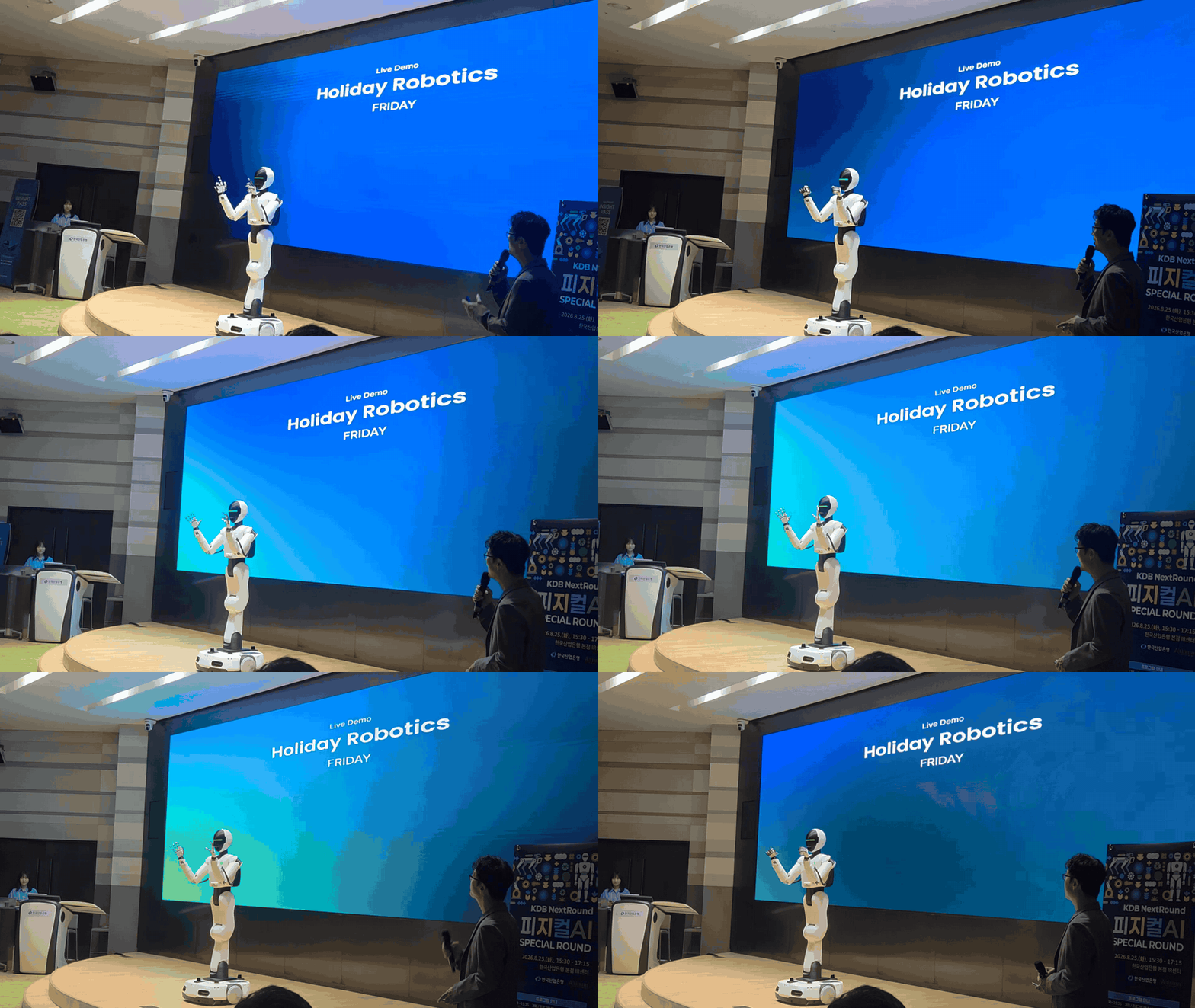
Before the IR sessions, industrial humanoid robot company Holiday Robotics demonstrated its humanoid 'Friday' on-site. Friday performed actions required in industrial settings, such as moving finger joints and operating drills.
Song Ki-young, CEO of Holiday Robotics, emphasized in his keynote speech that Korea's manufacturing foundation could become a competitive advantage for the commercialization of physical AI.
Song (CEO) said, "Korea is a country with an overwhelmingly high robot density globally, with 1,220 industrial robots per 10,000 workers." He added, "Commercializing first in Korea and then expanding to the global market based on the experience and technology accumulated here would be a good approach."
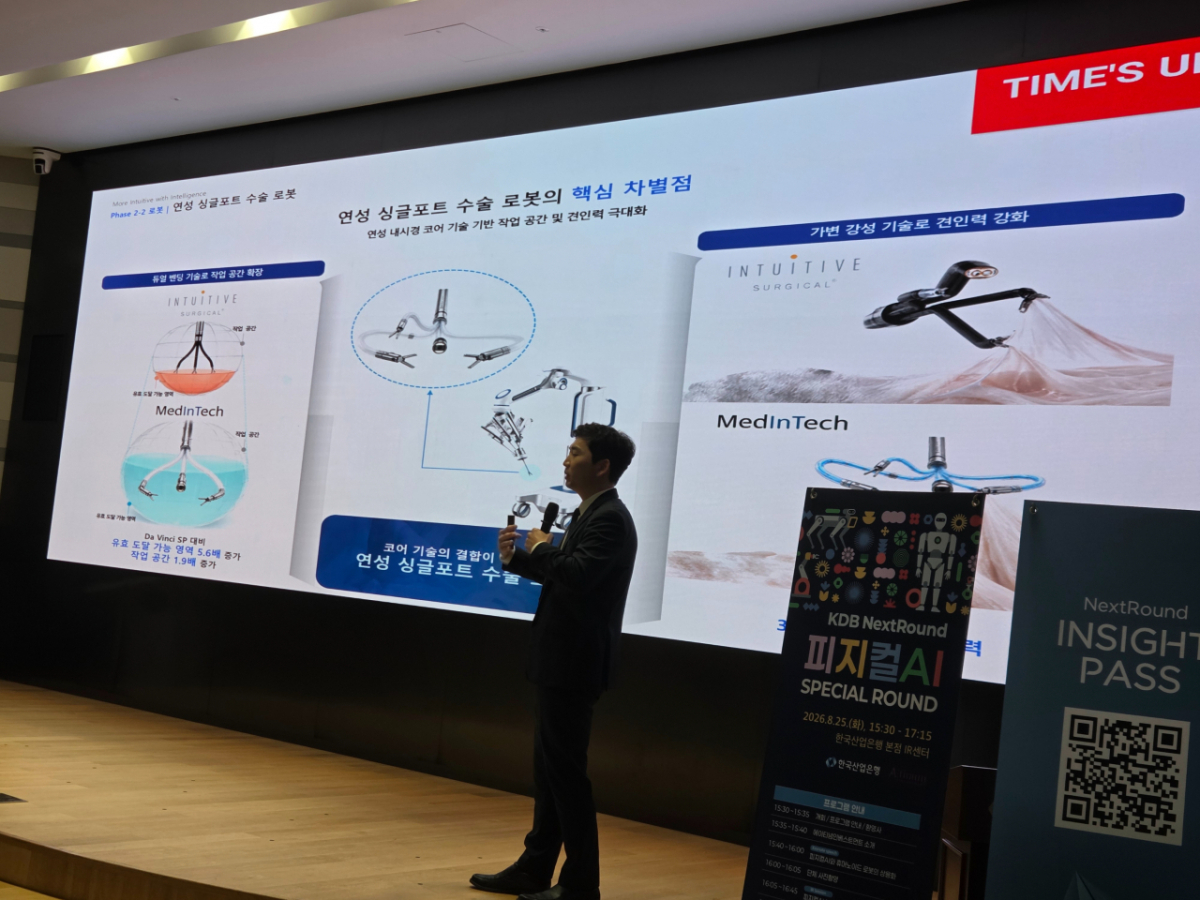
At the event today, physical AI companies from various fields, ranging from robots roaming shipyards to surgical robots used in medical settings, presented their technologies through IR sessions.
Kim Jun-ha, CEO of Diden Robotics, stated, "Automation is urgently needed in harsh environments like shipbuilding or ships, but many sites exceed the design scope of existing robots." Diden Robotics targets non-standard industrial sites such as shipbuilding and shipping where existing robots struggle to access. To this end, it is developing 'Diden Spider,' a quadruped robot with magnetic feet specialized for steel structures, and 'Diden Walker,' a humanoid robot. It has also developed core hardware including actuators and magnetic feet. The company plans to secure Series A funding and expand into Yangsan and global markets in the future.
In the following presentation, Choi Byeol-i, CEO of MooBin, emphasized the importance of 'data,' a key resource for physical AI. Choi (CEO) said, "For humanoids to work alongside humans, motion data that enables learning human movements will become crucial."
MooBin has developed markerless motion capture technology that uses LiDAR, cameras, and AI to digitize human movements in real time without attaching separate sensors to the body. The company began supplying its product to Yangsan last year for global markets, with approximately 70% of its revenue coming from overseas. More than half of this comes from the North American market.
Lee Chi-won, CEO of MedinTech, presented a blueprint to expand technology beyond robotic endoscopy into treatment and surgical areas. Based on technology developed by the Korea Electric Power Research Institute, MedinTech developed a flexible robot endoscope that converts conventional mechanical endoscopes into robots. Clinical trials involving approximately 550 patients were completed at five university hospitals including Seoul National University Hospital. The company is also supplying products to domestic national fire hospitals and countries such as Thailand, the Philippines, and Mongolia.
Lee (CEO) stated, "Even without doctor steering, AI finds its own direction, and the robot moves in that direction." He further revealed his vision: "In the future, we plan to expand into non-invasive surgical robots where AI recognizes lesions and major blood vessels and nerves, and the robot approaches the lesion to resect tissue."
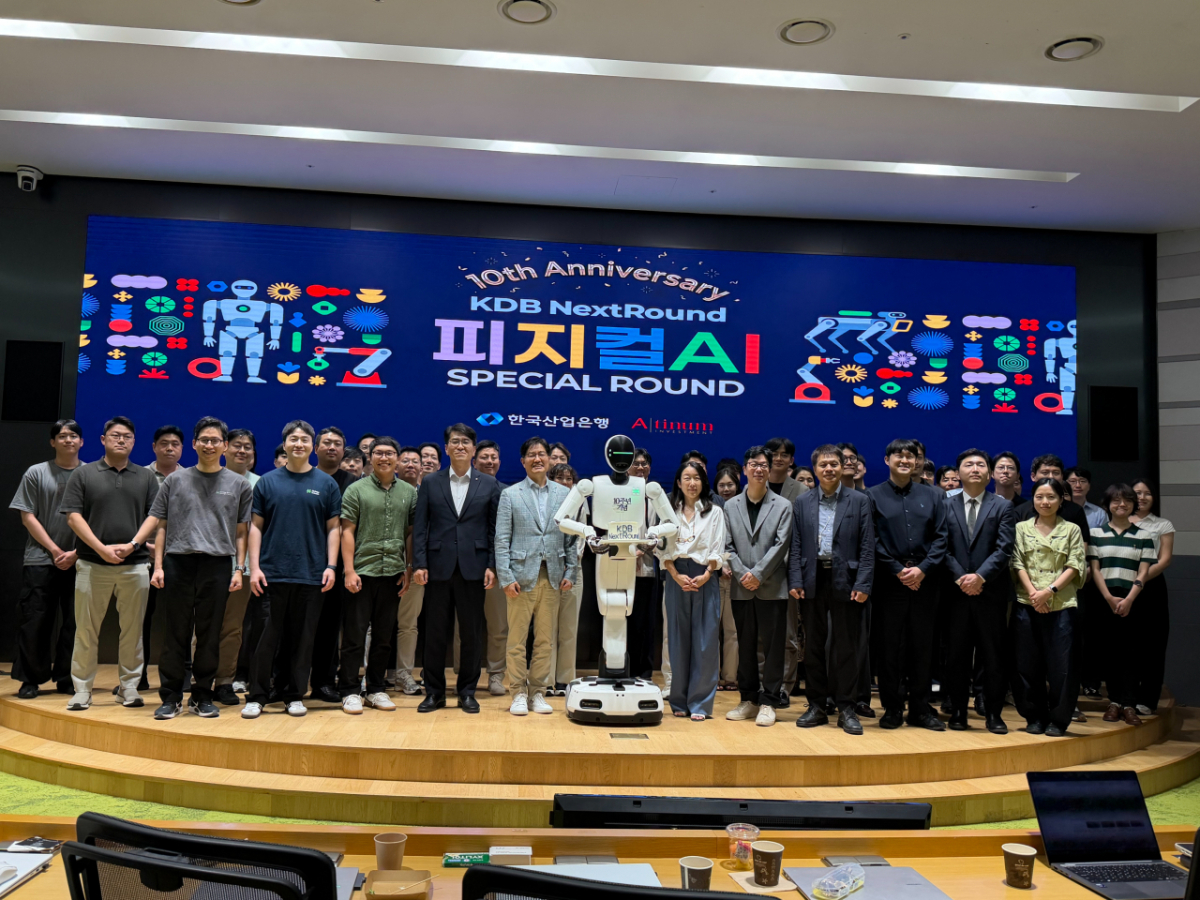
Korea Development Bank and Atnem Investment emphasized that for physical AI to spread into actual industries, large-scale capital supply over an extended period is necessary.
Yoon Tae-jeong, Deputy President of Korea Development Bank, said, "Physical AI is a field where AI drives change beyond the digital realm into actual industrial sites such as manufacturing and logistics, with massive funds already being invested in the global market." He added, "We must closely connect startups with investors who share their future to ensure South Korea gains a competitive edge."
Meng Du-jin, CEO of Atnem Investment, also stated, "The physical AI industry is now entering its embryonic stage," emphasizing that proactive large-scale investment and efficient growth support are needed. Atnem Investment was selected this year as the manager of the National Growth Fund's major league and is pushing to establish a new fund with a scale of 1 trillion won by the end of this year.
Meanwhile, KDB Next Round is a market-based venture investment platform operated by Korea Development Bank to help innovative companies secure investments and revitalize the venture investment ecosystem. This year marks its 10th anniversary since launch.
[MoneyToday startup media platform Unicorn Factory]

 in FUTURE


