

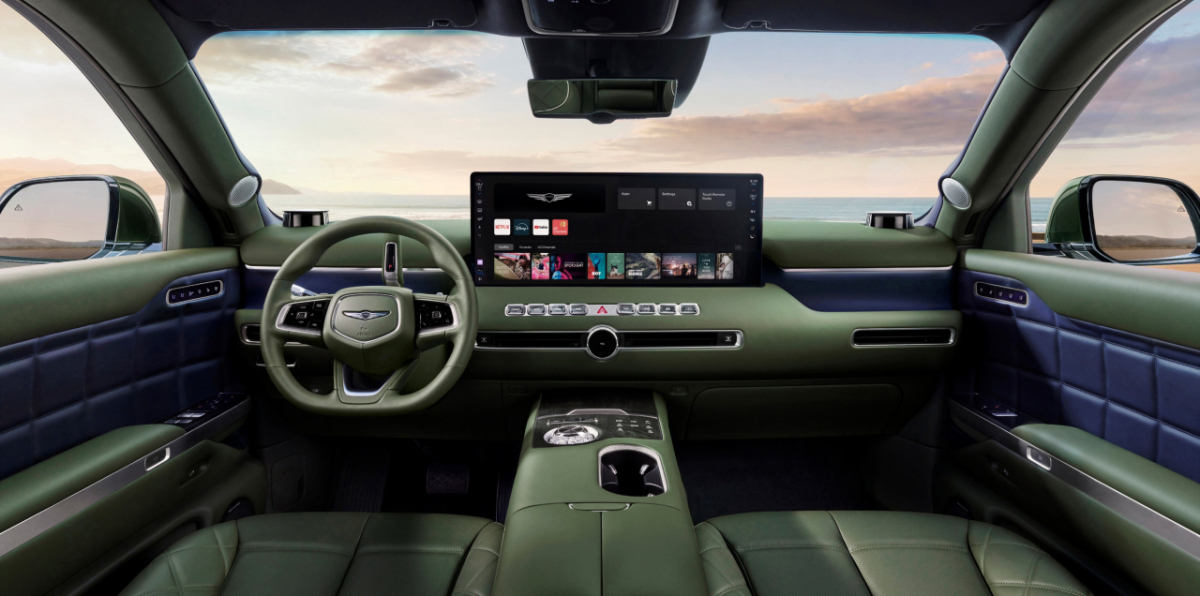
The domestic display industry is accelerating its push into the automotive OLED (organic light-emitting diode) market. With premium vehicles increasingly adopting OLED technology, steady growth in the related market is expected. Samsung Display and LG Display are securing global automakers as customers one after another to strengthen their market leadership.
Samsung Display announced on the 26th that it will begin full-scale shipments of two types of OLED screens—24.6-inch and 13.2-inch—to Genesis's flagship all-electric SUV, the GV90, starting this month.
In fact, the center console of the GV90 is equipped with a variable display featuring a 24.6-inch OLED screen. Its key feature is that the screen size changes depending on the situation. While driving, drivers can view driving information, navigation, and media content on a 23.6-inch wide-screen format. After stopping the vehicle and pressing the expansion button on the center fascia, the display rises by 90mm, expanding to a 24.6-inch large screen that is approximately 1.7 times wider than during driving.
With an ultra-wide 24:9 aspect ratio and 3840×1440 high resolution, it is optimized for enjoying video content such as movies. The application of a 'tandem' structure, which stacks two organic light-emitting layers, ensures high brightness and long lifespan. Additionally, 13.2-inch OLED displays are installed on the back of the headrests in the front seats of the GV90.
Recently, the proportion of OLED adoption has increased, particularly among premium vehicles. Compared to LCD (liquid crystal display) panels that require a separate backlight (light source), OLEDs are approximately 30% thinner and 70% lighter, allowing greater freedom in interior vehicle design. As the number and size of screens installed inside vehicles have grown, demand for high-resolution, curved, and large-sized OLEDs has expanded.
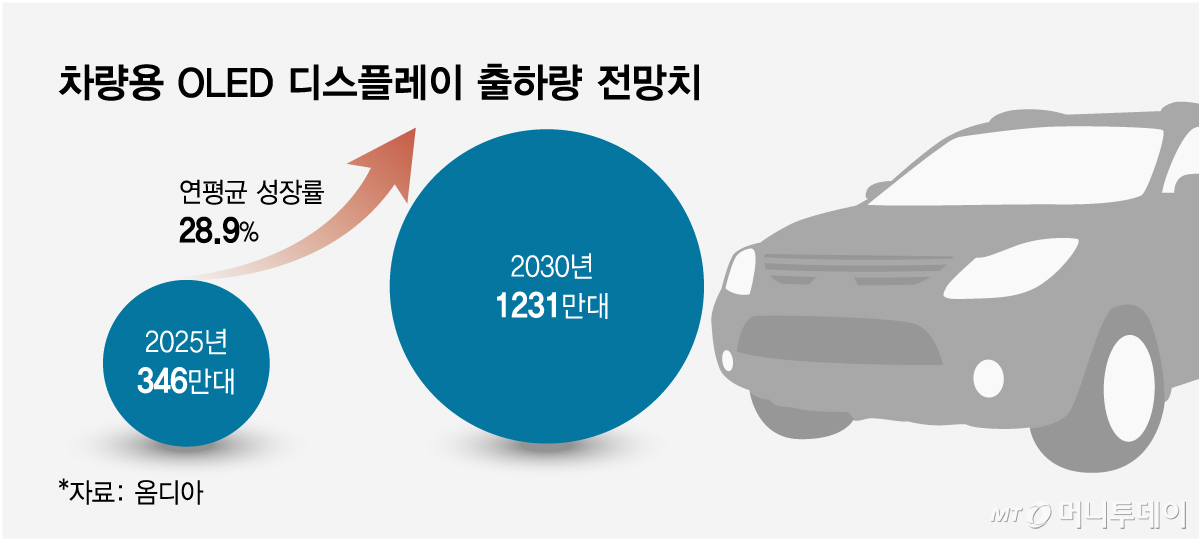
According to market research firm Omdia, global shipments of automotive OLED displays are projected to rise from 3.46 million units last year to 12.31 million units in 2030. The compound annual growth rate is expected to reach 28.9%. Over the same period, the share of OLEDs in total revenue within the global automotive display market is forecast to expand from 6.7% to 18.1%.
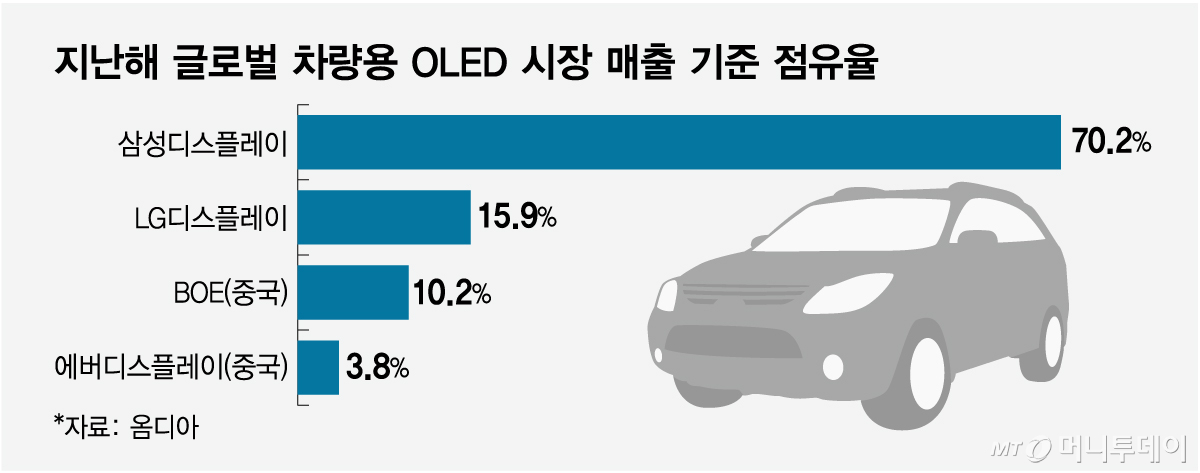
Currently, the domestic companies lead the automotive OLED market. In last year's global market, Samsung Display and LG Display held revenue-based market shares of 70.2% and 15.9%, respectively, ranking first and second. Both companies are pursuing a strategy to expand their market dominance by strengthening cooperation with global automakers. Samsung Display supplied four types of OLED screens ranging from 6.3 to 12.9 inches to Ferrari's 'Lucid' this year alongside Genesis. Notably, the Lucid's Binnacle applied a multi-layer design for the first time in the world, stacking two OLED panels of 12.9 inches and 12 inches. It also supplied two types of OLEDs to China's Zeekr models '8X' and '9X'. Additionally, it has secured German automakers Audi and Mini, as well as Chinese manufacturer Li Auto, as customers.
LG Display is currently supplying OLED panels to over 10 major global automakers. In the automotive business segment, LG Display plans to continuously strengthen its leadership in the growing automotive display market by leveraging a differentiated product and technology portfolio—including tandem-technology-based P (plastic)-OLED, ATO (Advanced Thin OLED), and high-end LTPS (low-temperature polycrystalline silicon) LCD—along with solid customer relationships.
An industry executive stated, "Long-term collaboration with automakers and securing high-quality and reliable products are essential for automotive OLEDs." He added, "Domestic companies that have secured major automakers as customers possess strong competitiveness in the market."

 in INDUSTRY


