

[More diverse corporate information on startups can be viewed at Unicorn Factory's Big Data platform 'Data Lab'.]
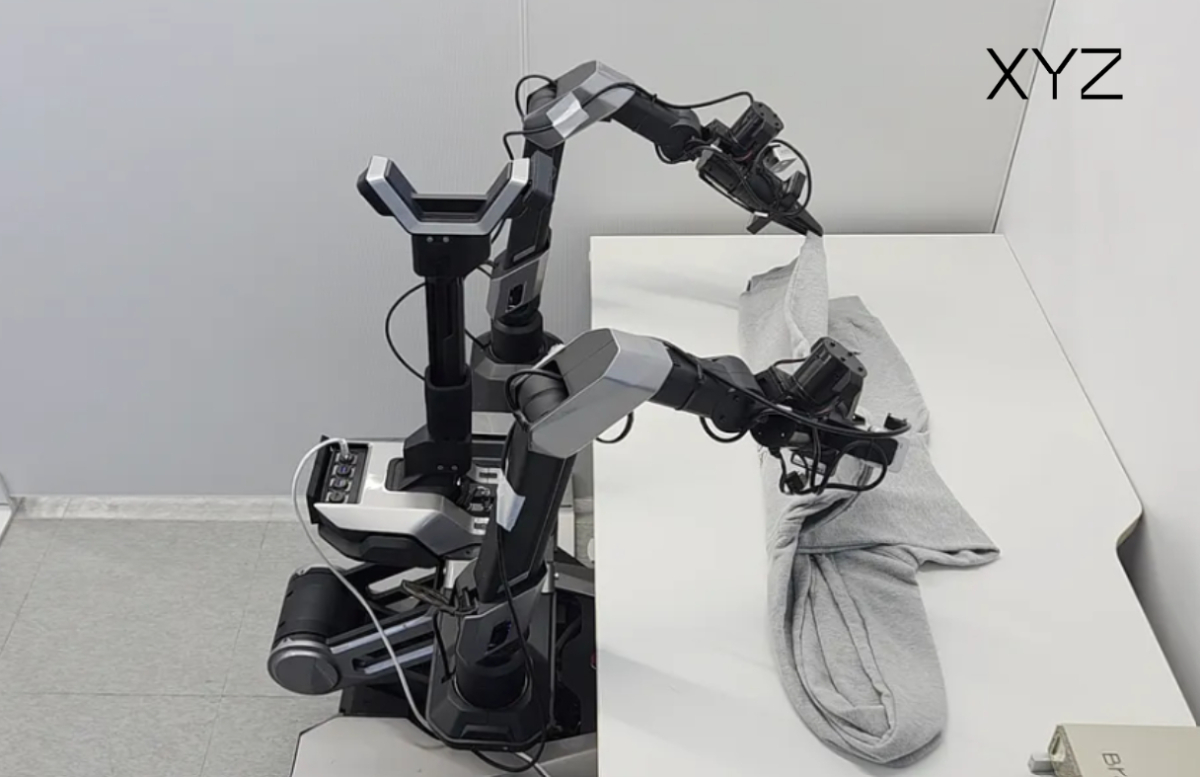
AI robotics company WIZ, which operates under the brand WIZ, announced on the 7th that it has doubled the speed of robots folding clothes compared to previous levels, based on its proprietary behavioral intelligence platform "Brain X."
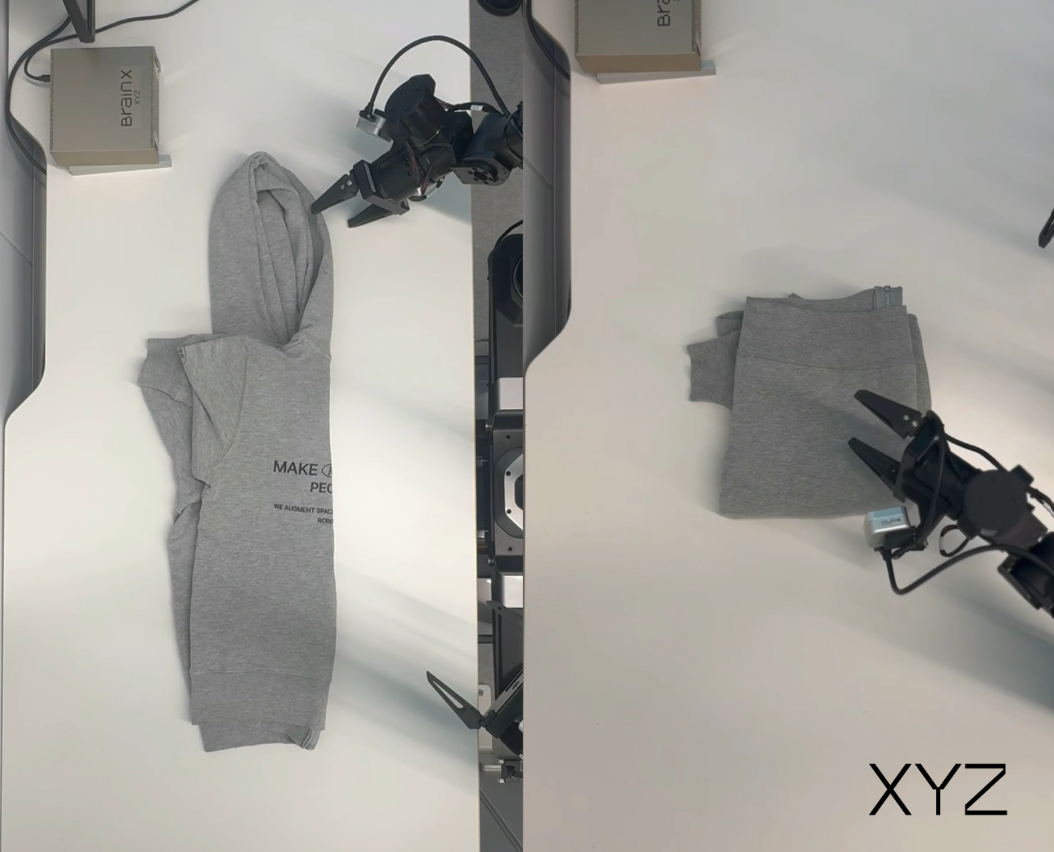
The clothing folding task, which previously took about 50 seconds, was reduced to approximately 25 seconds, achieving a 96% success rate even in a double-speed environment. The success rate in the single-speed environment was 100%.
Objects that do not have a fixed shape like clothing and experience friction and slipping may see increased trajectory errors or vibrations as the manipulation speed increases, potentially lowering work success rates and completion quality.
An XG representative emphasized that this enhancement signifies optimizing not only the playback speed of actions but also jointly optimizing from the model's inference to the robot's execution and control, thereby securing both speed and stability simultaneously.
XG utilized Galaxy's "R1 Pro Lite," a Chinese robotics company, to train its clothing folding model and optimize it for high-speed manipulation environments. The system employed an asynchronous inference method that overlapped the VLA (Vision-Language-Action) model's inference with robot execution while the robot performed actions, enabling real-time reasoning of subsequent movements.
The research team applied the open-source model and core algorithms of 'VLASH' to a clothing folding environment to reduce inference latency in real-time VLA, conducting an ablation study to verify the contribution of each component.
Verification results revealed that certain approaches of VLASH, which predicts the state at a future execution time, have limitations in generating movements larger than the range required for precise fabric manipulation in high-speed clothing folding environments.
Although "temporal-offset augmentation" designed to address inference delays was also validated using its own dataset, it did not lead to performance improvements at the targeted level due to the friction characteristics of the fabric.
In response, XG applied the core concept of asynchronous inference to BrainX instead of using its existing method, combining it with proprietary optimization technology tailored for high-speed operations.
Specifically, it was explained that the entire control process from model inference to robot execution was optimized by applying △acceleration based on efficient data learning and low sampling △smoothing filters, and adaptive speed control together.
Low sampling reduces the impact of noise included in expert trajectories while helping the model learn core movements, and smoothing filters reduce end-effector jitter and trajectory noise occurring during high-speed movements.
Adaptive speed control adjusts speed limits in real time according to the robot's movements. It moves quickly during transit sections and precisely during segments requiring delicate contact, such as grasping or releasing clothing.
After completing the task, we confirmed that the folding quality was comparable to the previous level, with no unwanted wrinkles, clumping, or degradation of shape. To apply physical AI in real-world environments, it is necessary to comprehensively optimize not only the model's task execution capabilities but also its inference speed and the robot's execution and control performance.
Kim Jae-hyun, a team leader at XG's Robot Intelligence Division, said, "We will continuously enhance BrainX's models and robot control technologies to achieve faster and more stable robot operations," adding that the company also plans to establish and publicly release quantitative evaluation methods capable of objectively measuring and verifying clothing folding quality.
[Money Today startup media platform 'Unicorn Factory']

 in FUTURE

