

[For more diverse corporate information on the startup featured in this article, visit the Unicorn Factory big data platform 'Data Lab'.]
"A 30% sales commission? Is that even a reasonable number?"
The eyes of an accountant with eight years of experience widened as he examined documents from a home appliance rental company at a major accounting firm. He witnessed that customers were paying nearly twice the manufacturing cost due to exorbitant sales commissions and intermediary fees incurred during the distribution process.
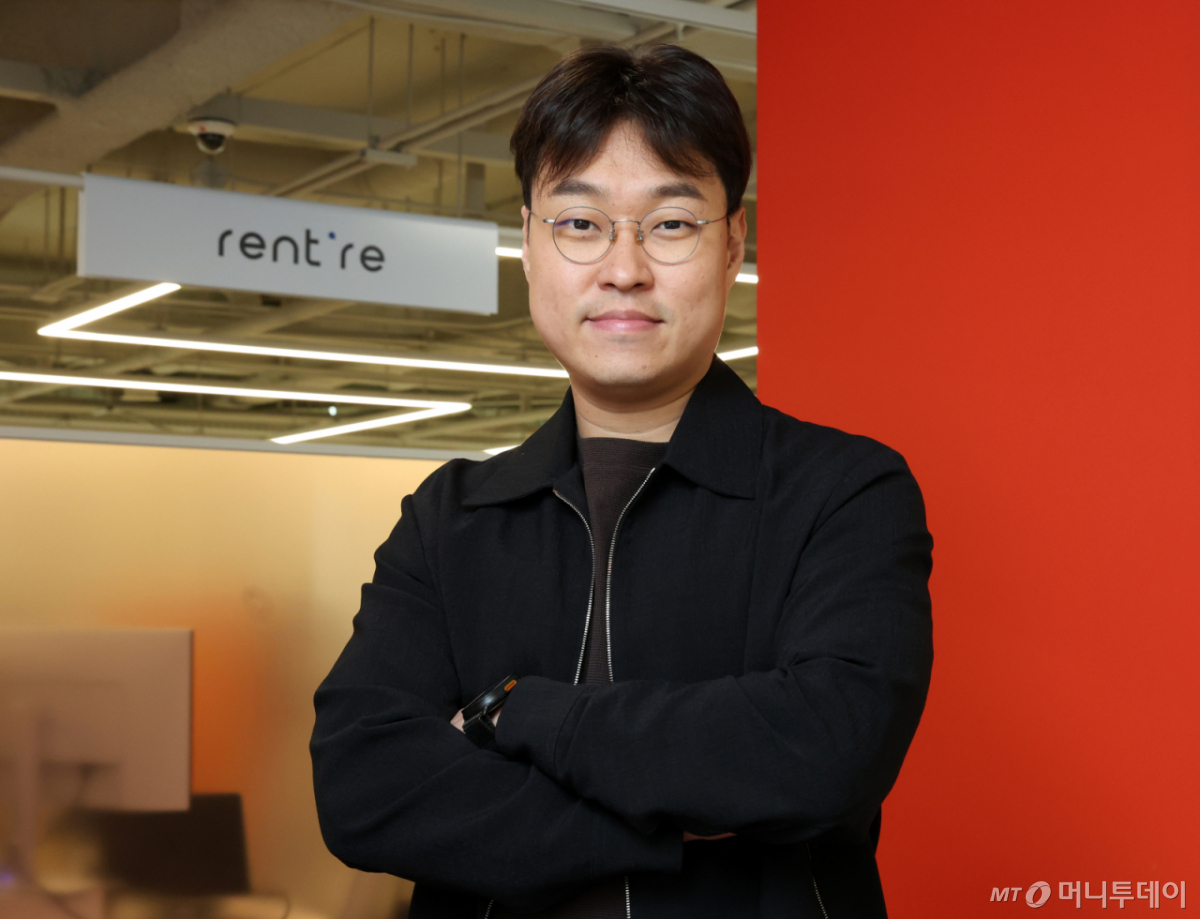
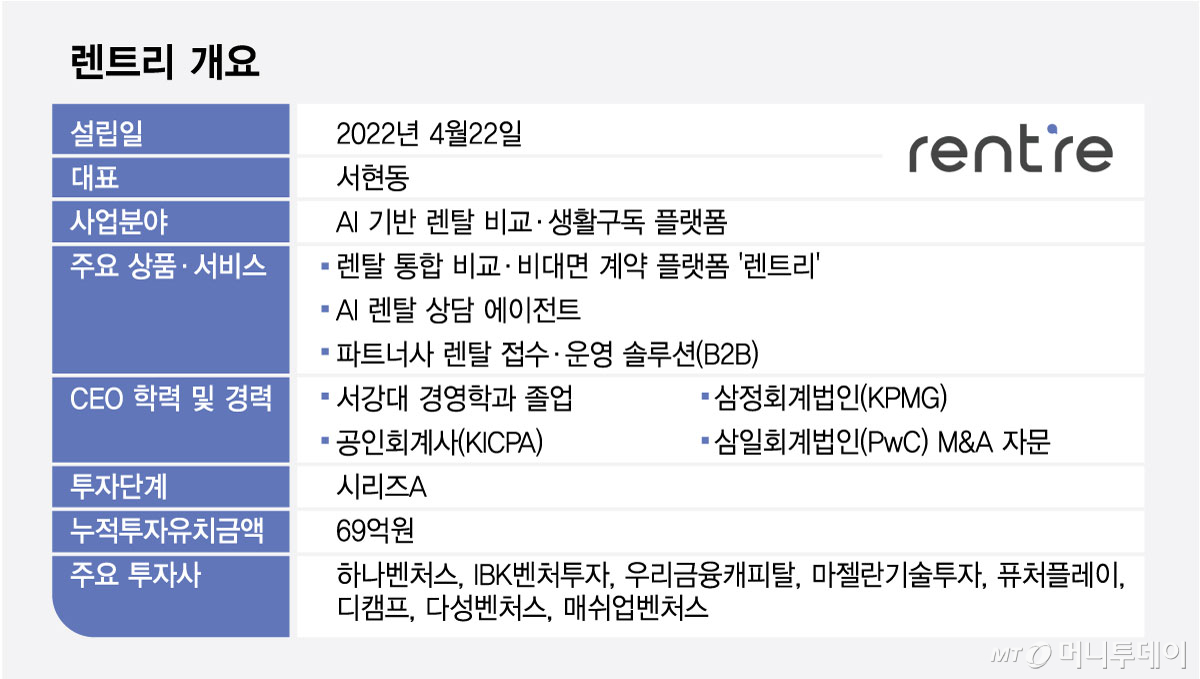
The accountant focused on the fact that annual sales commissions alone amount to 3 trillion won in the home appliance rental market, which exceeds 10 trillion won. Judging that there was a chance to capture the entire market given a clear customer problem and the precise existence of the market, he started a business. This is the story of the CEO of Seohyeon-dong Rentree.
Rentree is a platform where users can compare rental terms for water purifiers, home appliances, and telecommunications products in one place and complete contracts. Seo (CEO) described the company as "helping anyone start complex rentals without loss," adding, "Our goal is to have the system calculate scattered conditions on behalf of customers, providing them only with answers they can choose with peace of mind."
After deciding to start a business, the first thing he did was experience being a consumer. It took a full month just to look into one water purifier. Searching online yielded only advertisements, and phone calls revealed different terms from each seller. He had to decide on a 2 million won long-term contract over a single phone call without knowing the terms until the very end. Seo (CEO) said, "Even I, who know numbers, gave up on calculating exact profits and losses. I wondered how much worse it must be for ordinary consumers."
Rentals are essentially close to financial products. Monthly fees, subsidies, penalty fees, and partner card benefits are intertwined, and ownership transfers after the mandatory usage period ends. However, customers had to perform these calculations alone through a closed channel of phone consultations. Moreover, since terms varied by seller, even comparing them was left to the customer.
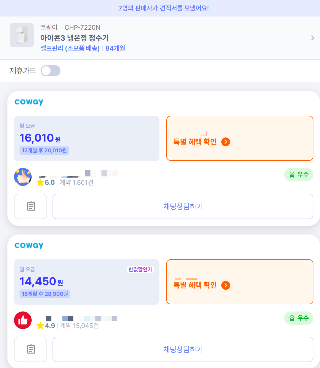
The first service launched after trial and error was simple. It simply made sellers compete for estimates on a single customer and allowed consultations via chat instead of phone calls. Yet, one out of two customers who compared estimates proceeded to an actual contract.
Currently, Rentree is focused on minimizing phone consultations. The structure allows AI to learn the questions and judgments exchanged during consultations, enabling customers to reach the most favorable terms without a person holding the phone. However, for customers unfamiliar with digital platforms, phone consultations are not completely eliminated.
Reducing phone consultations also aims to secure "cost competitiveness" in addition to customer convenience. Seo (CEO) stated, "Rental sales have low barriers to entry, so competition ultimately becomes a battle over who offers more subsidies," adding, "To win sustainably, our costs must be structurally lower than those of competitors." By actively utilizing AI agents, Rentree has significantly reduced operating costs per contract compared to the traditional method relying on call center personnel.
Data is what lowers those costs. Conditions for over 4,000 products from more than 130 brands are constantly refined, and approximately 700 sales organizations known for their top performance nationwide have joined Rentree. In addition, data from a cumulative 2.8 million consultations and 36,000 contracts has been accumulated. Over 10,000 consultation data points are added daily. Seo (CEO) said, "The only secret to success is that we decided from the beginning to solve this problem with a 'product' rather than by expanding consultation personnel."
Rentree's metrics have surged over the past year. Monthly Active Users (MAU) increased from 10,000 to 410,000, monthly transaction volume rose from 50 thousand won to 13 billion won, and monthly revenue grew from 300 million won to 1.2 billion won. Cumulative transaction volume has exceeded 2 million won, with 70 billion won transacted in the first half of this year alone. The number of cumulative members has surpassed 500,000. The company is also aiming for monthly profitability within the year.
The product lineup is expanding as well. Starting with water purifiers, it has expanded to home appliances and telecommunications, and recently added tire rentals and combined funeral service products. Regarding a product lineup that may seem inconsistent at first glance, Seo (CEO) described them as "goods that necessarily require consultation before purchase," explaining, "These are products for which many customers call multiple places just to rent once, yet still cannot be confident that their choice was correct." Consequently, mobile phones, insurance, and auto leasing are also candidates for expansion. Recently, the company has been increasing its direct sales share by directly eliminating intermediate distribution stages.
Seo (CEO) has set a goal beyond rentals to become a "lifestyle subscription platform." He said, "Paying 30,000 or 50,000 won per month to bring in dryers or dishwashers to improve quality of life is a desirable consumption method, but the reason it does not spread is the inefficiency of the distribution structure," adding, "I want to create a world where starting subscriptions for necessary home appliances and other products becomes as easy and transparent as subscribing to one OTT service."
Furthermore, he stated, "Within two years, we will build an overwhelmingly satisfying service for customers and aim to grow into a lifestyle subscription platform encompassing all necessary subscription services in the long term," adding, "We will also unveil service renewals that lower costs by directly executing distribution structures through listing self-planned rental products on the platform, and reduce even the burden of price comparison for customers by providing automatic matching or fixed-price products."
[MoneyToday startup media platform Unicorn Factory]

 in FUTURE


