

[For more diverse corporate information on the startups mentioned in this article, please visit the Unicorn Factory big data platform 'Data Lab'.]
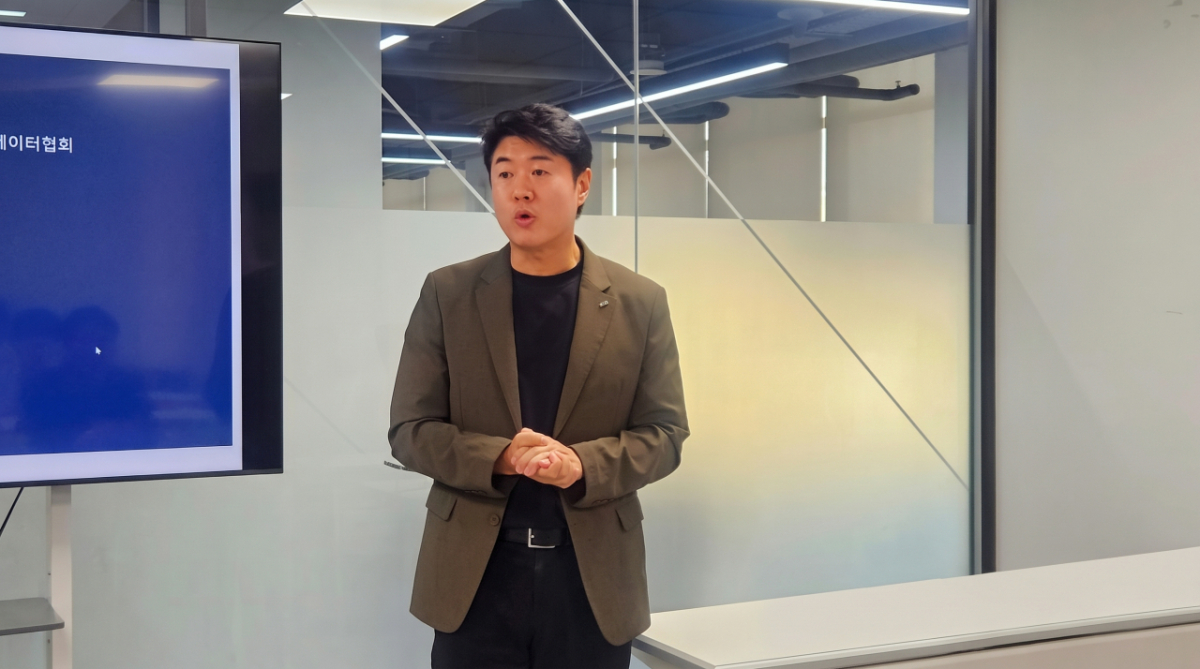
"The more AI (artificial intelligence) advances, the fewer jobs for young people there will be, and inevitably, more young people will be pushed toward entrepreneurship. In this situation, abolishing the Youth Startup Academy (YSA), which young people have trusted and relied on, is a policy that does not fit the AI era at all."
Chun Hwa-sung, Chair of the Early-Stage Investment Accelerator Association (Early-Stage Investment AC Association), said this at a press conference held on the 29th in Mapo-gu, Seoul, to mark the publication of the 'Accelerator Industry White Paper 2026' and report on the achievements of the association's fourth board.
The YSA, launched in 2011, has provided commercialization funds, space, coaching, and other support to early-stage entrepreneurs aged 39 or younger. The government has decided to remove the YSA-related budget from next year's budget proposal and utilize the nationwide hubs, facilities, and personnel previously used by the YSA for the 'Second Chance Success School,' which supports re-entrepreneurs.
The background behind the government's push to abolish the YSA includes issues of duplication in startup support programs and operational inefficiency. As hubs expanded nationwide, operating methods such as direct management by the Korea Small and Medium Business Promotion Corporation and private outsourcing became mixed, and management problems, including improper receipt of government subsidies, emerged in some cases.
Jeon Hwa-seong (Chairman) stated, "The YSA has been a program that has served as a pillar of the Korean startup ecosystem since its opening in 2011," adding, "The alumni network that produced companies such as Toss and Zigbang, along with the standardized accelerating curriculum, are assets that cannot be easily replaced."
He noted, "If the YSA disappears, not only will the startup education and incubation system accumulated over 16 years be shaken, but the role of private ACs could also significantly diminish," proposing that the YSA should be transformed from an existing one-year support program into a growth platform linking 'startup-growth-investment.'
Jeon (Chairman) emphasized, "Incubation and investment must be centered on private ACs for the current government-led system to shift to a private-led model in the long term." He added, "I plan to make this proposal when I meet the Minister of the Ministry of SMEs and Startups on the 8th of next month. We must move forward in a future-oriented manner while fully preserving the know-how and processes accumulated over 16 years."
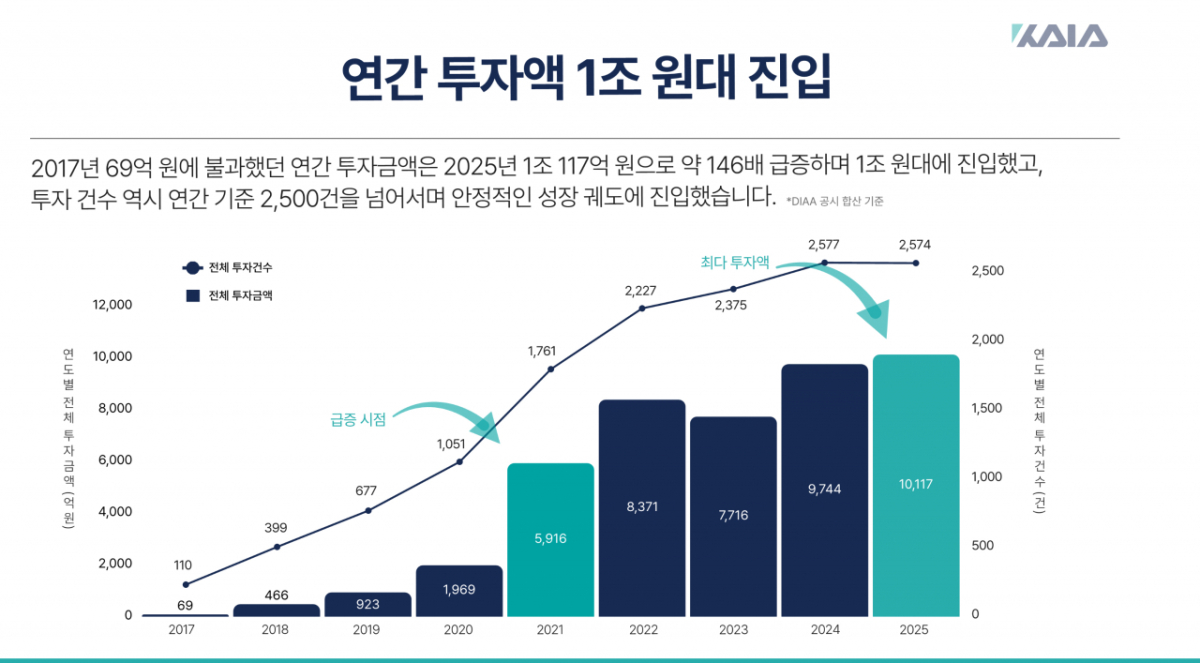
According to the AC Industry White Paper, which analyzed the investment and incubation performance of 495 registered ACs as of the end of last year from 2017 to 2025, the annual investment amount by domestic ACs increased from 6.9 billion won in 2017 to 1 trillion 11.7 billion won last year. This marks the first time the annual investment volume has surpassed the 1st trillion won mark since the implementation of the startup planning system.
The number of ACs that executed investments last year was 295, which is 11.8 times the 25th companies in 2017. During the same period, the annual number of investment deals increased from 110 to 2,574. The cumulative investment amount from 2017 to last year was 4 trillion 529.1 billion won, and the cumulative number of investment deals was 13,751.
Jeon (Chairman) said, "There has been a perception that ACs do not make investments but focus only on incubation projects." He added, "If the association had not collected data directly, the fact that ACs are an industry investing over 1 trillion won annually would not have been properly known."
However, while external metrics such as investment scale have grown, polarization within the AC industry has deepened. Among the 400th ACs with cumulative investment performance, 54 companies with investment amounts of 20 billion won or more executed 3 trillion 432.2 billion won, accounting for 75.8% of the total cumulative investment amount.
Furthermore, among the 495th registered ACs, 95 companies (19.2%) had no investment history at all. Thirty companies had no investment performance even after three years since registration, and 39 companies, which had past investment performance, have suspended activities for more than three years since their last investment.
Among the 39th companies that suspended investments for more than three years, 18 were continuing incubation activities, while the remaining 21 were found to have suspended both investment and incubation. The association plans to separately investigate the causes of investment suspension and operational status of these institutional investors.
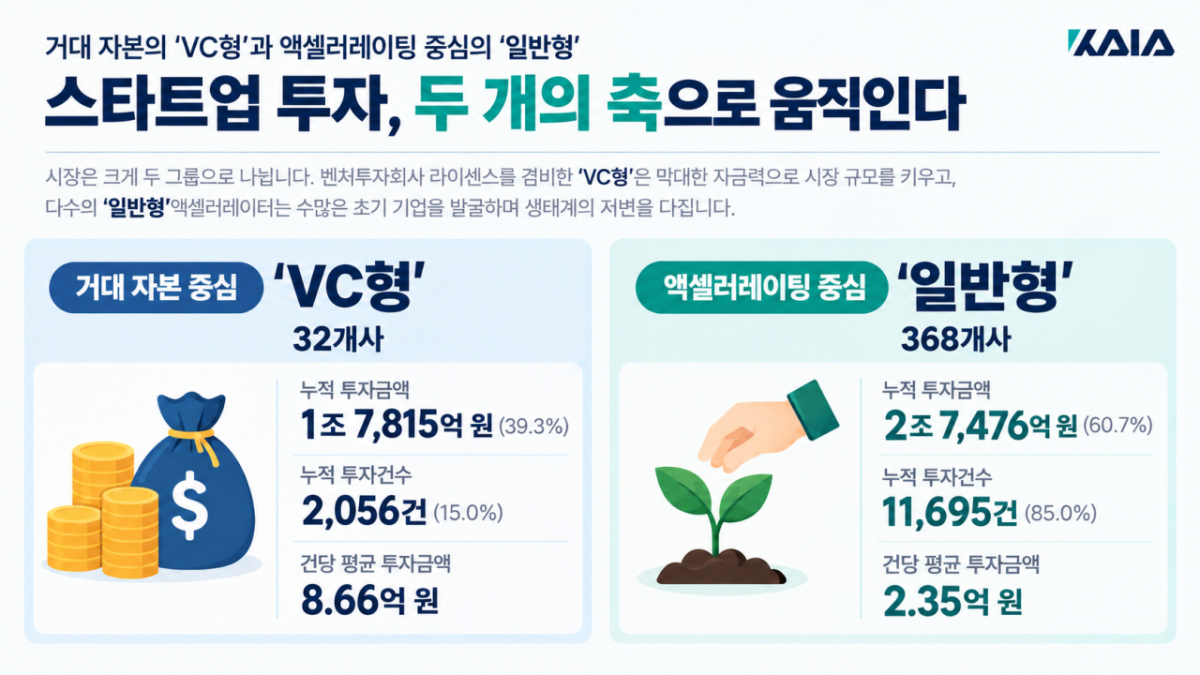
The nature of ACs is also showing a division into 'VC (Venture Capital)-type ACs' and 'General-type ACs.' Among the total AC investment amount of 1 trillion 11.7 billion won last year, ACs that also held VC licenses accounted for 49.1%. In contrast, their share by number of investment deals was only 16.5% of the total.
This means that VC-affiliated ACs led a small number of large investments, while general ACs executed multiple small investments targeting early-stage companies. The investment amount for ACs without VC licenses last year was 515.3 billion won, with 2,150 deals. The average investment per deal was 240 million won.
The association analyzed that the roles are being divided such that VC-type ACs handle follow-on investments and scale-ups for startups, while general-type ACs broaden the foundation of the ecosystem through early-stage company discovery and incubation.
In addition, AC investment capabilities were found to be concentrated among participants in policy programs such as TIPS (Technology Innovation Promotion System) and fund of funds (Korea venture fund) operators. Among the total AC investment amount last year, the amount executed by TIPS operators was 755.5 billion won, accounting for 74.7%. The investment amount by fund of funds (Korea venture fund) managers was 698.3 billion won, representing 69% of the total.
Jeon (Chairman) presented the supplementation of the Venture Studio system as a major task for the AC industry. A Venture Studio is a company building model in which investors directly participate from idea discovery to team formation, corporate establishment, and initial investment.
Under the existing system, investments by ACs for the purpose of management control were restricted, making it impossible to pursue business through the Venture Studio method. While the institutional foundation was established as related regulations were relaxed upon the association's proposal, it is judged that the actual application and approval procedures and detailed requirements remain unclear.
There are also concerns that only ACs with capital strength can utilize this system. Jeon (Chairman) stated, "Opportunities must be given to small ACs as well," adding, "We have proposed to the Ministry of SMEs and Startups to relax the requirements so that small-scale ACs can operate Venture Studios by contributing around 20 billion won in conjunction with TIPS."
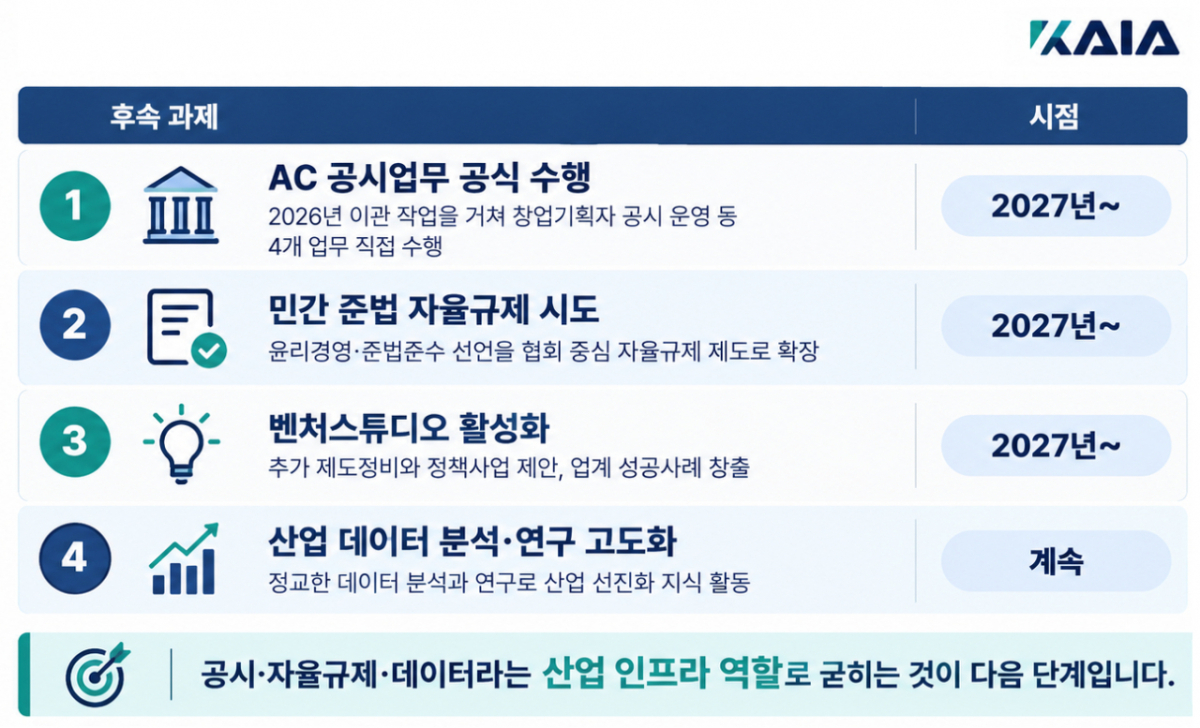
The association will take over the startup planning statistical work, which has been handled by the Startup Support Agency, starting next year. Jeon (Chairman) cited this as one of the core achievements during his term.
Until now, the association directly crawled data from systems such as the Electronic Disclosure System for Startup Planners (DIAA) to create the white paper. There were limitations in enhancing data reliability due to a shortage of personnel responsible for disclosure and the omission or delay of disclosures by some institutional investors.
After the transfer of duties, the association plans to place three to four policy and data personnel to encourage monthly disclosures. For ACs where risk signals are detected regarding the fulfillment of investment obligations, it will induce improvement through a 'coaching' approach rather than sanctions or audits. It is also promoting measures to automate data collection and anomaly analysis using AI.
Aggregating AC recovery performance remains a task. Under current disclosure rules, reporting on the recovery of investment funds is not mandatory, and information on the liquidation of private investment funds is managed by other institutional investors, making it difficult to grasp the overall recovery performance of the AC industry. The association plans to reflect the status of investment recovery in the white paper through a separate survey.
Meanwhile, Jeon (Chairman)'s term ends in February next year. Hong Jong-cheol, CEO of Infobank iXcel, and Myeong Seung-eun, CEO of Venture Square, have registered as candidates for the next chair. This is the first election since the association's establishment. The association plans to select one candidate at a board meeting in mid-October and obtain final approval at the general assembly of full members in February next year.
Jeon (Chairman) stated, "If the past 10 years were a time for ACs to establish themselves as an industry, the next 10 years must be a time to prove what kind of industry they will grow into." He added, "We must create better growth beyond more investment and contribute to the growth of the entire startup ecosystem beyond the performance of individual institutional investors."
[MoneyToday Startup Media Platform 'Unicorn Factory']

 in FUTURE


