

As share prices plummeted recently, losses for shareholders at SK Hynix have grown significantly, sparking intensified labor-management conflict over the performance bonus payment method. SK Hynix, which first introduced the so-called "N% performance bonus" system that pays a certain percentage of operating profit as bonuses without an upper limit, proposed changing from the existing full cash payment to partial stock compensation. The labor union strongly opposed this move. Critics argue that this structure allows employees to secure profits before even taking their share of dividends and other returns meant for shareholders—the company's owners—leading to controversy. Now, there is criticism that the union is also unwilling to bear the risk associated with stock price fluctuations.
According to industry sources on the 31st, SK Hynix labor and management have been unable to narrow their differences over the performance bonus payment method after four rounds of main negotiations so far. While the company proposed paying part of the PS (profit-sharing surplus) in stock, the union is demanding cash payments as before, citing the risk of stock price volatility.
The plan put forward by SK Hynix management is virtually identical to the stock compensation method agreed upon by Samsung Electronics and its labor union last May (special management performance bonus). Samsung had faced strong union demands for unconditional pre-fixed cash payments based on a certain percentage of operating profit, which raised concerns about damaging shareholder value, rigidifying cost structures, and spreading social controversy. Consequently, Samsung successfully implemented a "full stock compensation method." Conditions were attached to the distributed shares: one-third can be sold immediately, one-third is restricted for one year, and one-third is restricted for two years. This approach links shareholder interests with employee compensation while also aiming to prevent talent drain through selling restrictions during a certain period. When employees leave the company, all restricted shares must be returned. This is a form of RSU (restricted stock unit) commonly seen in global big tech companies.
Such a system directly ties stock prices to employee interests. If the reference share price at the time of distribution has plummeted, employees receive more shares. In other words, if the stock price rises again, they can gain significantly larger profits.
In SK Hynix's case, which first launched the "N% performance bonus," there is already a precedent of paying 100% in cash, so it appears the company is now attempting to convert even a portion into stock. According to the minutes of the fourth labor-management main negotiation meeting confirmed on this day, the company stated during negotiations that "it is urgently necessary to find a way to wisely navigate various social demands and gain the empathy of stakeholders" and "we request the union's understanding and determination so that this system can take root as a sustainable one."
However, the union opposes this. The union side stated, "We absolutely cannot accept any proposal that undermines the spirit of last year's labor-management agreement on performance bonuses," and "We will never accept a method where members bear the risk of stock price fluctuations." Regarding the company's proposal to adjust wages in case of losses, the union drew a line, saying, "Adjusting wages temporarily due to losses also does not align with the basic principles of the labor union."
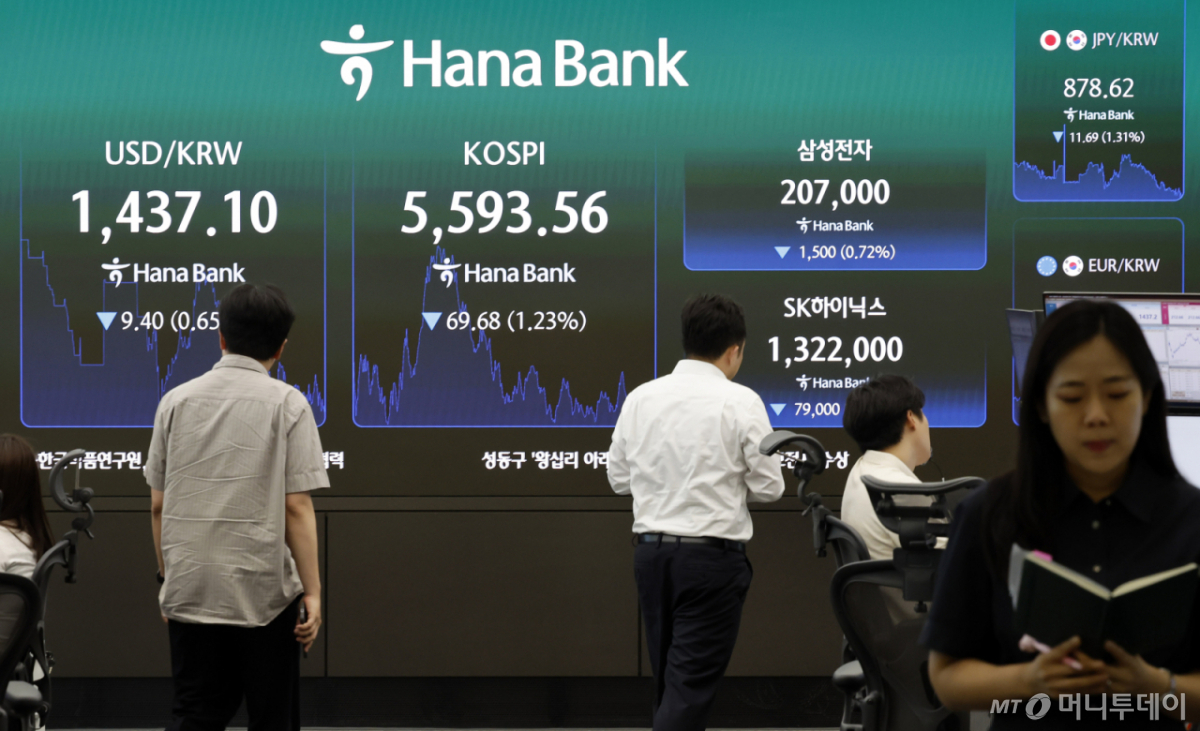
Voices are being raised both inside and outside the business community that the union's stance is open to criticism given that shareholders are currently bearing losses directly in an unprecedented market crash. SK Hynix shares have experienced extreme volatility, plummeting to less than half of their all-time high recorded in June this year (2.987 million won).
Of course, the union's position also has merit. The company's proposal seeks to overturn the method agreed upon by labor and management last year. Hwang Yong-sik, a professor at Sejong University Gyeong Yeong-hak-gwa (Prof.), explained, "Stock compensation is a method that allows employees to participate in changes in corporate value and form interests aligned with shareholders," adding, "Global companies are utilizing this approach because it also shares risks associated with market fluctuations." He further suggested, "However, in SK Hynix's case, there are aspects that make it difficult for the union to accept during the process of changing the previously agreed performance bonus payment method. It is necessary to proceed through an agreement among stakeholders from a long-term perspective."
Meanwhile, SK Hynix achieved operating profit close to 100 trillion won in the first half of this year alone due to a semiconductor super-boom driven by the AI (artificial intelligence) industry. Securities firms project that annual operating profit could reach approximately 250 trillion won. Last year, labor and management agreed to set aside 10% of future operating profit over the next decade as a source for PS (profit-sharing surplus), eliminating any upper limit on performance bonuses. A simple calculation based on all employees (approximately 35,000 people) suggests that by early next year, each employee could receive an average pre-tax performance bonus of around 700 million won.

 in INDUSTRY

