

Chinese memory semiconductor (hereinafter "memory") company CXMT (Changxin Memory Technologies) has officially acknowledged the technology gap with leading firms such as Samsung Electronics and SK Hynix. While it is accelerating its catch-up efforts in the general-purpose DRAM sector, evaluations suggest that there are high walls to overcome in actual Yangsan competitiveness and process miniaturization.
In an investment prospectus submitted to the Shanghai Stock Exchange prior to its listing, CXMT stated, "There is a gap in technology accumulation, production capacity, and product structure optimization compared to Samsung Electronics, SK Hynix, and Micron," and specified that it would "promote R&D investment and production expansion to overcome this." The market also confirms the gap. According to Counterpoint Research, Samsung Electronics held the top spot with a 39% share of the global DRAM market in the second quarter of this year. SK Hynix (26%) and Micron (25%) followed, while CXMT accounted for only 7%.
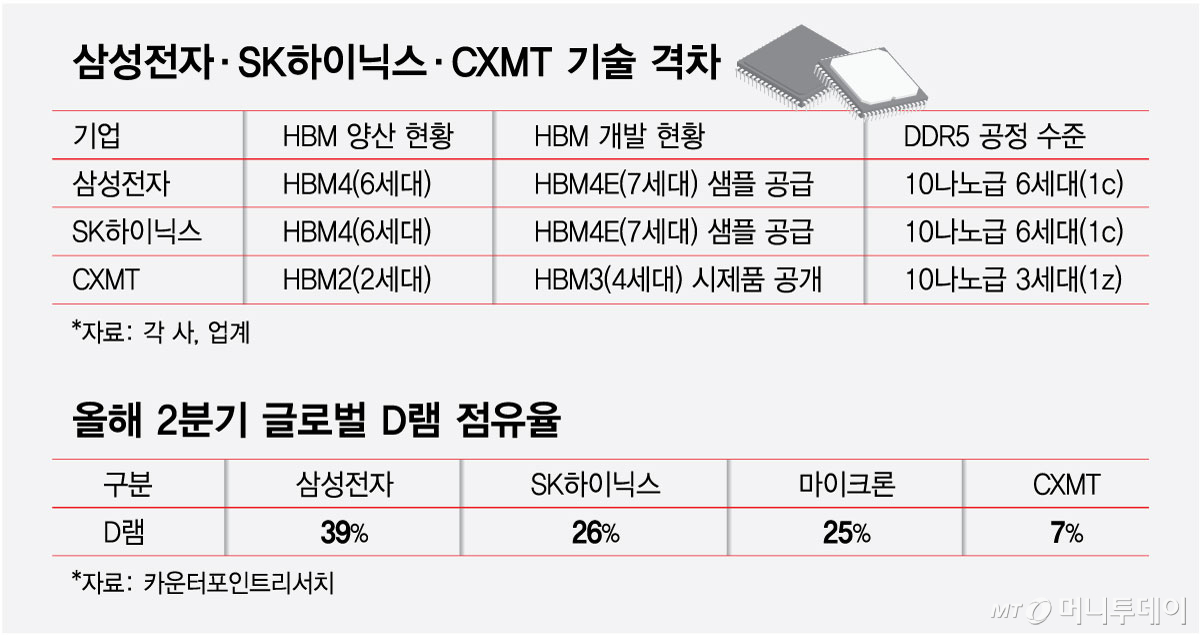
Products recently released by CXMT have performance specifications close to some of Samsung Electronics' and SK Hynix's key products, but differ in process generation. While Samsung Electronics and SK Hynix manufacture DRAM using 6th-generation (1c) processes, CXMT's main production is reportedly at the 3rd-generation (1z) stage, around 10 nanometers. Considering that DRAM processes are miniaturized in the order of 1x·1y·1z·1a·1b·1c, CXMT lags behind Samsung Electronics and SK Hynix by three generations. This gap leads to differences in the number of chips required to produce products of the same capacity, power efficiency, and production cost competitiveness.
The same applies to HBM (High Bandwidth Memory), a core component of AI (artificial intelligence) memory. CXMT remains at the development stage for HBM3 (4th generation), while Samsung Electronics and SK Hynix have begun mass production of HBM4 (6th generation) and are supplying samples of next-generation products (HBM4E·7th generation). HBM is a highly complex field that goes beyond simple DRAM production, requiring stacking, TSV (Through-Silicon Via), heat dissipation control, yield stability, and customer certification. CXMT has yet to secure large-scale supply experience and customer certification.
Industry experts also point to the localization of Chinese semiconductor equipment as a variable. With EUV (Extreme Ultraviolet) access restricted due to U.S. export controls, China is seeking a way out by building its own equipment ecosystem. State-owned enterprise Aixinna Electronic Technology Group has begun production of immersion-type DUV (Deep Ultraviolet) lithography equipment, aiming to supply about five units this year and about 20 units next year. However, Yangsan performance requires verification. According to the Financial Times (FT), this equipment is at a level similar to what Dutch lithography equipment company ASML introduced around 2008, meaning it has lower precision and productivity compared to the latest equipment, requiring yield improvements.
Chinese semiconductor companies are circumventing EUV restrictions through DUV multi-patterning (a process of running older equipment multiple times). While this method avoids access controls on advanced equipment by repeating exposure and etching steps, it increases the number of process steps, leading to high costs and yield burdens. The industry reports that when CXMT applies SAQP (Self-Aligned Quadruple Patterning), the chip area becomes about 40-50% larger than that of domestic companies. With fewer chips producible per wafer, it is evaluated as being at a disadvantage in cost competitiveness.
Experts believe that even with equipment independence and production expansion, it will be difficult to narrow the technology gap between Korean and Chinese memory companies in the short term. Lee Chang-han, former vice president of the Korea Semiconductor Industry Association, stated, "Processes below 12 nanometers and yield assurance are not technologies that can be caught up with in a short time," and predicted, "Since process technology, design, and Yangsan know-how must be accumulated together, the gap will likely persist for a considerable period."

 in INDUSTRY

