

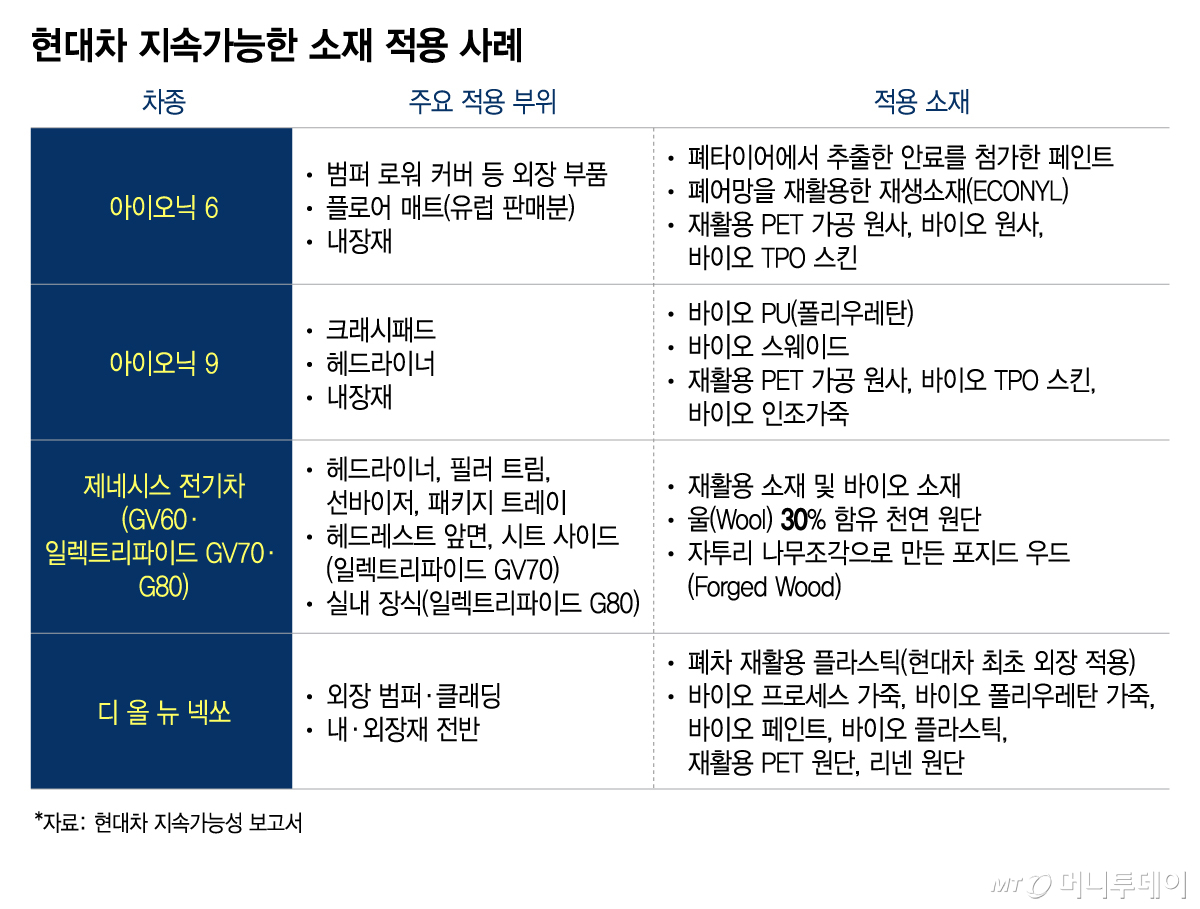
Recycled materials used in Hyundai Motor vehicles have already reached 'visible areas.' The scope of application has expanded from exterior paints to interior trim, and the number of parts under review for Yangsan application after development is increasing. Hyundai Motor's plastic recycling rate is reported to be around 4%, surpassing the European average (approximately 2-3%). Nevertheless, it still falls short of the European ELVR (End-of-Life Vehicle) standard (15%) to be applied to new cars from 2032, leaving a long way to go.
Hyundai Motor first widely utilizes paint containing pigments extracted from scrap tires. After being initially applied to the 'Ioniq 5 N,' it is now also used in exterior parts such as the bumper lower cover of the 'Ioniq 6.' For Genesis models including the 'GV60' and 'Electrified GV70·G80,' recycled materials are used in interior components such as headliners, pillar trims, sun visors, and package trays.
The challenge is to meet both recycling rates and safety regulations. While the use of recycled materials is restricted for safety-related parts like airbags and seatbelts, higher content standards are required for other parts. Choi Min-ho, a senior researcher at Hyundai Motor Group's Exterior & Closure Materials Development Team, explained, "Except for parts directly related to safety, we must significantly increase the proportion of recycled materials in other components."
Large-sized parts are ideal for boosting recycling content. Even with the same percentage, heavier parts have a greater effect on raising the overall recycling rate per vehicle. This is why development is focused on PP (polypropylene) used in bumpers and door trims, PET (polyethylene terephthalate) used in interior textiles like headliners, and PA (polyamide) used in parts that must withstand heat.
The Lisa Ecl (recycling) method has two paths: mechanical recycling, which crushes scrap plastic into small pieces, melts it, and molds it back into parts; and chemical recycling, which uses chemical reactions to return materials to the level of raw oil extraction. Hong Seong-jun, Hyundai Motor Group's Carbon NeutralityGi Sul-hyeok-sin (Team Lead), emphasized, "Chemical recycling is currently difficult for Yangsan application, so mechanical recycling is the main focus."
The more recycled materials are used, the lower their physical properties become. This means technology must fill the gap. Vehicles require performance levels matching new materials in terms of color, transparency, scratch resistance, and flame retardancy. The industry is focusing on how to improve these declining physical properties as recycling content increases. Hyundai Motor's adoption of an open collaboration approach not tied to specific companies and its operation of regular technical exchange meetings with domestic and international petrochemical firms aim to reduce physical property deviations in recycled raw materials.
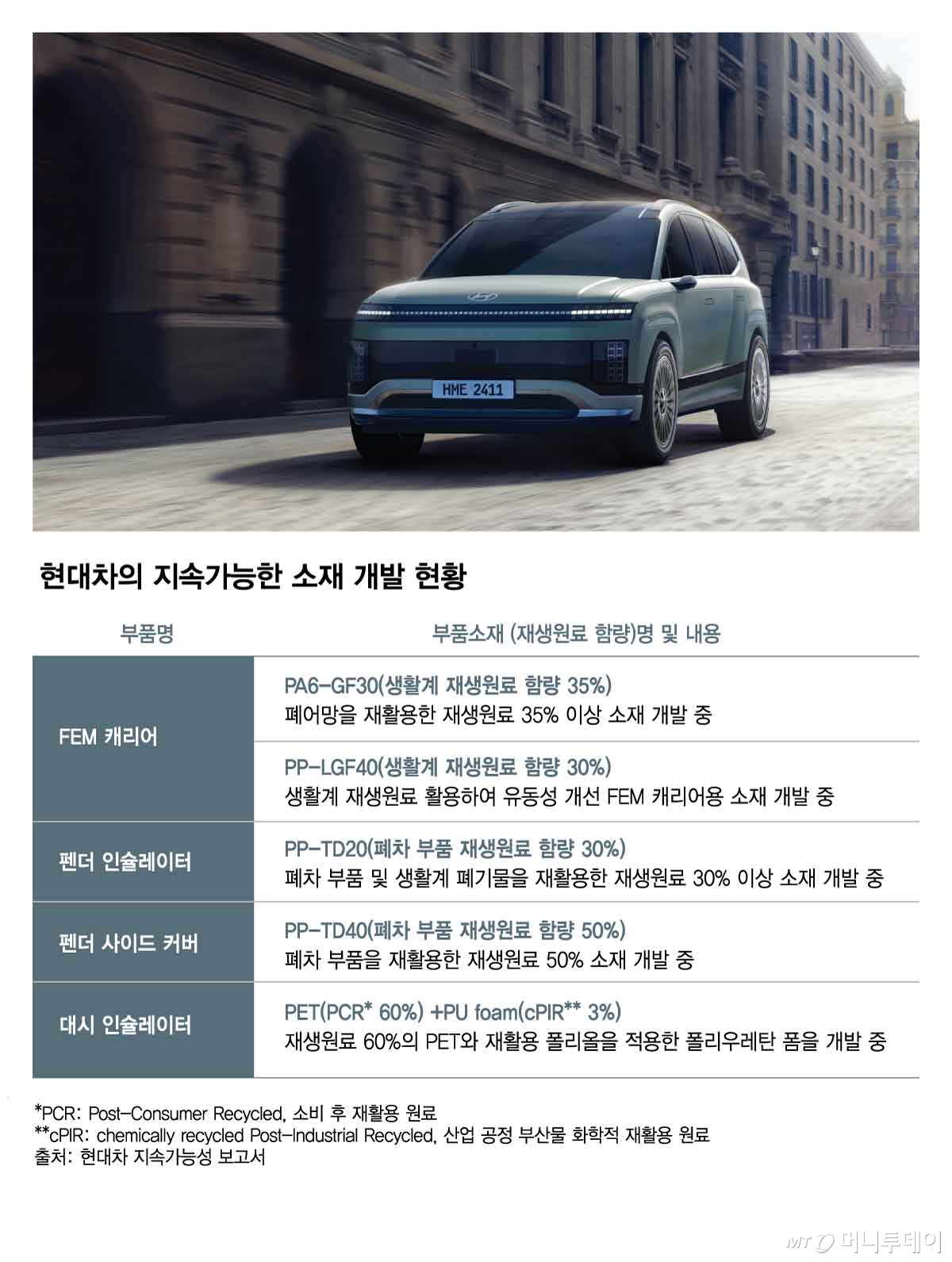
Development of parts with higher proportions of recycled raw materials continues. A fender side cover using 50% recycled raw material from scrapped cars is under development, as is a fender insulator that increases the proportion to over 30% by adding household waste to scrap car parts. Development of the FEM (Front End Module) carrier and dash insulator for noise blocking has been completed. The timing of when these parts will be actually installed in vehicles depends on new car development schedules, material costs, and supply conditions.
Where recycled raw materials come from is also crucial. Hyundai Motor is promoting the 'Car to Car' project, which recovers materials from scrapped cars and reuses them in new cars. The goal is to create a closed-loop cycle by targeting five key areas: plastics, steel, aluminum, and core EV components—batteries and motors. The company is reviewing a medium-to-long-term roadmap to gradually increase the use of recycled raw materials and is also preparing a system for material tracking and management.
Although this initiative began as a response to regulations, overseas brands are leveraging it as a selling point. Volvo's 'EX30' was revealed to be filled with approximately 25% aluminum and 17% plastic made from recycled materials, while MINI's 'Countryman' finished its dashboard surface with 100% recycled polyester fabric. This is based on the judgment that preference for recycled materials has become a purchasing criterion in advanced markets such as Europe.

 in INDUSTRY


