

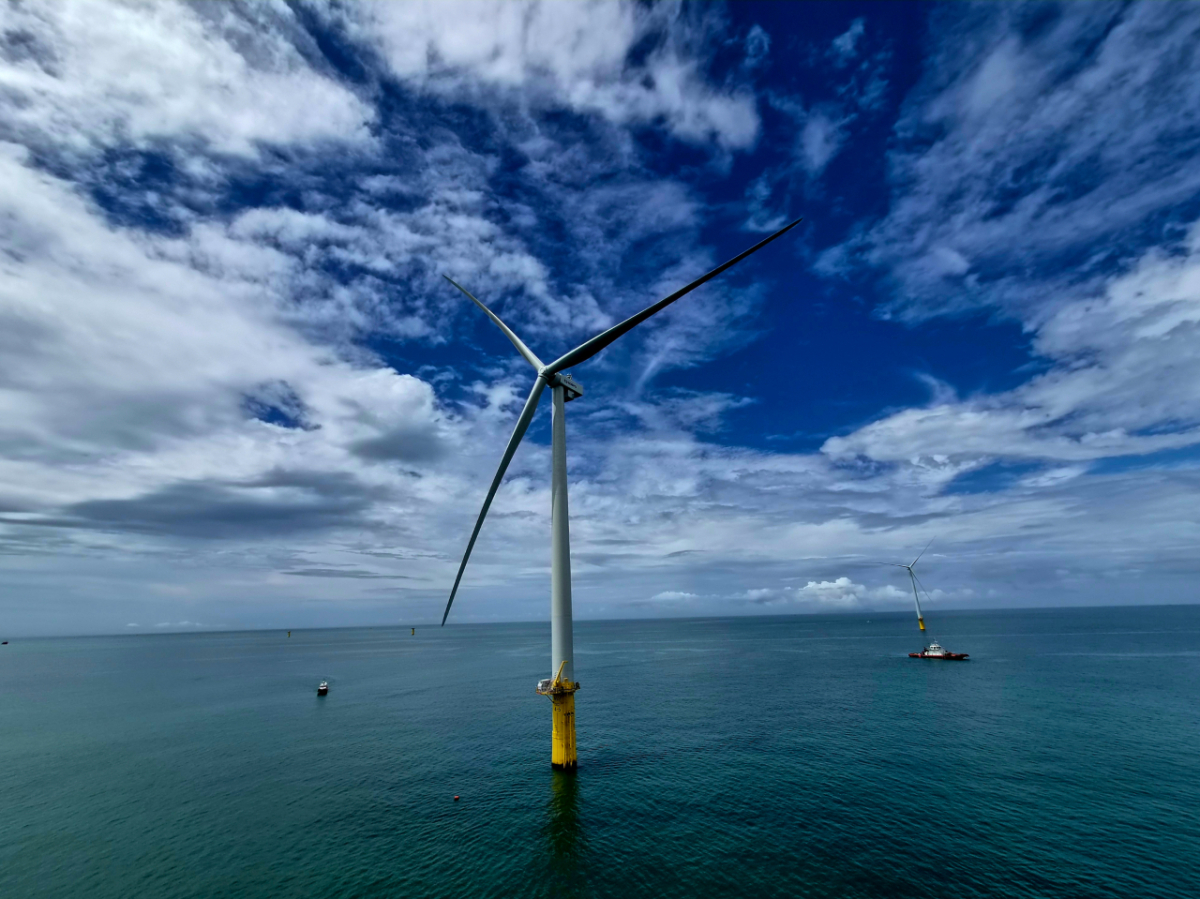
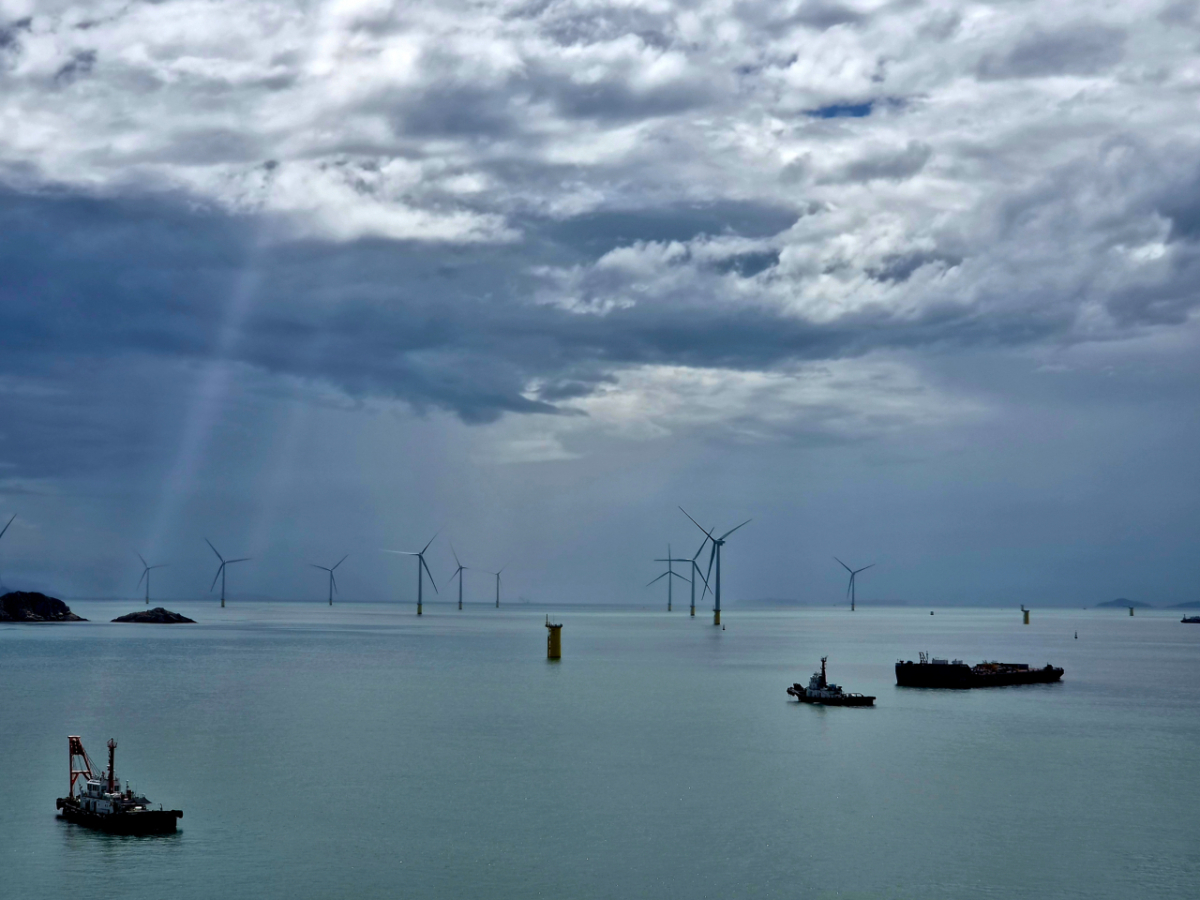
On the 19th, at Hawuri Port in Sinan County, Gwangju Metropolitan City, Jeollanam-do. After about an hour and a half by boat on a crew transfer vessel (CTV), as we approached the waters near Songido Island in Yeonggwang County, white wind turbines began to appear one by one outside the window.
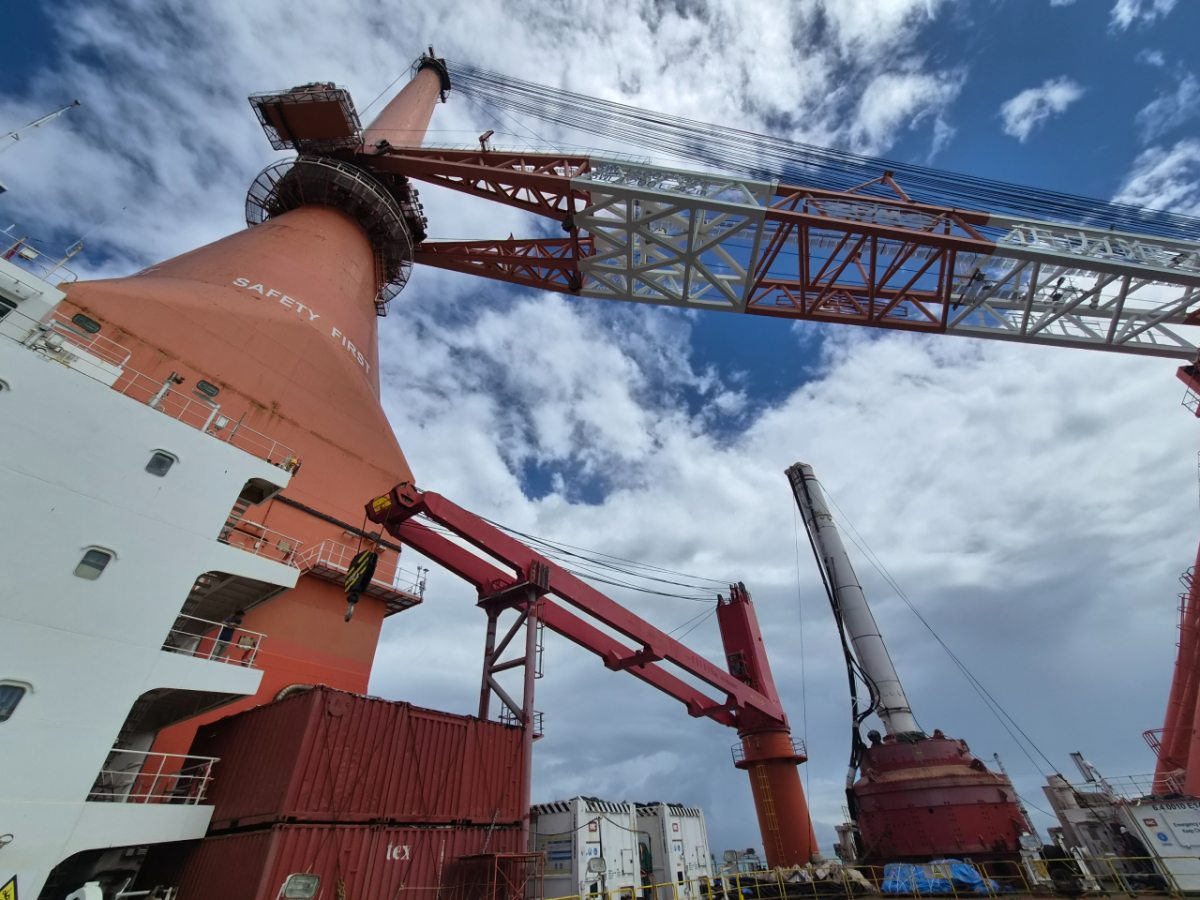
Between these turbines, a massive red steel structure filled the view. This structure is a 'ship.' It is the offshore wind installation vessel 'Hansan 1,' measuring 123.6 meters in length and 58 meters in width, currently deployed for the final phase of offshore construction at Yeonggwang Nakhwal Offshore Wind Farm (hereinafter referred to as Nakhwal Offshore Wind).
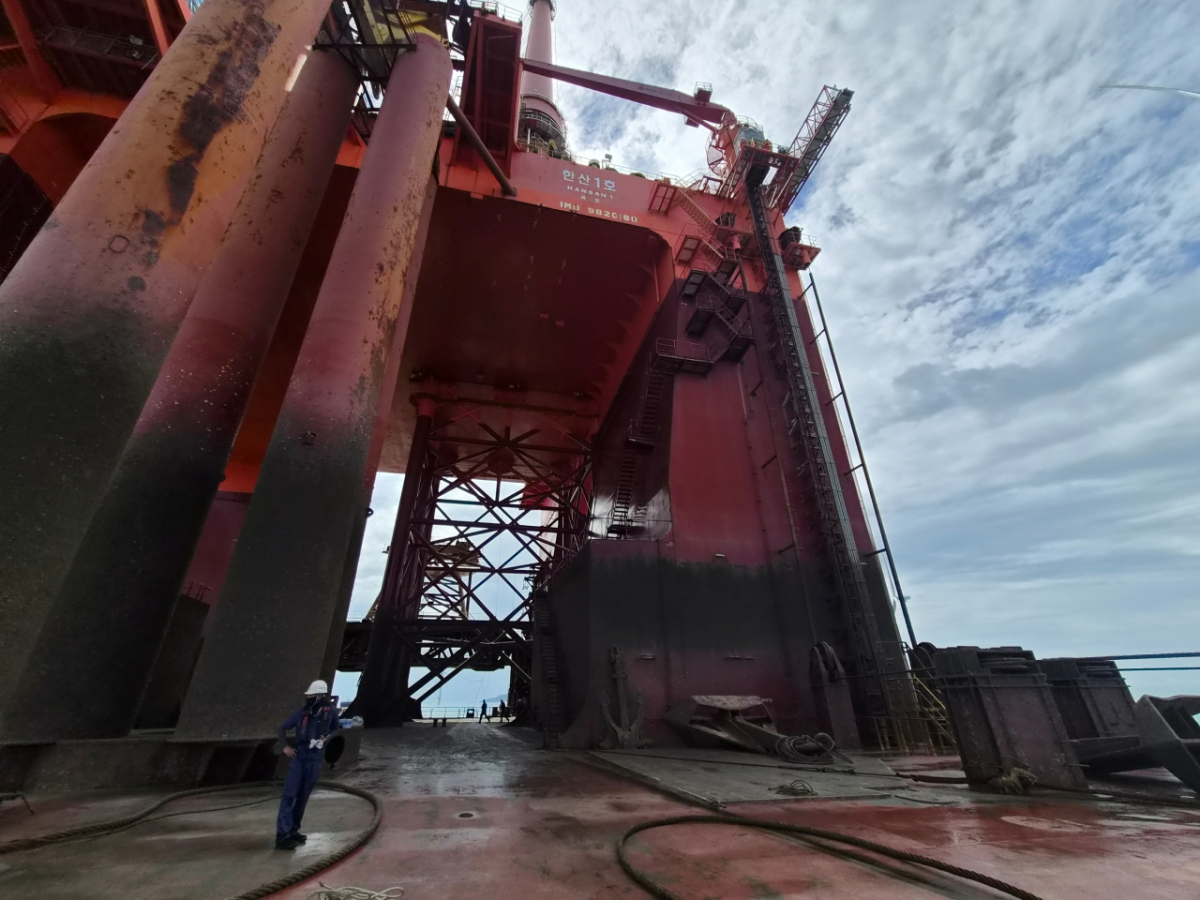
Unlike typical offshore wind installation vessels that lower a bridge to the seabed and lift the hull above the water surface for operations, Hansan 1 fills tanks inside the ship with seawater to submerge its lower hull onto the seabed, securing itself at the bottom of the sea.
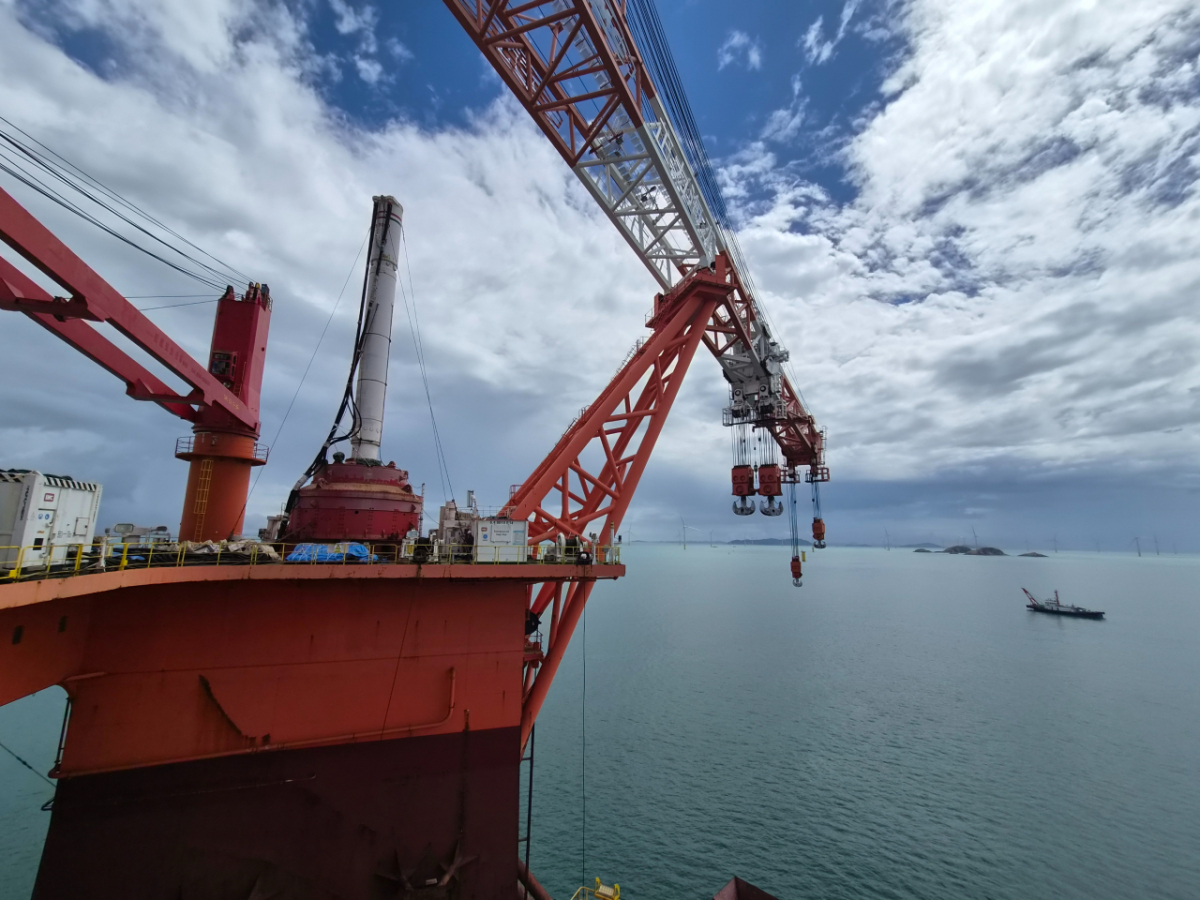
Once positioned, filling the ship's tanks with seawater causes the heavier hull to sink until it touches the seabed. Only the work deck and crane remain above the water surface, creating a stable 'offshore workplace' that does not sway with waves. After work is completed, the water is drained, and the vessel is floated again by buoyancy to move to the next location.
Upon boarding Hansan 1, a black band covered with marine organisms such as barnacles was clearly visible beneath the pillars supporting the deck—a sign of its time underwater. A site official said, "This part was submerged in seawater just two hours ago."
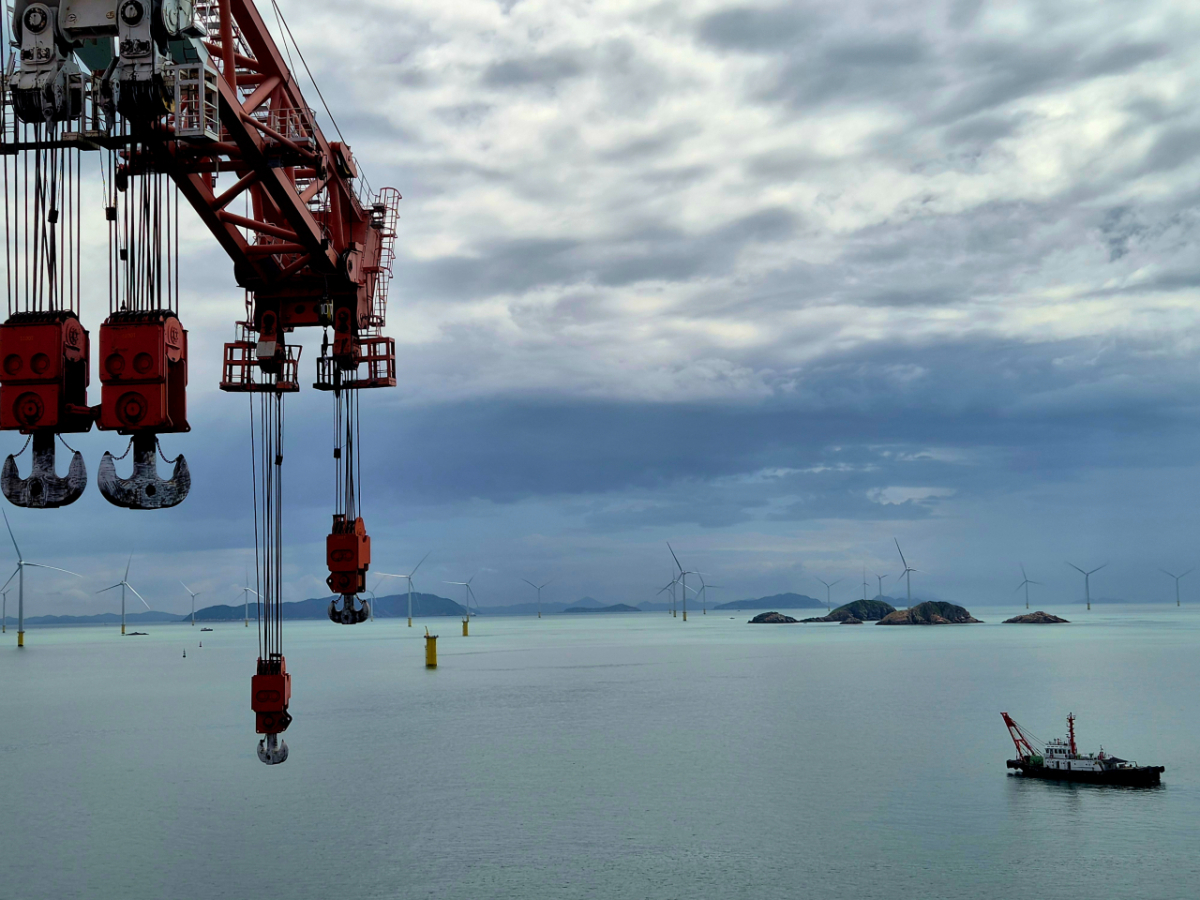
Ship Pressed Against Seabed; Turbines as Tall as 63 Building Erected
Taking the elevator inside the ship to the work deck 40 meters above the water surface, a large crane capable of lifting up to 1,800 tons came into view. Standing on the deck, the sea stretched in all directions, and already installed white turbines stood in rows along the horizon.
Construction of the Nakhwal Offshore Wind Farm began in 2024, with offshore work officially commencing last year when monopiles were driven into the seabed. Each monopile measures 60.2 to 71.2 meters in length, has a bottom diameter of 7.5 meters, and weighs between 754 and 888 tons—equivalent to the weight of about 600 passenger cars. On-site workers use cranes to erect the monopiles transported by cargo ships vertically, then hammer them into the seabed strata using large equipment resembling a giant mallet.
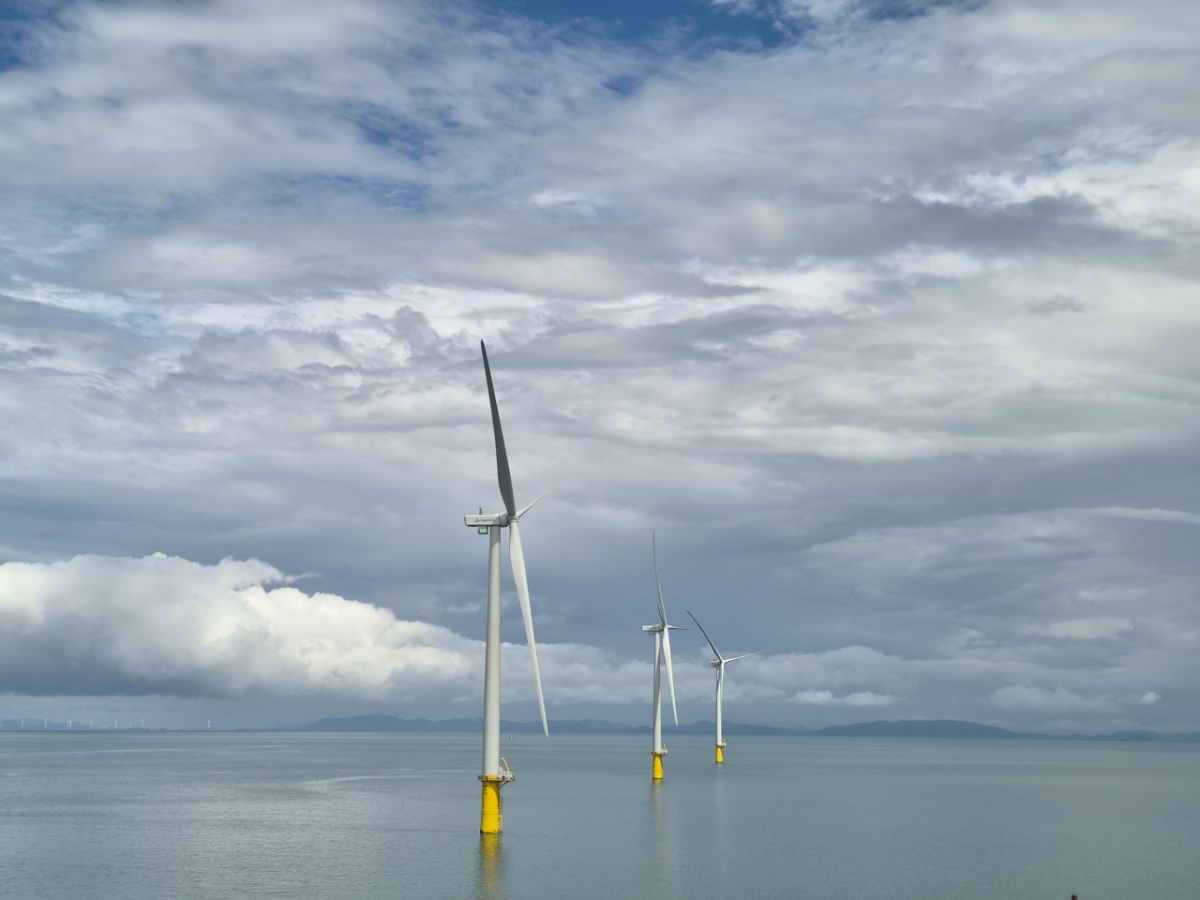
A transition piece (TP) connecting the monopile and tower is installed atop the monopile, followed by sequentially placing the tower and nacelle. Then, three pre-assembled blades are connected. Under favorable weather conditions, erecting one turbine takes about three days.
The completed power generation structure, including the seabed foundation, is enormous. When the blades stand vertically, their tips reach approximately 195 meters above sea level, while the monopile ends extend about 50 to 70 meters below sea level. The vertical distance from the highest blade tip to the monopile end embedded in the seabed ranges from about 245 to 265 meters—roughly equivalent to the height of the 63rd Building (249 meters). The three blades, each 82.5 meters long, trace a circle with a diameter of approximately 165 meters when rotating, which is about 1.5 times the length of a soccer field.
Construction to Be Completed by Year-End
The Nakhwal Offshore Wind Project involves installing 64 turbines of 5.7-megawatt (MW) capacity, totaling 364.8 MW. The project is being implemented by Nakhwal Bluehat, a special purpose vehicle (SPC) with Myeongwoon Industrial Development as its largest shareholder.
Installation of all 64 monopiles has been completed, and 47 turbines have been erected, among which 33 are already in commercial operation. Once cable installation is finalized in October, full-scale commercial operations will commence in December. Upon completion, it will become Korea's largest offshore wind farm, exceeding the total installed capacity (364.1 MW) of all currently operating domestic offshore wind farms combined.
The electricity generated by the 64th turbines will be collected via 33-kilovolt (kV) submarine cables to the Songido Substation nearby. There, the voltage is stepped up to 154 kV for transmission to the onshore power grid. Efficiency has improved by utilizing Songido as a landing point instead of constructing a separate offshore substation.
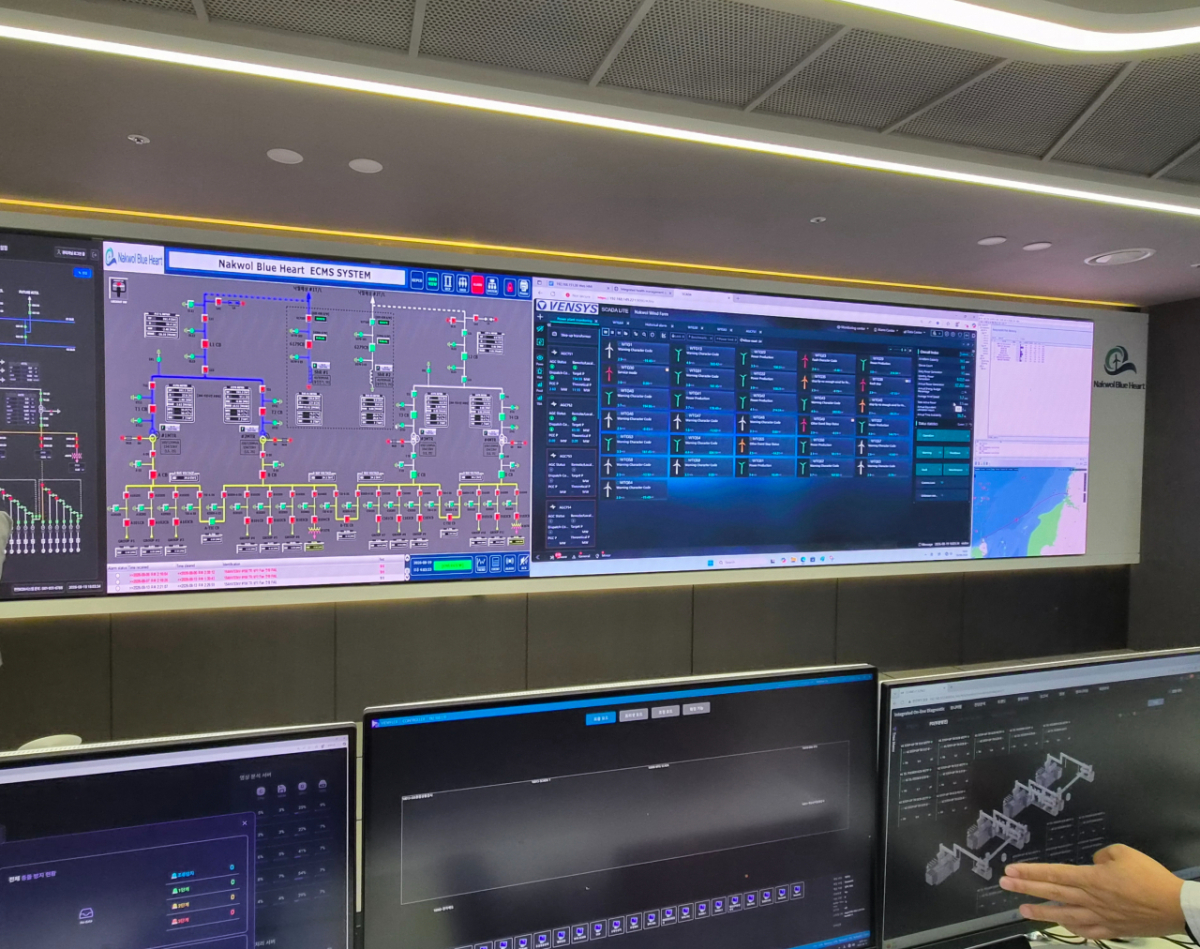
From this offshore construction site, traveling approximately one hour and thirty minutes across the sea again leads to an area near Gima Port in Hongnong-eup, Yeonggwang County, where a SCADA (Supervisory Control and Data Acquisition) control center is monitoring the status of each turbine in the wind farm in real time.
Shortage of Large Installation Vessels
As the Nakhwal Offshore Wind construction enters its final phase, the current concern is 'equipment' for future offshore wind projects. For Hanbit Offshore Wind, a project being promoted by Myeongwoon Industrial Development nearby, 25 turbines of 13.6 MW capacity will be deployed—more than double the capacity of the turbines used in Nakhwal Offshore Wind.
As turbines grow larger, the installation vessels required to deploy them at sea must also increase in size. Hansan 1 can handle turbines up to 10 MW. To install 13.6 MW units, significant modifications to existing major equipment or a larger installation vessel will be necessary. Since offshore construction is heavily constrained by weather conditions, missing the optimal window could delay project schedules by over a year. Securing an installation vessel is therefore critical for ensuring project viability.
The government also views the shortage of installation vessels as a key bottleneck in offshore wind expansion and is implementing countermeasures. The Ministry of Climate, Energy and Environment has set a goal to expand the domestic fleet from two currently operational 10 MW vessels to at least six by adding four or more 15 MW vessels by 2030. However, only one 15 MW vessel, scheduled for delivery by Hanwha Ocean in 2028, is currently visible on the construction horizon.
Kim Wook-jin, Executive Vice President of Nakhwal Bluehat, stated, "Securing equipment such as installation vessels is one of the most challenging aspects during construction." He added, "For offshore wind projects to continue, related companies must be able to invest in ships and factory facilities. Only then can securing equipment become easier."

 in INDUSTRY


