

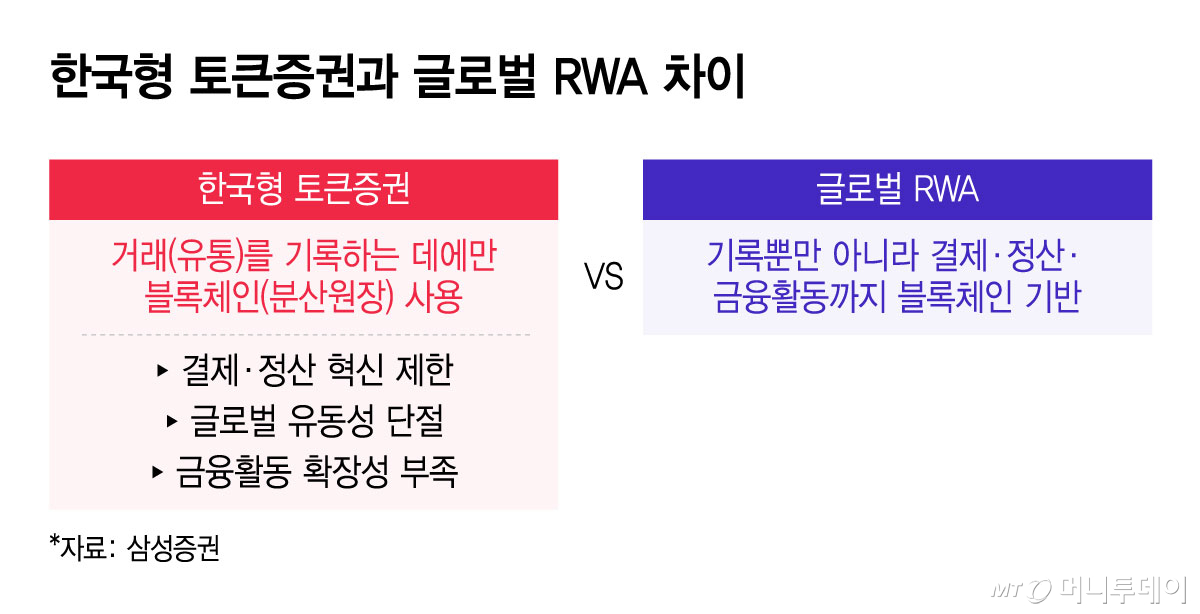
The government has prepared a plan for introducing won-denominated stablecoins, but concerns persist that the tokenized securities system scheduled to take effect in February next year will be half-baked.
This is because infrastructure capable of simultaneously processing the transfer of rights and payment settlement for securities on the blockchain has not yet been established, even if securities are tokenized and the issuance and distribution of stablecoins are institutionalized.
Experts point out that to narrow the gap with major countries such as the U.S., a concrete roadmap connecting the issuance, distribution, and settlement of securities must be prepared, and cooperation between the government and market participants must be strengthened.
Securities tokenization and payment infrastructure remain separate… On-chain settlement schedule undecided
According to the Financial Services Commission on the 25th, the bill for the "Act on Innovation in the Digital Asset Industry and Protection of Users" includes provisions to institutionalize the issuance and distribution of stablecoins. However, no specific plan or schedule was presented for building a securities settlement infrastructure that links the tokenized securities system taking effect in February next year with stablecoins.
Tokenized securities are "securities" subject to the Capital Markets Act, similar to stocks or bonds, where their rights are recorded and managed on a distributed ledger utilizing blockchain technology. While existing electronic securities manage rights through a centralized electronic registration system, tokenized securities utilize a distributed ledger. The legal nature of the securities remains unchanged; only the method of recording and managing rights differs.
A key factor behind the rapid spread of tokenized securities in global markets such as the U.S. is cited to be the $42 trillion dollar stablecoin market. This is because payment means for trading financial products on the blockchain were already available.
Although South Korea has also moved to institutionalize stablecoins, additional regulatory adjustments and infrastructure development are needed to use them as a payment method for securities transactions.
In a roadmap announced in September last year, financial authorities proposed building on-chain settlement infrastructure that processes both the transfer of rights and payment of funds for securities entirely on the blockchain using stablecoins and other means as a three-stage task, but did not specify a concrete implementation date.
In major overseas countries, markets are expanding to tokenize various real-world and financial assets, including real estate, beyond just securities.
Consequently, the scope of RWA (Real World Asset) tokens that can be traded on the blockchain is also broadening. If asset tokenization is the starting point, the next step is blockchain-based payment, remittance, and settlement.
By utilizing digital payment means such as stablecoins and smart contracts that automatically execute agreements according to pre-set conditions, the transfer of rights and payment of funds for assets can be processed simultaneously.
Hong Jin-hyun, a senior researcher at Samsung Securities, explained in a report published last April, "Payment and remittance are core infrastructure directly linked to increased transactions as RWAs spread, and which currency (stablecoin) is used for settlement is the key competitive advantage."
He added, "In South Korea, asset transfer and payment functions are separated, resulting in a structure where actual settlement is performed through traditional financial networks based on securities accounts."
U.S. separates stablecoin legislation… U.K. and Hong Kong pursue public-private cooperation
In this bill, the government proposed introducing a licensing system for the stablecoin issuance business and allowing issuance initially by consortiums in which banks hold a majority stake during the early stages of the system.
However, given the complex interests surrounding key issues such as the entities issuing stablecoins and the ownership structure of virtual asset exchanges, it is difficult to guarantee when the bill will pass. Even if the bill passes, subsequent procedures such as preparing subordinate regulations and licensing issuers are required.
An industry official said, "Since this is a bill being unveiled for the first time, when we get into the details, the positions of stakeholders such as exchanges and financial companies differ significantly.
Considering the need to gather opinions, it may not be possible to pass the bill until around the end of the 22nd National Assembly." The official added, "The urgent regulatory improvements needed for the development of our country's digital capital market could be pushed down in priority."
There are also concerns that the legislative approach of incorporating the regulatory framework for stablecoins and the entire digital asset market into a single law may slow down the pace of institutionalization.
The U.S. handles these separately, with the GENIUS Act (passed last July) regulating stablecoins and the CLARITY Act (currently under discussion) addressing the overall structure of the digital asset market. It prepared laws related to stablecoins before completing legislation on the entire digital asset market.
Lee Jun-ho, a researcher at Hana Securities, stated, "In our country, because we are trying to do it all at once with the Digital Asset Basic Act, the preparation of the system is constantly delayed." He added, "It is an environment where new things cannot be tried unless regulations or systems are in place, so the longer institutionalization takes, the more inevitable it is that the gap with advanced countries will widen."
The government also included provisions in this bill to expand and reorganize the existing Virtual Asset Committee into a Digital Asset Committee and strengthen its function in formulating medium- and long-term policy and supervisory directions. Along with the institutionalization of the digital asset industry, there is a need to discuss ways to link it with the existing capital market. Overseas, governments and market participants are operating cooperation models where they jointly prepare specific utilization plans for tokenized securities and regulatory improvement tasks.
In the U.K., experts from the asset management industry participate in a technical working group under an asset management task force led by the Ministry of Finance to prepare a blueprint including plans for introducing fund tokenization.
The Hong Kong Monetary Authority (HKMA) has also launched an expert group on tokenized bonds composed of various market participants to discuss regulatory improvement measures and utilize these discussions in reviewing improvements to the legal and regulatory framework.
Jung Hwa-young, a research fellow at the Capital Markets Institute, said, "The regulatory responses of major overseas countries offer significant implications for domestic policy." She added, "We must seek specific utilization plans together through consultations between policy authorities and market participants and progressively refine the relevant regulatory framework."

 in STOCK
