

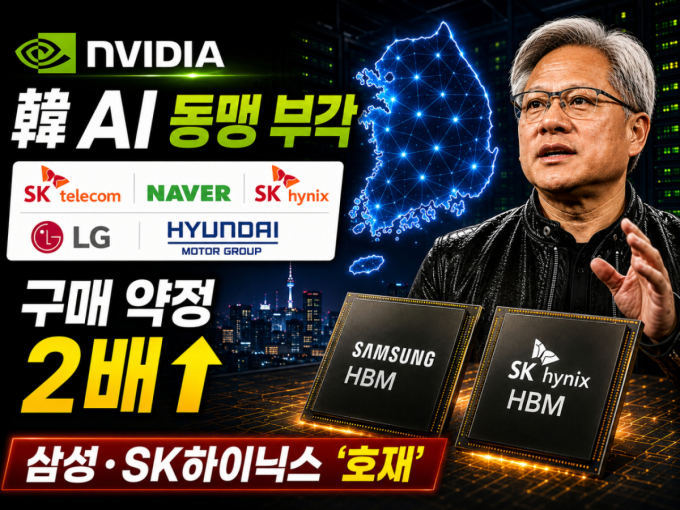
In its earnings announcement, NVIDIA highlighted its "AI alliance" with major Korean companies including SK Telecom, Naver, and SK Hynix. As AI investment expands, driving up memory prices and supply pressures, purchase commitments have more than doubled within a single quarter, expected to positively impact domestic memory makers such as Samsung Electronics and SK Hynix.
According to NVIDIA's second-quarter results for fiscal year 2027 released on the 27th, revenue reached $96.2 billion, a 106% increase compared to the same period last year. Data center revenue surged 117% to $89 billion, marking a record high.
NVIDIA is also accelerating efforts to secure supply chains in response to surging AI demand. Purchase commitments for NVIDIA's supply chain and infrastructure rose from $119 billion in the previous quarter to $279 billion—a 2.3-fold increase. The increase was primarily related to memory procurement.
This is due to a sharp rise in demand for HBM (high-bandwidth memory) embedded in GPUs as AI data centers expand. Expectations are growing that Samsung Electronics, SK Hynix, and Micron of the U.S.—the three major suppliers of HBM to NVIDIA—will expand their supply.
Collette Kress, NVIDIA's CFO, stated that the rise in memory prices has exceeded expectations and is expected to continue rising through next year. She explained that AI infrastructure construction itself is exacerbating memory shortages.
Despite supply constraints, NVIDIA forecasts fiscal 2028 revenue will grow by approximately 70%. CFO Kress noted, "This forecast accounts for supply constraints." Jensen Huang, NVIDIA's CEO, added, "Without supply constraints, it would be much higher," emphasizing that while significant supply has already been secured, additional production capacity is needed to meet the surging demand.
Collaboration with Korean companies was also highlighted as a key achievement. NVIDIA announced it is expanding Korea's "AI Factory" ecosystem by building gigawatt-scale sovereign AI infrastructure based on the DSX platform in partnership with SK Telecom, Naver, and Brookfield. It also emphasized a multi-year technology partnership with SK Hynix to jointly develop next-generation memory required for global AI factory expansion.
CFO Kress directly mentioned collaborations with LG and Hyundai Motor Group, stressing efforts to expand AI applications in Korea. CEO Huang also visited Korea in June this year, meeting with SK Group Chairman Tae-won Choi, LG Group Chairman Kwang-mo Koo, and Naver Chairman Jae-yun Lee to discuss AI cooperation plans.
CEO Huang joked, "One of the most fun things last year was figuring out where and with whom I would have dinner," adding, "Then the company's stock price doubled the next day." This is believed to refer to his meetings with top executives of domestic companies, including Samsung Electronics Chairman Lee Jae-yong and Hyundai Motor Group Chairman Jay Y. Lee, during his visit last year.
As NVIDIA expands cooperation with major Korean companies across memory supply chains, AI infrastructure, manufacturing, and mobility, Korea is solidifying its position as a core pillar of the global "AI Factory" strategy.
-"Supply Shortages to Continue Until 2028"…Samsung and SK Hynix Accelerate Production Capacity Expansion
The "memory supercycle" (period of extreme boom) for Samsung Electronics and SK Hynix is expected to extend. This follows NVIDIA's confirmation of robust AI data center demand, with supply shortages projected to continue at least until 2028. Both companies are accelerating production capacity expansion to meet the rapidly growing memory semiconductor (hereinafter "memory") demand.
Earlier, Collette Kress, NVIDIA's CFO, stated during a second-quarter earnings conference call for fiscal year 2027 on the 26th (local time) that Vera Rubin is expected to account for about 20% of data center revenue, and fiscal 2028 revenue will grow approximately 70% year-over-year. She added, "Supply shortages are expected to persist through the end of fiscal 2028."
Vera Rubin is NVIDIA's next-generation AI computing platform launched this month in Yangsan. It combines structures such as the "Rubin GPU" and "Vera CPU." One Rubin GPU unit will be equipped with 288GB of HBM4 (sixth-generation high-bandwidth memory), while one Vera CPU unit will feature 1.5TB of LPDDR5X (low-power double data rate). Samsung Electronics and SK Hynix are the key suppliers for both products.
Memory supply shortages are cited as a factor exacerbating supply constraints in NVIDIA AI systems. CFO Kress explained, "Memory shortages are a sign of surging demand driving NVIDIA's growth," adding, "We are closely cooperating with three major memory suppliers to expand production capacity further." Consequently, global big tech companies are increasingly proposing long-term agreements (LTAs) directly to Samsung Electronics and SK Hynix to secure supply volumes.
![[Gyeongju=NEWSIS] Reporter Choo Sang-cheol = NVIDIA CEO Jensen Huang received a gift of SK Hynix's HBM4 semiconductor wafers from SK Group Chairman Tae-won Choi, who also serves as President of the Federation of Korean Industries, at the Asia-Pacific Economic Cooperation (APEC) CEO Summit held on the 31st at Gyeongju Arts Center in Gyeongju, North Gyeongsang Province. (Joint reporting) 2025.10.31. photo@newsis.com /Photo=](https://thumb.mt.co.kr/cdn-cgi/image/f=avif/21/2026/08/2026082723025296066_3.jpg)
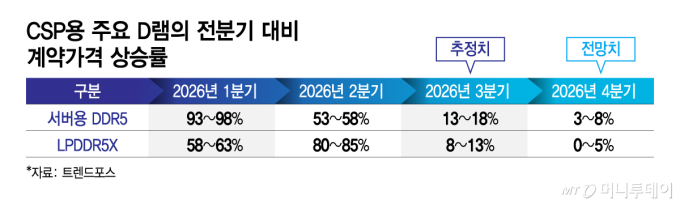
NVIDIA expects its gross profit margin, which was about 74% this quarter, to decline to the 71st–72% range in the fourth quarter due to cost pressures from rising memory prices. According to market research firm TrendForce, server DDR5 prices for CSPs rose 13–18% compared to the previous quarter in Q3 and are expected to rise an additional 3–8% in Q4. LPDDR5X prices are also projected to rise up to 5% more in Q4 after increasing 8–13% in Q3.
Investment in AI data centers is also expanding. According to NVIDIA, infrastructure investment by the top five global hyperscalers (large-scale data centers) is expected to grow from $800 billion (approximately 1,105 trillion won) this year to 1.3 trillion won (approximately 1,795 trillion won) next year. As a result, Samsung Electronics and SK Hynix recorded record-breaking operating profits of 89.5 trillion won and 60.5426 trillion won, respectively, in the second quarter. The combined operating profit consensus estimate for both companies this year reaches 658.4335 trillion won.
Both companies are moving to expand production capacity. Samsung Electronics plans to fully operate its P4 (Factory 4) in Pyeongtaek, Gyeonggi Province, six months ahead of schedule by the end of this year. Construction on P5, which had been halted, resumed in April. The company is also reviewing memory production utilization at the Yongin semiconductor cluster. SK Hynix plans to invest 600 trillion won and 100 trillion won long-term, respectively, for new fab construction at the Yongin semiconductor cluster and Cheongju, North Chungcheong Province. On the 27th (local time), it will hold a groundbreaking ceremony for advanced packaging in West Lafayette, Indiana, U.S.
An industry source stated, "As long as global big tech continues AI investments, memory demand will remain at high levels," adding, "Although Samsung Electronics and SK Hynix are expanding production capacity, it will likely take considerable time for supply to catch up with demand."
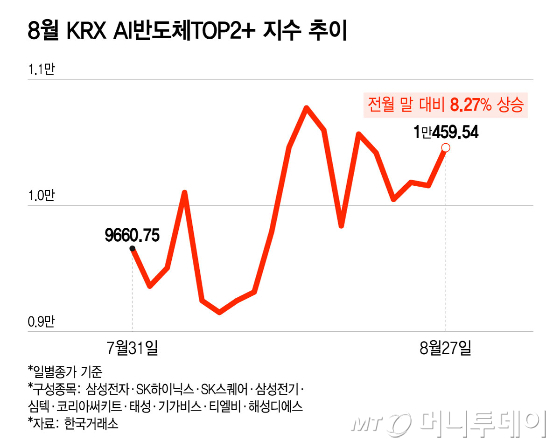
As NVIDIA delivered an AI-driven demand forecast that met market expectations, domestic semiconductor stocks rebounded collectively despite interest rate pressures. The atmosphere has lifted one layer of fear regarding peak-out (post-peak decline) due to the optimistic stance of key industry players.
On the 27th, the KRX K-AI Semiconductor TOP2+ Index, composed of two major semiconductor stocks and ten materials, components, and equipment-related stocks on the Korea Exchange, closed at 10,459.54 points, up 301.17 points (2.96%) from the previous trading day.
While Samsung Electronics closed with a gain of over 1% and SK Hynix with over 2%, buying interest spread evenly across the market. On this day, Simtek surged over 12%, TLV jumped over 6%, Samsung Electric and Korea Circuit rose over 4%, Gigabyte gained over 3%, Haesung D&E advanced over 2%, and Taesung increased over 1%. SK Square also closed with a slight gain.
The KRX Semiconductor Index, comprising 35 stocks, saw 34 stocks rise, closing at 13,418.66 points, up 325.24 points (2.48%).
Domestic securities firms focused on NVIDIA's earnings call guidance of a 70% revenue growth rate for fiscal year 2028 (February 2027 to January 2028).
Moon Jun-ho, a researcher at Samsung Securities, stated, "This is a forecast accounting for supply constraints; based on current customer demand, even 100% growth is possible, so expanding production capacity in the supply chain is key," adding, "Today's guidance significantly exceeded the consensus estimate, which had been formed at around 45%."
He further noted, "The background for the higher guidance is estimated to include a one-time upward revision of hyperscaler capital expenditure (CAPEX) forecasts, expansion of product portfolios such as Vera CPUs and Grok LPUs, and price increase effects. According to Timeline, sovereign AI projects including StarGate are expected to begin contributing to demand from the end of this year."
Strong sales to AI cloud, industrial, and enterprise (ACIE) sectors outside hyperscalers, along with a high next-quarter revenue forecast even excluding China, were also cited as positive factors.
Hwang Soo-wook, a researcher at Meritz Securities, stated, "Data center revenue growth for ACIE (138%) overwhelmingly surpassed that for hyperscalers (102%)." He added, "Based on proof of profitability in AI infrastructure, industry-specific leverage investments are now fully underway, enabling not only hyperscalers but other entities to actively invest in AI infrastructure. This marks a significant turning point this year."
He continued, "The conventional view among investors focusing solely on hyperscalers is expected to break with this announcement. If growth in ACIE revenue becomes recognized, overall perception of the total addressable market (TAM) will rise, potentially leading to a comprehensive revaluation of AI infrastructure companies."
Consequently, domestic securities firms maintain a positive outlook for the semiconductor industry. Go Young-min, a researcher at Dael Investment & Securities, stated, "Strong business conditions combined with shareholder return policies are expected to raise the stock price floor for the sector."

 in INDUSTRY


