

Chinese TV manufacturers are accelerating their push into the European market to offset sluggish domestic demand. As the influence of Chinese brands rapidly expands in overseas markets, competition within Europe — a key arena for Samsung Electronics and LG Electronics — is becoming increasingly fierce.
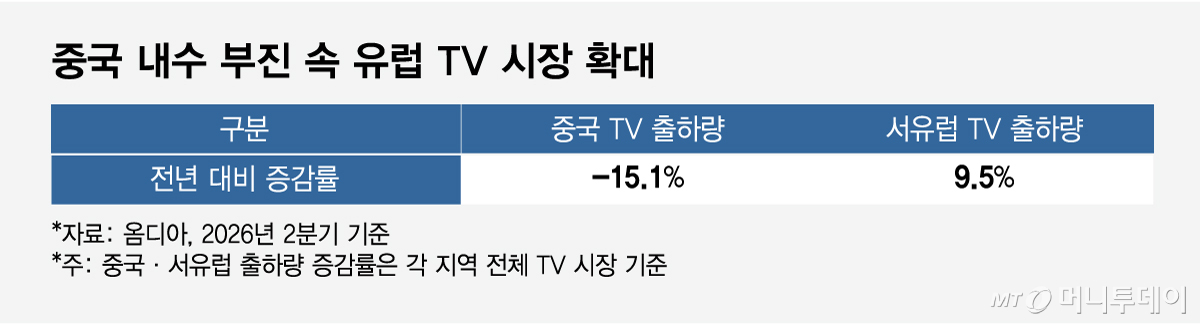
According to market research firm Omdia on the 3rd, Chinese TV shipments in the second quarter of this year fell 15.1% year-on-year, while Western European shipments rose 9.5%. This shift comes as major Chinese firms such as TCL and Hisense turn their attention overseas following a contraction in the domestic market due to the Chinese government's reduction of home appliance trade-in subsidies.
This expansion of presence in Europe is clearly reflected in market share data. Counterpoint Research analyzed that while Samsung Electronics maintained its top position with a 27% shipment-based market share in the Western European TV market last April, it faced fierce pursuit from China's Xiaomi. Xiaomi's share surged from 2% in April last year to 13% in April this year, and its shipments in Western Europe increased approximately 12-fold over the same period. This contrasts sharply with Xiaomi's global shipment decline of 17% from January to April this year. Xiaomi is strengthening its local market offensive by expanding sales channels in Western Europe and increasing the supply of new mini-LED (light-emitting diode) products.
Chinese manufacturers are also competing with Korean firms on shipments in the global TV market. According to TrendForce data, Samsung Electronics' TV shipments in the first half of this year reached 17.6 million units, up 6.3% from the same period last year. TCL recorded the highest growth rate among the top four manufacturers, with a 7.1% increase to 15.08 million units. Hisense reported 14.23 million units, up 3.0%, while LG Electronics accounted for 11.3 million units, a 3.9% increase.
The battle for dominance between the two sides is also intensifying in the premium TV market. TCL is prominently featuring mini-LED technology, while Hisense is pushing RGB (red, green, blue) mini-LED to target the high-value-added segment. In fact, according to Omdia research, TCL, which held the top spot with a 30.2% share of global mini-LED TV shipments in the first quarter of this year, ceded the lead to Samsung Electronics (28.2%) in the second quarter. Domestic manufacturers are making a comeback in the mini-LED market, intensifying the struggle for leadership.
Samsung Electronics and LG Electronics are responding to China's price offensive by significantly expanding their mini-LED product lines and lowering entry price points. Samsung Electronics is strengthening its premium LCD (liquid crystal display) lineup, including micro RGB, while simultaneously pursuing a strategy to solidify its lead in mini-LED. LG Electronics is also reinforcing its mini-LED lineup to defend the mid-to-low-end market, even as it maintains its differentiation strategy centered on OLED (organic light-emitting diode) TVs.
Global TV shipments are trending upward ahead of the year-end holiday season. In particular, forecasts suggest that global TV shipments will hit their annual peak in October, when Black Friday and Christmas inventory is fully supplied. As Chinese manufacturers' overseas expansion gains momentum, sales competition between Korean and Chinese firms in the European TV market during the year-end rush is expected to heat up further.
An industry official stated, "It is a reality that Chinese manufacturers are rapidly penetrating overseas markets such as Europe by leveraging their price competitiveness and mini-LED lineups." The official added, "Domestic companies have no choice but to protect profitability through premium product differentiation and securing distribution networks for the year-end holiday season."

 in INDUSTRY
