

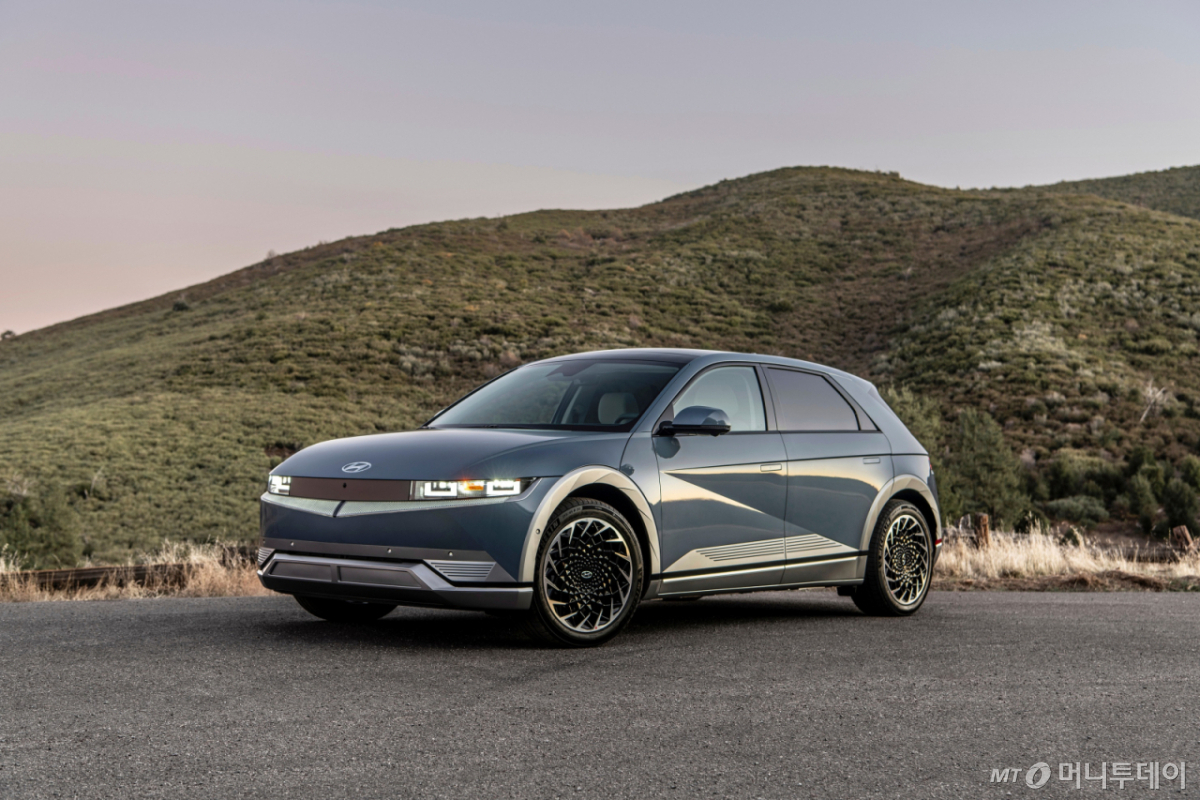
Hyundai Motor Group has secured technology to enhance downhill braking performance of electric vehicles (EVs) targeting the European market, which features many high-altitude regions like the Alps. The technology ensures stable braking performance by maintaining regenerative braking capacity even after fully charging the battery at a high-altitude charging station before entering long downhill stretches.
According to the semi-annual reports of Hyundai Motor and Kia released on the 28th, both companies developed CBCR (Compulsory Battery Consumption for Regen) and HBCR (High-altitude Battery Charge limit for Regen) this year.
When an EV's battery charge level approaches 100%, it becomes difficult to store additional electrical energy generated during deceleration. Consequently, if regenerative braking is limited, friction brakes using brake pads and discs must compensate for the insufficient braking force.
However, repeatedly using friction brakes on long downhill stretches causes heat to accumulate in the discs. If temperatures rise excessively, a fade phenomenon may occur where braking power temporarily drops. CBCR artificially secures battery charging capacity when discs overheat, reactivating regenerative braking. By sharing the braking load between regenerative and friction brakes, it maintains stable deceleration performance even on long downhill roads.
HBCR is a function designed to proactively reduce the risk of degraded braking performance. When the vehicle ascends to high altitudes, it displays a pop-up asking the driver whether to limit the battery charge level to 90%. If the driver agrees, approximately 10% of the battery capacity remains unused even after charging at high-altitude stations, allowing the vehicle to accept regenerative energy generated on downhill slopes. This ensures regenerative braking capacity is secured from the moment the vehicle enters a downhill stretch, preventing heat concentration in friction brakes.
While CBCR revives regenerative braking when brake discs overheat, HBCR limits full charging to proactively reduce overheating risks. By maintaining a higher proportion of regenerative braking through both functions, it is expected not only to prevent degradation of braking power but also to reduce wear on brake pads and discs.
Regenerative braking limitations are common characteristics shared by all EVs. Tesla also advises in its user manual that regenerative braking may be restricted when the battery is cold or fully charged. Some Tesla models automatically activate conventional brakes during such conditions to maintain deceleration performance. The two technologies developed by Hyundai Motor and Kia focus specifically on directly controlling the battery charge state to secure regenerative braking capacity itself.
This technology is believed to have been developed with the driving environment of European regions in mind, characterized by significant elevation changes and continuous long downhill stretches. Europe has numerous areas where high-altitude charging stations and long-distance downhill roads coexist around the Alps. As Europe is one of the most competitive markets for EVs, Hyundai Motor and Kia appear to be targeting the European EV market with differentiated software control technologies tailored to regional road conditions.

 in INDUSTRY
