

Hanwha TotalEnergies is accelerating the rationalization of its petrochemical product production facilities, whose profitability has been steadily declining.
According to industry sources on Tuesday, Hanwha TotalEnergies recently halted an LLDPE (linear low-density polyethylene) production line at its Dasan plant in Chungnam Province. The company is currently removing residual materials and sealing the facility with nitrogen for preservation, a measure that effectively anticipates a long-term suspension of operations.
This marks 32 years since the plant first began production in 1994. LLDPE is a general-purpose synthetic resin used in plastic bags and packaging films. Previously, Hanwha TotalEnergies had also suspended operations at Plant 1 of its two SM (styrene monomer) plants, which produce raw materials for synthetic resins.
The decision is attributed to oversupply caused by large-scale capacity expansions in China and the Middle East, and the resulting deterioration in profitability. According to Chinese petrochemical information provider Jinlian Chuang, the average price of LLDPE in China last year fell 11.5% from 8,453 yuan per ton the previous year to 7,484 yuan per ton.
During the same period, South Korea's exports of LLDPE to China plummeted 42.8%, dropping from 74,382 tons to 41,568 tons. As China expanded its domestic production, both the export volume of Korean products and local product prices declined simultaneously, worsening sales conditions.
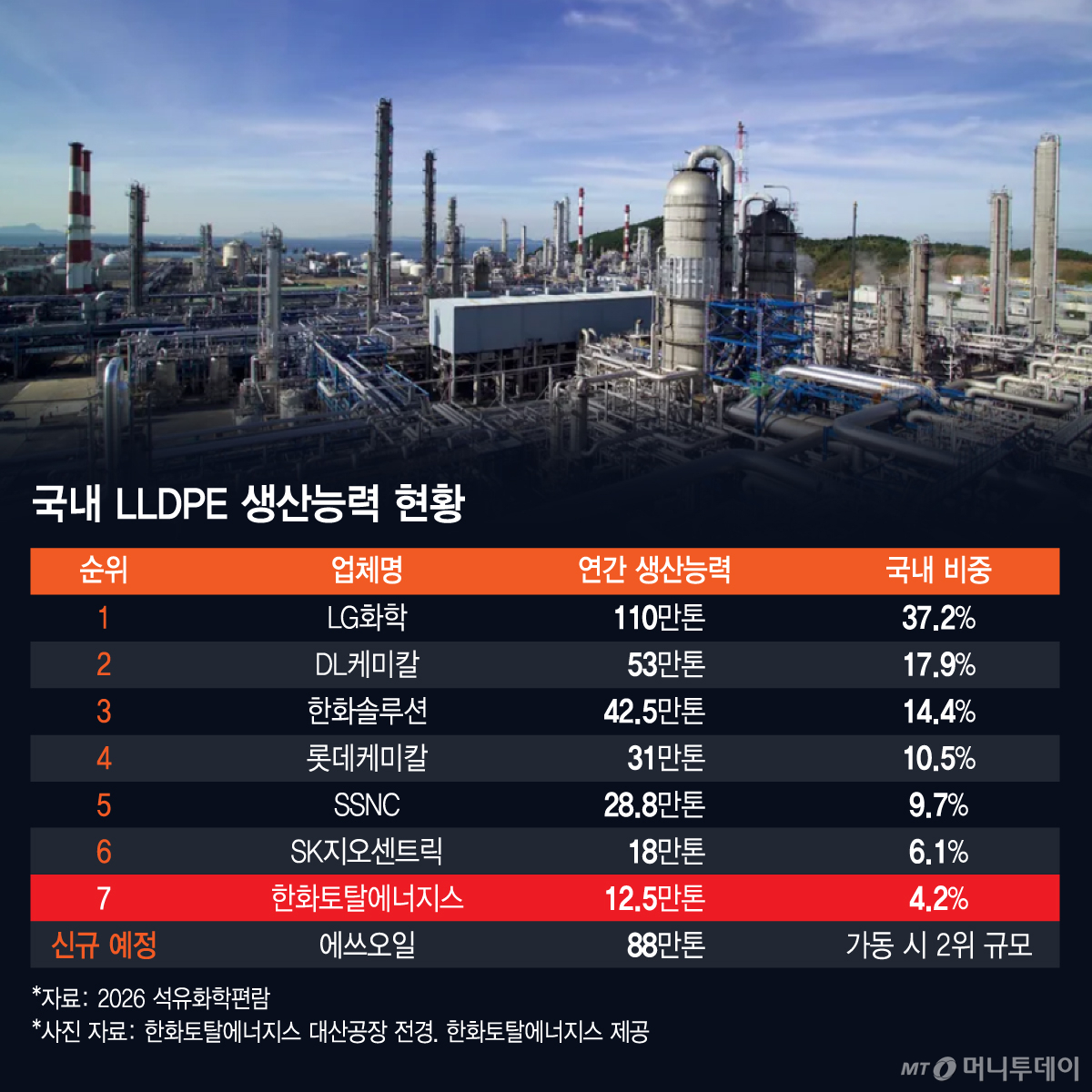
Hanwha TotalEnergies is reportedly judging that the impact on domestic supply and demand will be limited despite the production halt. The current annual production capacity for LLDPE is 125,000 tons, accounting for only 4.2% of the total domestic production capacity (2.958 million tons).
By company, LG Chem has the largest share with 1.1 million tons (37.2%), followed by DL Chemical at 530,000 tons (17.9%), Hanwha Solutions at 425,000 tons (14.4%), Lotte Chemical at 310,000 tons (10.5%), SSNC at 288,000 tons (9.7%), and SK Geo Centric at 180,000 tons (6.1%). Hanwha TotalEnergies has the smallest production capacity among the seven domestic producers.
S-Oil's plan to operate new facilities also influenced Hanwha TotalEnergies' decision. S-Oil plans to supply LLDPE with an annual capacity of 880,000 tons through its Ulsan Shahran project. This is approximately seven times larger than Hanwha TotalEnergies' production capacity. Once the facility becomes operational, it will immediately rise to second place domestically, behind LG Chem. With the entry of a large volume of new supply into the market, existing companies are expected to face increased production burdens.
For now, Hanwha TotalEnergies is committed to restructuring its business portfolio with a focus on high value-added products. In the first half of this year, the company commercialized PP (polypropylene) materials for insulation in medium-voltage underground distribution cables.
It also completed pilot verification of catalyst performance applicable to commercial scale in the development of LAO (linear alpha olefin) manufacturing processes. Additionally, it developed HDPE (high-density polyethylene) materials for Daegu Kyung pipes and applied them on-site, diversifying its high value-added product lineup.
A Hanwha TotalEnergies official stated, "We decided to halt operations at the LLDPE plant as part of adjusting our product portfolio to strengthen business competitiveness," adding, "We are supporting existing customers in securing inventory and establishing alternative supply lines to ensure there are no disruptions."

 in INDUSTRY
